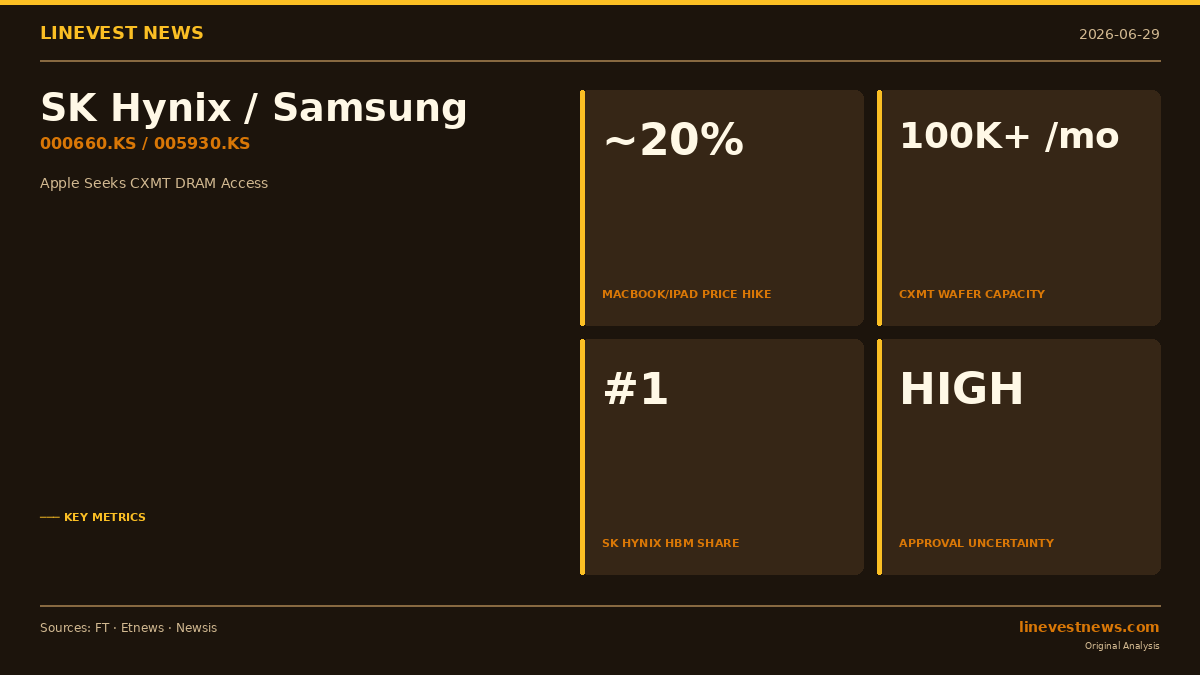
Apple Inc. is lobbying the Trump administration for approval to source DRAM chips from China's Changxin Memory Technologies (CXMT), a manufacturer listed on the US Department of Defense's roster of companies deemed to support the Chinese military — a move that, if successful, would materially weaken the pricing power of SK Hynix (000660.KS) and Samsung Electronics (005930.KS) in the global memory market.
The Financial Times first reported the lobbying effort on June 27, citing multiple people familiar with the matter. Apple has engaged the White House and the Commerce Department in recent weeks, seeking authorisation to transact with CXMT, which is designated under Section 1260H of the National Defense Authorization Act (NDAA). While that designation does not legally prohibit commerce, proceeding without government clearance exposes Apple to significant political and regulatory risk.
Why Apple Wants In
The impetus is straightforward: DRAM prices have surged to levels Apple describes internally as unsustainable. The iPhone-maker has already raised MacBook and iPad prices by approximately 20% to offset rising component costs. The AI boom has redirected capacity at Samsung and SK Hynix toward high-bandwidth memory (HBM) — the specialised chips used in Nvidia's AI accelerators — tightening supply of conventional LPDDR5X and DDR5 used in consumer devices.
By securing CXMT as an alternative supplier, Apple would gain the negotiating leverage it routinely deploys with incumbent vendors. The company has successfully run this playbook in displays, sourcing panels from Samsung Display, LG Display, and China's BOE to maintain price discipline across all three.
CXMT in numbers: The Hefei-based chipmaker produces DDR5 and LPDDR5X at hundreds of thousands of 12-inch wafers per month. CXMT remains competitive in consumer memory but lags meaningfully in cutting-edge HBM, where SK Hynix holds the leading position supplying Nvidia.
The Political Obstacle Course
Washington's political climate makes approval far from certain. Apple faced an almost identical situation in 2022, when it attempted to incorporate NAND flash from China's Yangtze Memory Technologies (YMTC) into China-market iPhones. Then-Senator Marco Rubio — now Secretary of State — warned Apple would face "unprecedented scrutiny" from the federal government if it proceeded. Apple shelved the plan.
Congressional opposition this time is equally pointed. Representative John Moolenaar, chairman of the House Select Committee on the Chinese Communist Party, told the FT that Apple choosing to work with a Chinese military-linked company "would be a serious mistake." Michael Sobolik of the Hudson Institute added that approving new Chinese semiconductor dependencies in a domain "as critical as AI" would directly contradict the administration's stated goal of reducing reliance on China for strategic materials.
In Apple's favour: the Trump administration last year approved Nvidia's sale of H200 AI chips to China despite internal opposition, suggesting pragmatic deal-making can override hawkish defaults.
What It Means for SK Hynix and Samsung
SK Hynix is Korea's most exposed memory producer in this scenario. While its leadership in HBM provides a structural buffer — Apple's devices do not use HBM — the company's commodity LPDDR and DDR business is exactly the segment CXMT targets. Any credible Apple-CXMT agreement would compress spot DRAM prices and dilute negotiating leverage for Hynix and Samsung alike.
LS Securities noted in a separate research note that a potential CXMT IPO would raise fresh concerns about accelerated DRAM supply expansion from Chinese makers, further weighing on price expectations for SK Hynix and Samsung.
Samsung Electronics faces a dual drag: it supplies Apple with both memory chips and OLED panels, and any successful Apple effort to diversify either supply chain reduces Samsung's structural pricing advantage.
Analyst Read
Industry observers view the near-term market impact as limited. CXMT would first need to pass Apple's certification process, described as among the most stringent quality standards in the industry. Pilot volumes would likely precede any meaningful supply share shift by 12 to 18 months.
The more immediate effect may be psychological: the mere credibility of the CXMT threat could soften the tone in Apple's annual memory supply negotiations with Samsung and SK Hynix, scheduled for later this year.
Apple declined to comment. The White House did not respond to a request for comment.
Sources: Financial Times (June 27) · Etnews · Newsis · Hankyung · Investing.com