Korea Accelerates Push for Mandatory Tender Offer as Minority Shareholder Protection Debate Intensifies
Korea's Financial Services Commission (FSC) is pushing to swiftly introduce a mandatory tender offer rule for listed company acquisitions, with regulators and academics clashing over whether the obligation should require buyers to purchase just over half the outstanding shares or the entire float.
Key Numbers
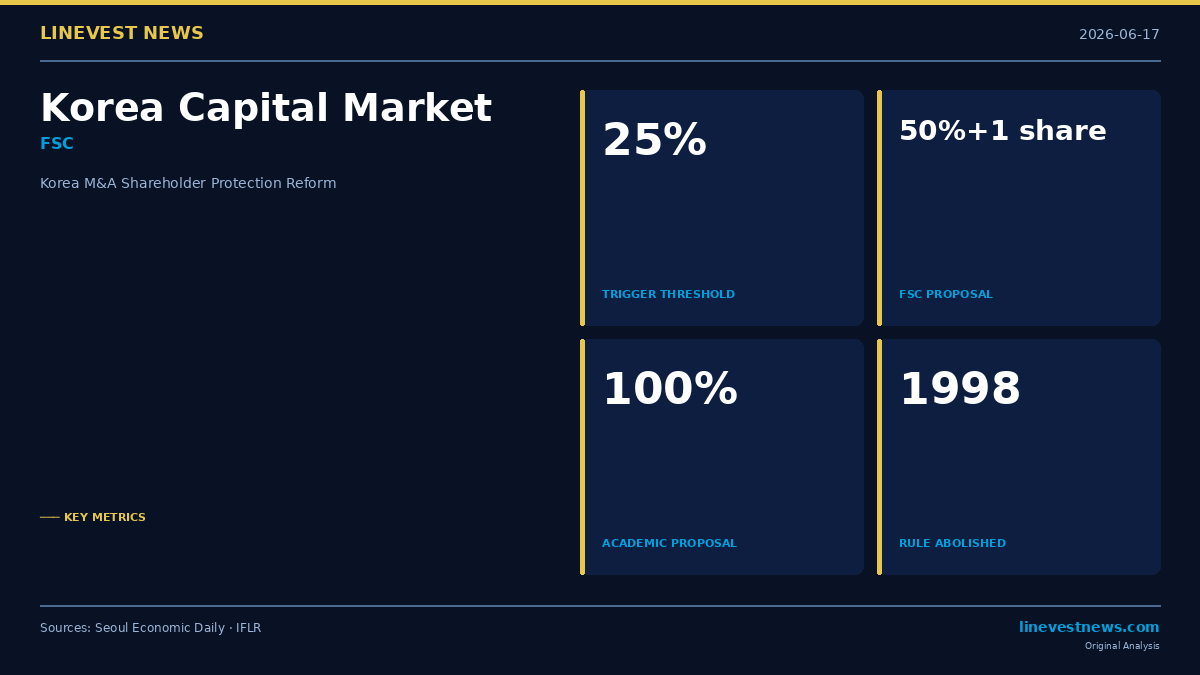
| Parameter | FSC Proposal | Academic Proposal |
|---|---|---|
| Trigger threshold | 25% stake (to become largest shareholder) | Same |
| Minimum offer size | 50% + 1 share at same price | 100% of all remaining shares |
| Offer price basis | Same as price paid to controlling shareholder | Same |
| Target enactment | H2 2026 | H2 2026 |
Regulator Signals Urgency
At a joint symposium held June 17 with academic, regulatory, and industry participants, FSC Vice Chairman Kwon Dae-young stated the mandatory tender offer system "should be introduced quickly" to protect the interests of minority shareholders in share-transfer deals. The remarks signal the government's intent to move legislation through the National Assembly by the second half of 2026, following the formation of new committee leadership.
The proposed framework would require any buyer seeking to acquire a 25% or larger stake — sufficient to become the largest shareholder of a KOSPI or KOSDAQ company — to simultaneously launch a tender offer for at least 50% plus one share of the company's total shares, at the same price paid to the selling controlling shareholder. This would close a long-standing loophole that allowed acquirers to pay a full control premium to the largest shareholder while minority investors received nothing.
Full vs. Partial: The Core Dispute
Professor Kim Woo-chan of Korea University Business School argued at the symposium that the FSC's partial model falls short. A 50%-plus-one-share offer "only partially realizes the principle of equal treatment" and "weakens the incentive to lower the control premium," Kim said, drawing on empirical data from 41 countries with mandatory tender offer regimes.
Kim's proposal: once the 25% threshold is crossed, the buyer must offer to acquire all remaining shares at the same price. Full-buyout mandates are the dominant international standard — the United Kingdom requires a 100% offer once a buyer crosses 30%, and the European Union follows similar logic.
Korea's rule was originally on the books until 1998, when it was abolished during the IMF financial crisis to facilitate distressed asset sales. Efforts to revive it re-emerged under the Yoon administration in 2022 as part of the broader "Korea Discount" reduction initiative, and have gained fresh momentum under the current government.
Industry Concerns and Market Implications
Critics of the full-buyout proposal argue that the financial burden would effectively freeze Korea's M&A market. With the average KOSPI-listed company carrying a market capitalization of roughly KRW 3 trillion (approximately USD 2.2 billion), mandatory 100% offers would require acquirers to mobilize resources far beyond what most domestic or foreign strategic buyers can deploy — potentially driving deal flow toward unlisted targets or structured transactions that fall outside the rule.
The FSC's 50%-plus-one compromise is designed to balance protection with dealmaking practicality. Japan's equivalent rule, by comparison, is triggered only when a buyer surpasses a two-thirds ownership threshold, reflecting a more acquirer-friendly market philosophy.
What Comes Next
The FSC has indicated it expects to publish a list of low price-to-book ratio companies in October 2026 as part of the broader Value-Up program. Legal revisions to the Financial Investment Services and Capital Markets Act (FSCMA) — the statute governing the mandatory tender offer — are expected to follow National Assembly committee formation in the second half of the year, with a minimum one-year grace period before implementation.
For foreign institutional investors, the debate is closely watched: mandatory tender offer rules are a key component of corporate governance frameworks used to justify premium valuations in comparable markets. Adoption — even in a partial form — could materially narrow the Korea Discount and affect control-premium pricing across the KOSPI and KOSDAQ.
Sources: Seoul Economic Daily (June 17, 2026); IFLR — "Korean mandatory tender offer proposal reflects drive for minority shareholder protection"; Financial Services Commission (fsc.go.kr)