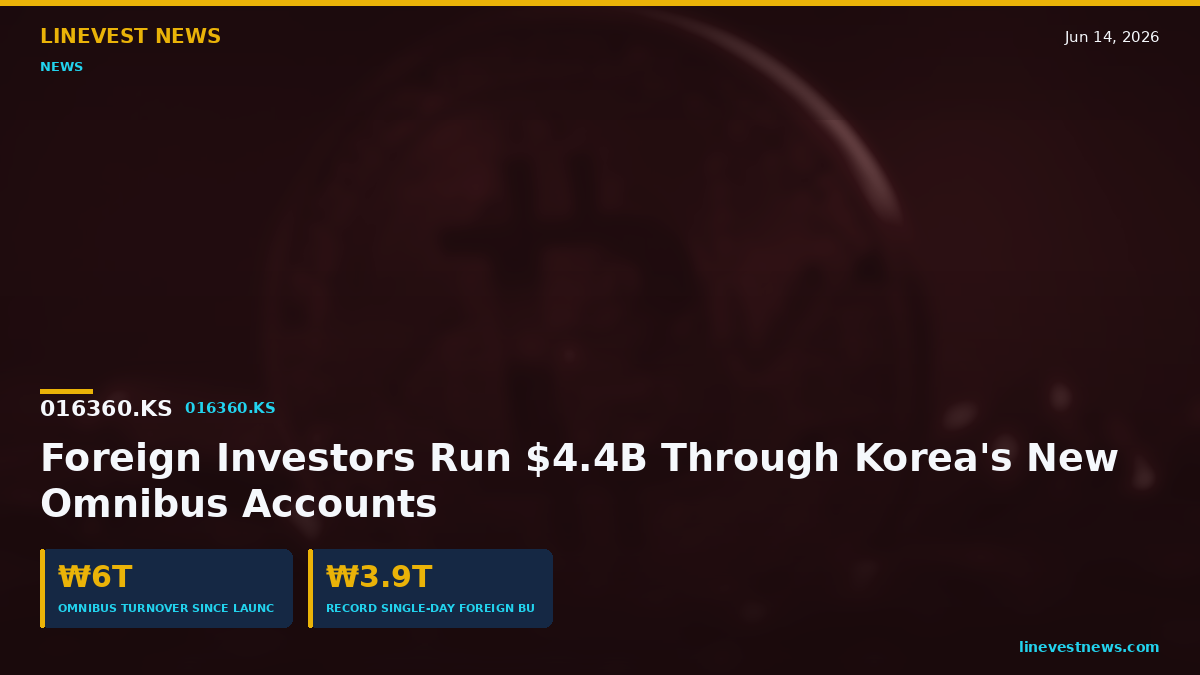
Foreign investors have traded more than ₩6 trillion (about $4.4 billion) through Korea's new omnibus account system since its May 2026 launch, according to the Korea Herald and The Investor. The figure is being read as proof of pent-up global demand for direct access to Korean equities. The more useful question for a portfolio manager is how much of the foreign-flow picture this channel actually carries — and the honest answer, for now, is: a sliver.
What the number is, and isn't
The ₩6 trillion is cumulative turnover routed through omnibus accounts over roughly six weeks, not net new capital. For scale, foreign investors net sold ₩75.569 trillion (about $55 billion) in the KOSPI market over a 24-session stretch before turning net buyers again on June 12, when they bought a net ₩2.1181 trillion (about $1.5 billion) in a single session, per Seoul Economic Daily. In other words, the omnibus pipe's entire first-month throughput is smaller than the swings foreign investors put through Korea's main board in a handful of ordinary days. The channel is new infrastructure gaining traction — not yet the dominant route for foreign money.
What actually changed
The mechanism matters because it removes friction rather than adding stimulus. An omnibus account lets a foreign brokerage trade on behalf of many clients through a single pooled account, eliminating the requirement that each overseas investor register individually with Korean authorities. Samsung Securities (016360.KS), the brokerage arm of the Samsung group, debuted Korea's first such service in partnership with Interactive Brokers (IBKR), the US-based global electronic broker, after the Financial Services Commission — Korea's top financial regulator — designated the service an 'innovative financial service' in September 2025. As of April 30, 2026, foreign investors also use encrypted identification numbers instead of submitting names and passport details, addressing a long-standing data-privacy objection, according to the Korea Times.
"Demand exceeded our expectations from Day 1," David Friedland, IBKR's Asia-Pacific head, told The Investor. "Volumes have continued to build." Separately, IBKR invested ₩15 billion (about $11 million) in Next Securities, becoming — per The Investor — the first overseas listed brokerage to make a strategic investment in a Korean brokerage.
The day it showed up on the tape
The reform's most visible moment came in early May. In a single session the KOSPI — Korea's benchmark index — surged 338.12 points, or 5.12 percent, to close at 6,936.99, clearing 6,900 for the first time, the Korea Times reported. Foreign investors bought roughly ₩3 trillion (about $2.2 billion) on the main board, or about ₩3.9 trillion (about $2.8 billion) including the alternative trading platform Nextrade — the largest combined net buying on record, the paper said. Samsung Electronics (005930.KS) and SK Hynix (000660.KS), Korea's two memory-chip giants, led the buying. "Foreign investors previously gained exposure mainly through ETFs. Easing omnibus account regulations has paved the way for direct inflows of foreign retail capital," said Kang Jin-hyuk of Shinhan Securities, a Korean brokerage, in the Korea Times.
The rally has since extended: the KOSPI closed at 8,123.62 on June 12, up 4.63 percent on the day, per Seoul Economic Daily — even though that same session merely ended a 24-day foreign selling streak. The juxtaposition underlines the point: easier plumbing has not made foreign flows one-directional.
The open question
The data point to watch is scope. Regulators are expected to widen omnibus accounts to cover exchange-traded funds and exchange-traded notes, and Friedland told The Investor he expects "institutions, asset managers, advisers and sophisticated retail investors" to seek Korean exposure through ETFs once that opens. Whether omnibus turnover climbs from a sliver toward a meaningful share of foreign trading — and whether rival Korean brokerages, which Seoul Economic Daily and the Korea Herald say are preparing competing services, convert intent into volume — will determine if this is a structural shift or a well-timed convenience. The ETF/ETN ruling and the next monthly foreign-flow figures are the near-term tells.
This article is for informational purposes only and does not constitute investment advice. Figures are as reported by the cited sources; currency conversions use an approximate rate of 1 USD = 1,370 KRW unless a source specified otherwise.