Samsung Foundry Enters Talks for Key Role in Google's 10th-Gen AI Chip
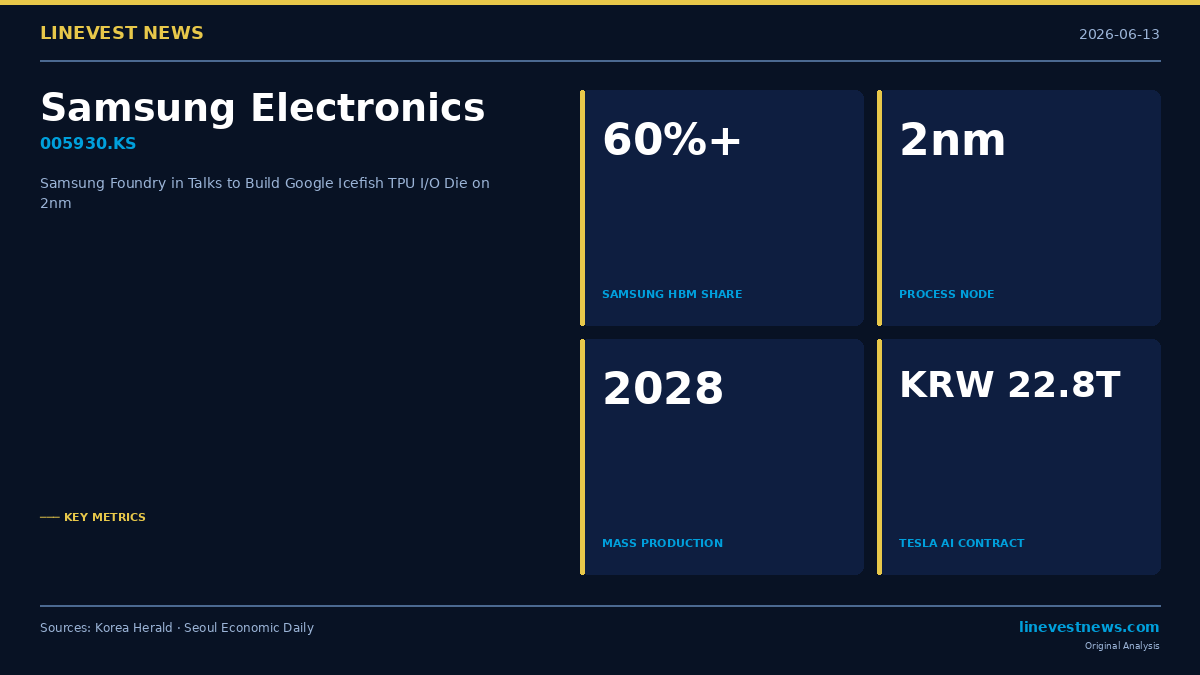
Samsung Electronics' contract chipmaking division is in negotiations to manufacture the memory input/output (I/O) die for Google's 10th-generation tensor processing unit, codenamed "Icefish," using its 2-nanometer process technology — a deal that, if confirmed, would mark the foundry's most consequential win in the AI chip race.
The Korea Herald and Seoul Economic Daily reported Thursday that Samsung Foundry would handle the I/O die, the critical bridge component that connects a chip's logic cores to High Bandwidth Memory. Taiwan Semiconductor Manufacturing Co. (TSMC) is slated to produce the more computationally intensive computing engine on its 1.4-nanometer node. Samsung and Google both declined to comment.
Mass production is not expected before 2028, and talks remain at an early stage, with concrete outcomes anticipated by late 2026 or early 2027, according to industry officials quoted by Seoul Economic Daily.
Why Samsung — and Why Now
The split order reflects a structural shift in AI chip procurement: TSMC's leading-edge capacity is fully allocated, forcing hyperscalers to diversify their foundry relationships rather than continue concentrating orders in Hsinchu.
Samsung holds a natural advantage on the I/O die specifically. The company supplied more than 60% of the High Bandwidth Memory integrated into Google's previous TPU generations, making its engineers intimately familiar with the memory-side interface requirements that define the I/O die's design. Winning the Icefish I/O role would effectively reward that long-running HBM partnership with a foundry contract.
The opportunity also arrives at a strategically sensitive moment for Samsung Foundry. The division lost the Tensor G4 mobile chip — used in Google's Pixel smartphones — to TSMC in 2024, a defection that intensified doubts about Samsung's ability to compete at the leading edge. Icefish would offer a direct answer: that its 2-nanometer process is validated for the world's highest-profile AI workloads.
Broader Foundry Context
Samsung reported this week that its foundry division does not expect to reach profitability until 2028, a projection that underscored the gap separating it from TSMC in yield, customer confidence, and overall volume. An Icefish contract, though limited to the I/O die, would serve as a commercial proof point that could reopen customer conversations for future logic work.
Separately, Samsung has secured a long-term agreement with Tesla to supply AI chips valued at approximately KRW 22.8 trillion (about USD 15 billion) — another sign that hyperscalers are actively routing advanced AI silicon orders to Samsung as TSMC booking windows lengthen.
Google's Icefish chip is part of a broader AI infrastructure buildout. The company also placed an order for more than 3 million TPUs from Intel for delivery by 2028, spreading risk across three foundries simultaneously and signalling a deliberate move away from single-source dependency.
Sources: Korea Herald (Jun 12, 2026) · Seoul Economic Daily (Jun 12, 2026) · SamMobile (Jun 11, 2026)