Samsung, SK Hynix Weigh Regional Chip Plants as Korea's Cluster Law Nears
Samsung Electronics (005930.KS), the world's largest memory chipmaker, and SK Hynix (000660.KS), the leading supplier of high-bandwidth memory for AI accelerators, are reviewing plans to spread new semiconductor facilities into Honam (Korea's southwestern Jeolla provinces) and Chungcheong (the central provinces), according to a June 9 report by Chosun Biz citing political and government sources. The first question for any investor is whether this is a binding capex shift or political signaling — and the honest answer today is that it is neither a commitment nor mere talk, but an early review backed by a real legal lever.
What is actually being reviewed
The facilities under discussion are back-end packaging plants, not the leading-edge wafer fabs that anchor Korea's chip map. Chosun Biz reports Samsung is weighing packaging sites in Gwangju, Jangseong in South Jeolla, and Onyang in South Chungcheong, while industry watchers speculate SK Hynix could place some packaging and test capacity in Honam. Both companies declined to confirm any talks; Chosun Biz quoted Samsung and SK Hynix as saying they had "nothing to share" on discussions with the government.
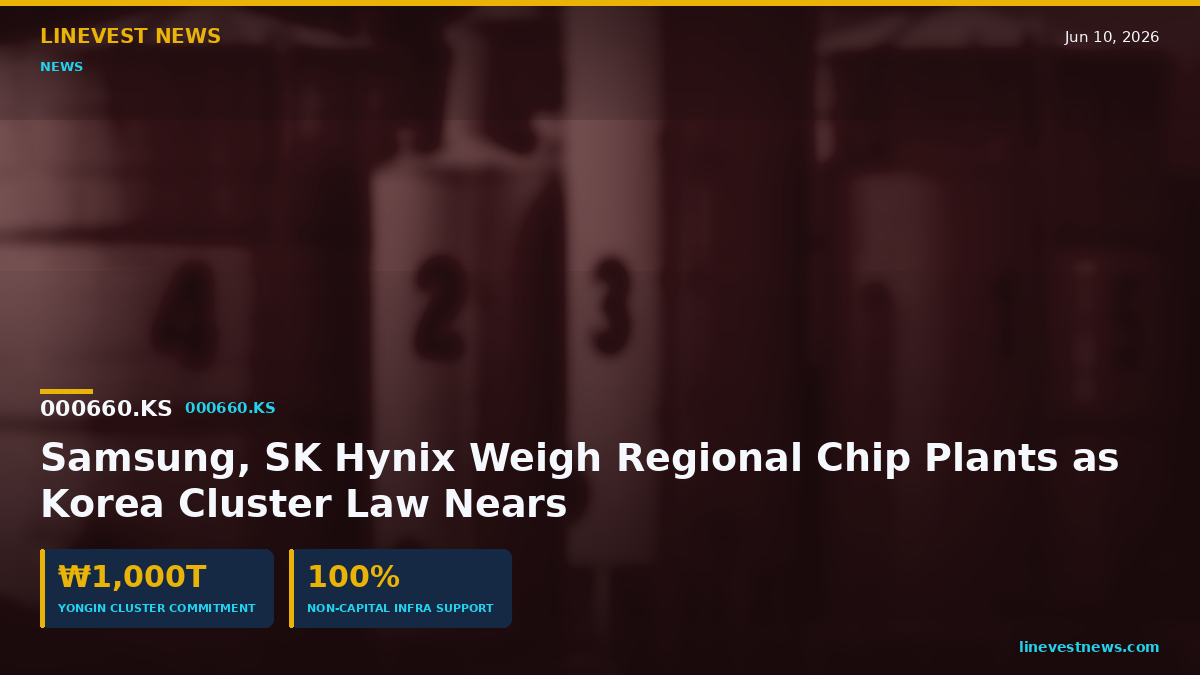
The context that makes the review credible is scale and policy. Samsung and SK Hynix have together committed roughly ₩1,000 trillion (USD 670 billion) to the Yongin mega-cluster now under construction in Gyeonggi Province, inside the capital region, The Korea Times reported. That capital-region concentration is exactly what a new law is designed to dilute.
The legal lever: the Semiconductor Special Act
The Special Act on Strengthening Competitiveness and Supporting the Semiconductor Industry takes effect August 11, 2026, The Korea Times reported. Its enforcement decree stipulates that complexes in Seoul, Incheon and Gyeonggi Province cannot be designated as "chip clusters" eligible for state support — government help with electricity, water and roads. For sites outside the capital region, Korea's Ministry of Trade, Industry and Energy will "provide up to 100% support for the construction costs of industrial infrastructure," Seoul Economic Daily reported. In other words, the policy does not order companies out of the capital region; it makes building elsewhere materially cheaper.
That lever is being amplified from the top. President Lee Jae-myung, marking his first year in office, told a press conference this week, "When pursuing industrial policy, I ask that you invest in the provinces as much as possible," Seoul Economic Daily reported, and signaled he would soon unveil a large-scale investment project tied to balanced regional growth.
How big a shift, in numbers
The back-end pieces are real but smaller than the headline implies. Samsung is conducting a final review of a packaging plant in the Jeonnam-Gwangju Integrated Special City, which launches July 1, Seoul Economic Daily reported. SK Hynix already has a non-capital packaging precedent: in January 2026 it announced the ₩19 trillion (USD 13 billion) P&T7 advanced-packaging fab in Cheongju, North Chungcheong, breaking ground in April with completion targeted for end-2027, The Asia Business Daily reported — giving it packaging hubs in Icheon (capital region), Cheongju (non-capital) and West Lafayette, Indiana. Honam's appeal, Chosun Biz noted, rests on relatively favorable renewable-energy and water-supply conditions versus the congested capital region.
A nearby anchor strengthens the regional case: Hyundai Motor Group, Korea's largest automaker, and Nvidia, the US AI-chip leader, agreed to build a "physical AI" value chain at Saemangeum, a reclaimed industrial zone on Korea's southwest coast, under a roughly ₩9 trillion (about USD 5.9 billion) plan with construction slated for the second half of 2026, per Hyundai Motor Group's announcement and Seoul Economic Daily. A clustering of packaging and AI infrastructure in the southwest would create supply-chain adjacency that chip back-end work can feed off.
The open question
Two near-term events should turn signaling into substance. Chosun Biz reported that a late-June meeting between President Lee and major conglomerate chairmen at the presidential office could surface concrete plans, and the Special Act's enforcement decree and full implementation arrive August 11. Until a company names a site and a won figure, the regional-investment story remains a policy-driven review rather than a committed reallocation of the ₩1,000 trillion already flowing to Yongin.
This article is for informational purposes only and does not constitute investment advice or a recommendation to buy or sell any security. Figures are drawn from cited reporting; readers should verify against primary disclosures.
Sources
- https://biz.chosun.com/it-science/ict/2026/06/09/2OIGRTCTBNHZ7LQ24XOLOMWPPM/
- https://www.koreatimes.co.kr/business/companies/20260517/proposed-ban-on-new-chip-clusters-in-capital-area-raises-concerns
- https://en.sedaily.com/finance/2026/06/09/samsung-plans-chip-packaging-fab-in-gwangju-as-sk-hynix
- https://en.sedaily.com/finance/2026/06/09/samsung-eyes-honam-for-second-chip-cluster-as-seoul-area
- https://en.sedaily.com/finance/2026/06/09/calls-to-invest-in-chips-flood-in-straining-samsung-sk-hynix
- https://www.asiae.co.kr/en/article/2026011309052525993
- https://www.asiae.co.kr/en/article/enterprise-CEO/2026061006594945385