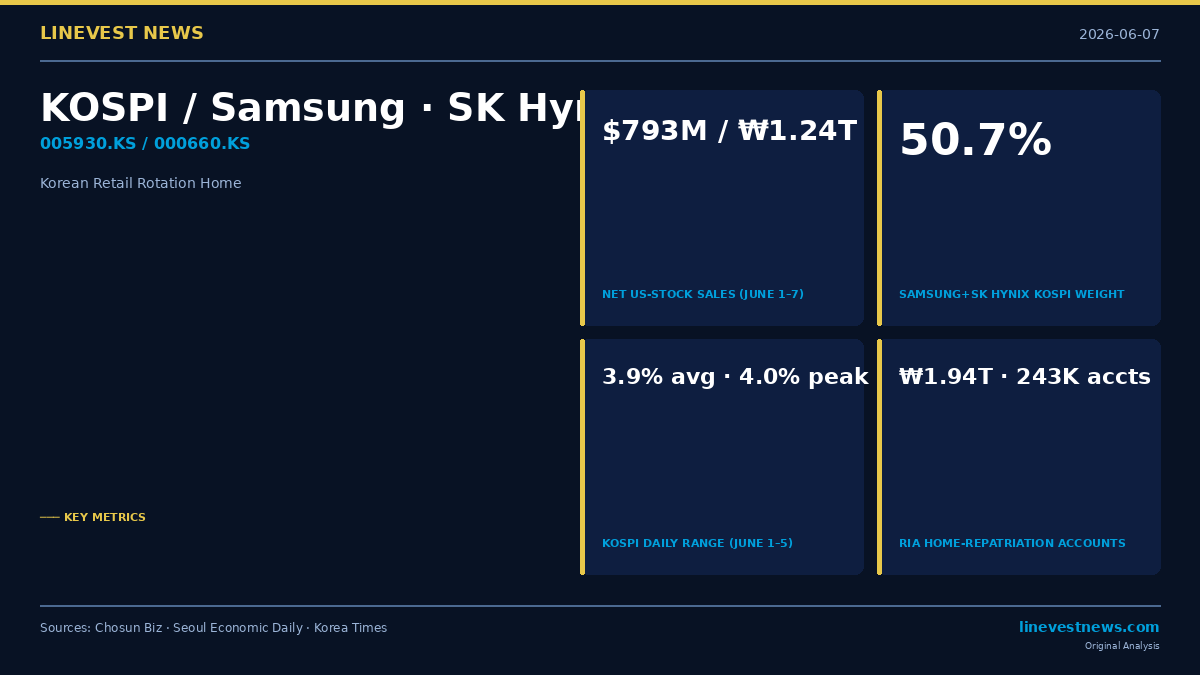
Korea's "Seohak ants" — the country's army of retail overseas-equity investors — net-sold USD 793.67 million (about ₩1.2373 trillion) of US stocks in the first week of June, a third consecutive month of net selling, according to data from the Korea Securities Depository's Seibro portal (Korea's central securities depository) cited by Chosun Biz. The streak follows net sales of USD 939.77 million in May and USD 468.92 million in April, the first three-month run of outflows since April–July 2023, per the same report.
For a fund manager in New York or London, the question is whether this rotation home is a durable shift or a tax-deadline trade — and how much risk now sits inside a Korean benchmark that two semiconductor names increasingly dominate.
Why the money is leaving Wall Street
Two forces are pulling capital back. The first is relative performance: Chosun Biz cited returns of 198% for Samsung Electronics (005930.KS, Korea's largest company and top memory-chip maker) and 258% for SK Hynix (000660.KS, the world's second-largest memory maker), against 20% for Nvidia and -8% for Tesla. The second is a closing tax window. Gains on overseas stock sales carry a 22% capital-gains tax in Korea, but the Return-to-domestic Investment Account (RIA) — a tax-advantaged repatriation vehicle launched in March 2026 — lets investors shelter those gains when proceeds are reinvested at home. That deduction ran at 100% through May, drops to 80% across June and July, and falls to 50% from August, according to Chosun Biz and Seoul Economic Daily. The RIA had drawn ₩1.9443 trillion (roughly USD 1.25 billion at the won's prevailing ~1,560/USD level implied by the same Seibro dataset) across nearly 243,000 accounts by mid-May, the Korea Financial Investment Association told Seoul Economic Daily.
The selling is still small against what remains abroad: Seohak ant custody value held at USD 201 billion, staying above the USD 200 billion mark, per Chosun Biz — so June's USD 793.67 million represents well under 1% of the stockpile. Where they are still buying in the US, the names skew to chips: Micron led June net purchases at USD 205.63 million, followed by Broadcom (USD 175.58 million) and Arm Holdings (USD 163.70 million), the report said.
The concentration problem at home
The cash coming home is landing in an unusually narrow market. As of May 29, Samsung and SK Hynix together accounted for 50.7% of total KOSPI market capitalization — the first time the pair crossed half of the index — according to financial-investment-industry figures cited by Chosun Biz. The pairing has earned a market nickname, "Samjeon-nix," and the crowding shows up in price swings.
KOSPI's average daily trading range ran at 3.9% over June 1–5, topping the 3.7% logged in March around the outbreak of the Iran war and well above this year's 3.0% average; on June 5 the intraday range hit 4.0%, Chosun Biz reported. Daily ranges above 4.0% have been rare since 1990 — confined, per the report, to the 1997–98 Asian financial crisis (5.7%), the 2000 dot-com collapse (4.6%), the 2008 global financial crisis (7.4%) and the 2020 COVID shock (4.9%). A batch of single-stock leverage products tied to the two chipmakers, launched May 27, has amplified the moves, the report noted.
The historical comparison cuts in an unusual direction this time. "All" prior episodes of 4%-plus volatility "occurred during sharp market declines driven by major crises — downside volatility — whereas this is upside volatility in a bull market, which is exceptional," Kiwoom Securities analyst Han Ji-young told Chosun Biz, adding that semiconductor-led earnings momentum and undemanding valuations remain intact.
Foreign demand for Korean equity products keeps building: overseas issuers — from U.S.-based Roundhill, whose Memory ETF (DRAM) listed on the NYSE in April, to Mirae Asset's Global X brand — are rolling out funds that give global investors indirect exposure to Samsung, SK Hynix and the broader KOSPI, The Korea Times reported.
What confirms or refutes the thesis
The near-term test is whether the home-rotation outlasts the tax incentive. If outflows from US stocks persist after the RIA deduction steps down to 50% in August, the shift looks structural; if they fade, it was largely a deadline trade. Two central-bank meetings in the interim will set the macro backdrop — the Bank of Japan on June 15–16, where a rate hike has been signaled, and the US Federal Reserve's FOMC on June 16–17 — against a tape where regional peers Indonesia and Sri Lanka have already tightened by 0.5 and 1.0 percentage points, Chosun Biz reported.
This article is for informational purposes only and does not constitute investment advice. Figures are as reported by the cited sources on the dates indicated.
Sources
- https://biz.chosun.com/stock/stock_general/2026/06/07/BHMQ5IUZCBDWPCCSJBUNHMV6TE/
- https://biz.chosun.com/stock/stock_general/2026/06/07/J2SABHUZYBCCXDUG2QWQBLZ5HU/
- https://www.sedaily.com/article/20052594
- https://www.koreatimes.co.kr/business/banking-finance/20260429/kospi-rally-sparks-overseas-demand-for-korean-etfs