Broadcom (AVGO) AI Miss Sinks Samsung, SK Hynix; KOSPI -6%
A single line of guidance from a US chipmaker was enough to halt program trading in Seoul. On June 5, the KOSPI — South Korea's benchmark stock index — opened down 3.66% at 8,323.20 and kept falling, with losses widening past 6% intraday and triggering a sidecar that suspended program trading for five minutes after KOSPI 200 futures dropped 5% (Seoul Economic Daily; TradingKey). The country's two memory giants led the rout: SK Hynix — the world's top supplier of high-bandwidth memory (HBM) — fell more than 9%, and Samsung Electronics, Korea's largest company, dropped past 7% after opening down 5.12% (Seoul Economic Daily; TradingKey).
The trigger sat some 9,000 km away. Broadcom (AVGO), the US custom-silicon and AI-networking supplier, reported fiscal Q2 results (quarter ended May 3) on June 3 that were, by any normal standard, exceptional: revenue of $22.187 billion, up 48% year-over-year, with AI semiconductor revenue of $10.8 billion, up 143% (Broadcom press release). It guided Q3 revenue to $29.4 billion, up 84%, and AI semiconductor revenue to $16 billion, up more than 200% (Broadcom press release).
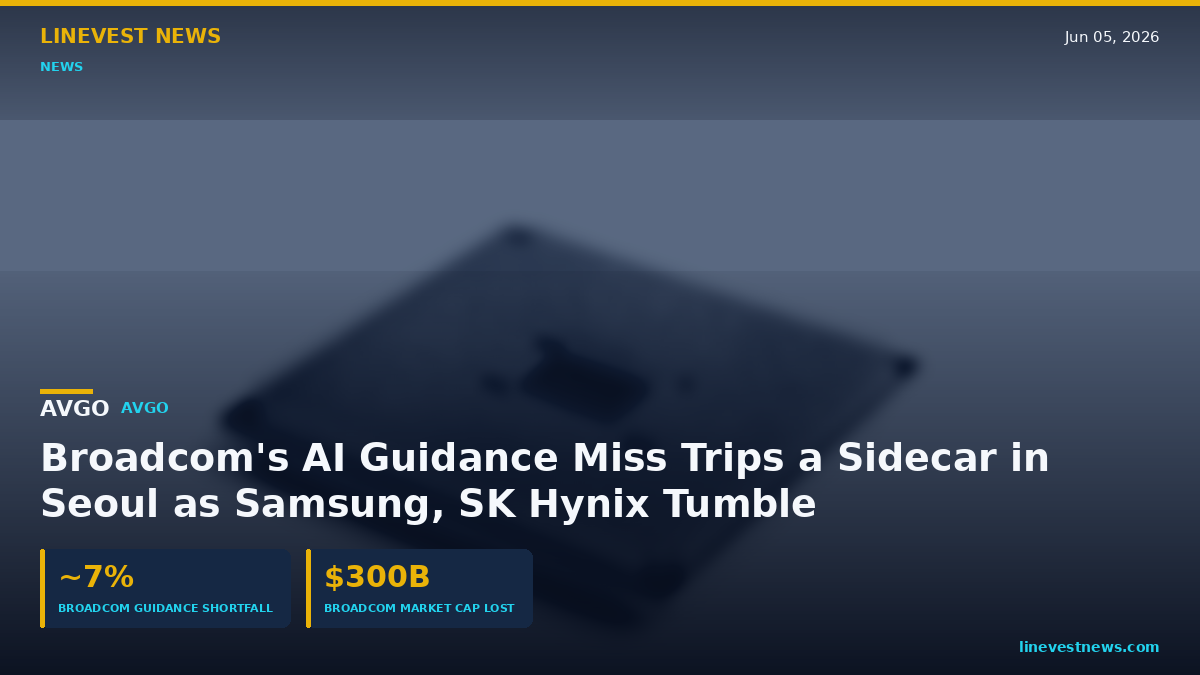
The problem was the gap to expectations. That $16 billion AI figure landed roughly 7% below the market's ~$17.2 billion estimate, and Broadcom's implied full-year AI number of about $56 billion trailed the ~$57.6 billion the street wanted (TradingKey). Crucially, CEO Hock Tan reiterated — but did not raise — his target for AI semiconductor revenue to exceed $100 billion in fiscal 2027 (Digitimes). On the call, Tan also acknowledged Google would likely draw on multiple chip suppliers and warned that surging AI sales were pressuring gross margins. Broadcom shares fell roughly 12% and shed an estimated $300 billion in market value (Seoul Economic Daily; Euronews).
Why Korea fell harder than the news warranted
Broadcom does not buy Korean HBM the way GPU makers do; its custom accelerators are a different layer of the AI stack. So the read-through to Samsung and SK Hynix is indirect — a sentiment and positioning channel, not a confirmed cut to memory demand. What made Seoul fragile was crowding. SK Hynix had just reached a roughly $1 trillion valuation in late May 2026 after a vertical AI-driven rally (CNBC), leaving the trade stretched and one-sided. Foreign investors had already net sold approximately $22 billion of Korean equities since the start of May, with about $12 billion of that monthly selling concentrated in SK Hynix alone (TradingKey). A market that is the export engine of its economy and the gravitational center of the global memory supply chain had become, in effect, a leveraged bet on AI hardware — so a "good but not enough" print abroad detonated locally.
A familiar pattern
Korean memory names have absorbed this kind of shock before. When China's DeepSeek unveiled a low-cost AI model in late January 2025, raising fears that advanced models might need less premium memory, SK Hynix fell 9.86% and Samsung 2.42% in a single session on demand worries (The Korea Herald). That selloff proved to be a sentiment spasm rather than a structural break: AI capital spending kept climbing and HBM stayed sold out through the following year. Whether June 2026 rhymes with that episode or marks a genuine cooling is the open question.
What confirms or refutes the thesis
The Broadcom miss is a guidance read-through, not a data point on Korean memory demand. The cleaner signals come next: SK Hynix's and Samsung's upcoming quarterly results and HBM pricing commentary will show whether order books are actually softening, and the pace of foreign flows will reveal whether the ~$22 billion exit is positioning hygiene or the start of a broader de-rating. Until those land, the June 5 sidecar is best read as a measure of how concentrated Seoul's AI exposure has become — not as evidence that the memory cycle has turned.
This article is for informational purposes only and does not constitute investment advice, a recommendation, or an offer to buy or sell any security. Figures are sourced from company disclosures and news reports as cited and may be revised.