Korean Banks Warn US Investors Over Lee Government's Inclusive Lending Push
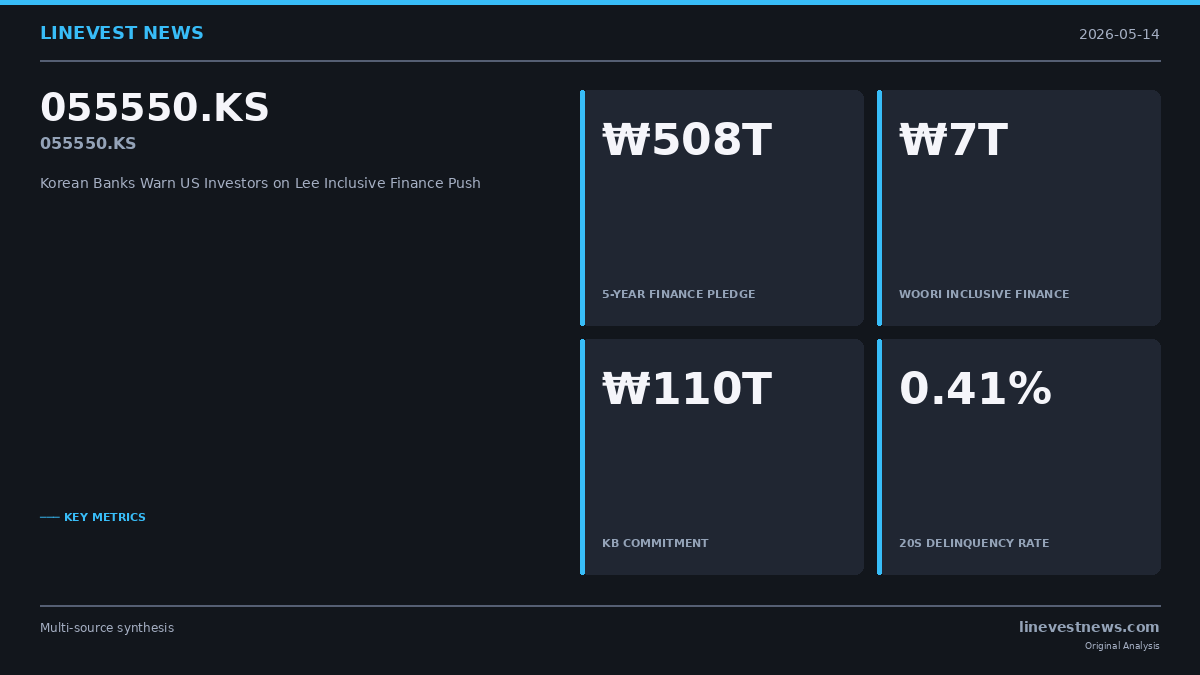
TL;DR - KB, Shinhan and Woori Financial flagged President Lee Jae Myung's "inclusive finance" agenda as a material risk in fiscal 2025 SEC annual reports — disclosures industry officials say were absent from the same groups' Korean filings. - The three groups, with Hana and NongHyup, have collectively pledged ₩508 trillion (about $371 billion) over five years in productive and inclusive finance, including a Woori commitment of up to ₩7 trillion ($5.1 billion) targeted at vulnerable borrowers. - Watch the FSC's bank inclusive-finance evaluation framework, scheduled to launch in the second half of 2026, for the next regulatory escalation.
Lead
Three of Korea's largest banking groups — KB Financial Group (105560.KS), Shinhan Financial Group (055550.KS) and Woori Financial Group (316140.KS) — used their U.S. Securities and Exchange Commission annual reports for fiscal 2025 to label the Lee Jae Myung administration's "inclusive finance" agenda as a management risk, according to a Korea Times review of the filings published Thursday. The same warnings did not appear in the groups' Korean domestic disclosures, the paper reported, citing industry officials. It marks the first concrete signal that Seoul's biggest lenders are pushing back publicly — even if only to American investors — against the new government's lending mandates.
What Happened
KB Financial, Shinhan Financial and Woori Financial filed their fiscal 2025 Form 20-F annual reports with the SEC (the U.S. Securities and Exchange Commission) in April 2026 — Shinhan on April 22 and KB on April 28 — as their American depositary receipts trade on the New York Stock Exchange, the Korea Herald reported. Hana Financial Group (086790.KS) did not file because it has no U.S.-listed ADR, per the Korea Times. All three filings added new risk-factor language warning that government-directed inclusive finance — preferential lending to low-income and vulnerable borrowers — could raise credit risk, compress net interest margins, weaken asset quality and curb operational flexibility, according to the Korea Times.
Woori's filing went furthest, telling investors the Korean government "may in the future request financial institutions … to make investments … as a matter of policy" and that such initiatives could "require us to provide financial support to sectors which we would not otherwise support," as quoted by the Korea Times. KB Financial warned in similar terms that such policies could "reduce our profit margins, limit our operational flexibility and increase competition," per the same source. Shinhan's risk language closely mirrored KB's, the Korea Herald reported. The Korea Times noted that these inclusive-finance references were newly added to the 2026 filings and absent from prior years' annual reports.
Why It Matters
The filings represent the first concrete signal that Korea's biggest financial groups view the Lee administration's lending agenda as material enough to warn U.S. shareholders about — even while staying silent in their domestic regulatory filings. That asymmetry challenges the long-standing consensus that Korean megabanks accept policy lending without public objection, and it formalizes a structural tension under U.S. SEC rules, which require issuers to disclose materially adverse policy risks regardless of whether they expect those risks to crystallize. The Korea Institute of Finance, a research arm funded by Korean banks, has warned that mounting productive- and inclusive-finance demands create "downward pressure on banks' earnings structures and financial soundness," as quoted by the Korea Herald — a view the new 20-F language now codifies for foreign investors.
Business Impact
The numbers behind the policy are large. On November 9, 2025, KB, Shinhan, Hana, Woori and NongHyup Financial Group — the agricultural-cooperative banking holding company — jointly pledged ₩508 trillion (about $371 billion at roughly ₩1,370 per dollar) in productive and inclusive finance over five years, the Korea Herald reported. KB committed ₩110 trillion (about $80 billion), including ₩17 trillion (about $12 billion) earmarked for inclusive finance; Shinhan matched at ₩110 trillion; Hana committed ₩100 trillion (about $73 billion); NongHyup ₩108 trillion (about $79 billion); and Woori ₩80 trillion (about $58 billion), per the same article.
Within that envelope, Woori has separately said it will invest up to ₩7 trillion ($5.1 billion at ₩1,370/$1) over five years specifically in inclusive-finance programs for vulnerable borrowers, the Korea Times and Korea Herald reported. The new 20-F language signals that some of that lending may carry credit costs the banks would not otherwise underwrite, and that group-level net interest margins could be pressured if delinquencies rise.
Industry & Historical Context
The Lee government has paired its inclusive-finance push with a "productive finance" agenda that channels capital into strategic industries, venture capital and small businesses, the Korea Herald reported. Regulators are extending the framework: the FSC (Korea's Financial Services Commission) plans to roll out an inclusive-finance evaluation system for banks in the second half of 2026 and is studying an expansion to non-bank lenders, per Seoul Economic Daily. President Lee has publicly criticized lenders for what he described as "predatory" practices, the Korea Herald reported separately. The backdrop is a stressed retail credit book: Koreans in their 20s carry a household-loan delinquency rate of 0.41 percent across Korea's five major banks — the highest of any age cohort — according to Korea Herald data.
What to Watch
Key near-term markers include the FSC's published methodology for the bank inclusive-finance evaluation framework, due in the second half of 2026, and any escalation of household-loan delinquency disclosed in the groups' interim first-half 2026 results. Market participants will also be watching whether non-bank lenders absorb part of the policy burden once the FSC's evaluation framework is extended beyond banks, as flagged by Seoul Economic Daily, and whether any of the five groups raises its multi-year productive- and inclusive-finance pledge above the current ₩508 trillion total.
Sources: - Korea Times — https://www.koreatimes.co.kr/business/banking-finance/20260514/financial-groups-flag-risks-from-govt-led-inclusive-finance-in-us-filings - Korea Herald (banks flag policy finance risks) — https://www.koreaherald.com/article/10738070 - Korea Herald (₩508 trillion banking-sector pledge) — https://www.koreaherald.com/article/10612008 - Seoul Economic Daily (inclusive-finance evaluation expansion) — https://en.sedaily.com/finance/2026/05/11/korea-to-expand-inclusive-finance-evaluation-to-non-bank - Korea Herald (20s delinquency data) — https://www.koreaherald.com/article/10595883 - Korea Herald (Lee criticizes lenders) — https://www.koreaherald.com/article/10736226
By LineVest Markets Desk — May 14, 2026This article is for informational purposes only and does not constitute investment advice.