
IntelINTC
About Intel
Intel Corporation designs and manufactures semiconductors, historically anchored by x86 central processing units for personal computers and servers. Its reporting is organized around Client Computing, which sells CPUs and related silicon to PC original equipment manufacturers, and Data Center and AI, which supplies Xeon server processors, accelerators and networking silicon to hyperscalers and enterprises. Adjacent units cover network and edge silicon, programmable logic through Altera, and autonomous driving via Mobileye, in which Intel retains a majority stake after a partial listing. A separate Intel Foundry segment reports the manufacturing operations serving both internal product groups and external customers. Client PCs have traditionally supplied the bulk of revenue, while Data Center historically drove disproportionate profit.
Holders track several structural questions that distinguish Intel from fabless peers. The company is one of very few remaining integrated device manufacturers at leading-edge nodes, so capital intensity, depreciation and factory utilization sit at the center of margin analysis. Progress on the internal process roadmap, external foundry customer wins and the split between internal and merchant fabrication are watched closely. Concentration among a handful of PC and server customers, exposure to U.S. and allied export controls on advanced chips to China, subsidy flows under the U.S. CHIPS Act and comparable European programs, dividend policy and the pace of divestitures such as Altera and Mobileye stakes are all recurring points of scrutiny.
Intel was founded in 1968 in Mountain View, California by Robert Noyce and Gordon Moore, initially producing memory chips before pivoting to microprocessors. The 1981 selection of the 8088 for the IBM PC, followed by the Wintel partnership with Microsoft, made x86 the dominant computing architecture for decades. Later chapters include the 2015 acquisition of programmable-logic maker Altera, the 2017 purchase of Mobileye, the 2022 relisting of Mobileye on Nasdaq, and the ongoing carve-out of Altera as a standalone entity. Under a strategy announced in 2021, Intel reorganized to separate its product businesses from an internal foundry operation offering wafer manufacturing to external customers.
Intel sells silicon primarily to computer and server original equipment manufacturers such as Dell, HP, Lenovo and Supermicro, to hyperscale cloud operators, to communications and industrial customers, and increasingly to external foundry clients contracting for wafer capacity. Sales move through direct relationships with large accounts and through distributors for the long tail, typically under multi-quarter forecasts rather than firm long-term take-or-pay contracts. Competitive position rests on manufacturing process leadership, the entrenched x86 software ecosystem, and platform breadth from client to data center. Its principal rivals are AMD in x86 CPUs, Nvidia in data-center accelerators, TSMC and Samsung in foundry services, and Arm-based designers in client and server sockets. A majority of revenue is generated outside the United States, with significant exposure to Asia-Pacific customers.
Company profile by LineVest editorial. Journalism, not investment advice.
Order a report on Intel — $15Intel coverage
3 articles
Sanders' AI Superintelligence Ban Act: Three Watch Points for MSFT, AMZN, and GOOGL Investors
Sen. Sanders's bill to ban superintelligent AI and pause frontier development targets Microsoft, Amazon, and Alphabet — a policy risk even if Congress fails to advance it.
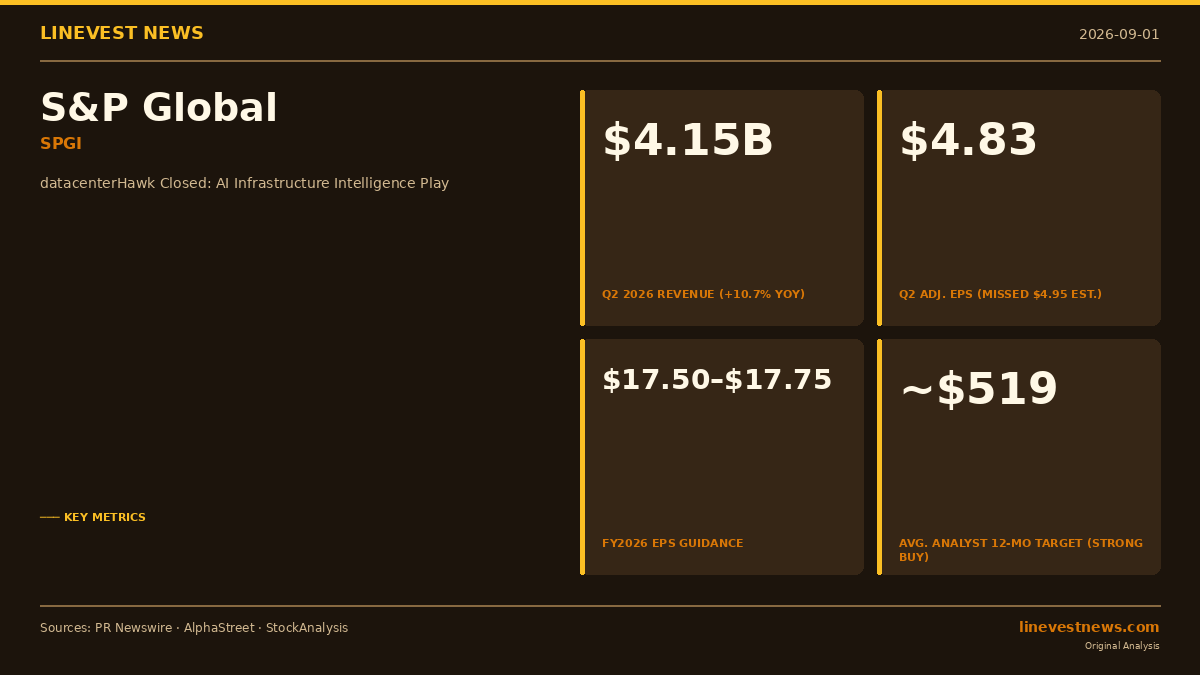
S&P Global Closes datacenterHawk Deal — SPGI's AI Infrastructure Intelligence Play, Explained
S&P Global closed datacenterHawk September 1, adding data center and fiber intelligence to S&P Global Energy. Terms undisclosed; deal is immaterial to near-term earnings.
Intel (INTC) Q2 2026: Revenue +25.4%, Op Profit Turns Positive; $10.85B Net Loss on Escrow
Intel posted Q2 2026 revenue of $16.13 billion, up 25.4% year-over-year, swinging to operating income of $1.796 billion from a $3.176 billion operating loss in Q2 2025.
Go deeper than the headline
You just read what happened. Here's how to read what it means.
The day's reports, every morning — free
LineVest Daily lands in your inbox before the opening bell with the reports we published that day — what each company's latest 10-K or 10-Q actually says about the numbers, in plain English. Free, no card required.
This report, on any company you name
What you just read on Intel is the format. Name any U.S.-listed company and we do the same for it — its latest SEC filing read in full, financials under US GAAP, governance, and what it means for the stock. PDF in your inbox within 3 hours.
Which company should we read?
$15 · one-time · PDF within 3 hours
Pick a company to continueIndependent journalism based on primary SEC filings — not investment advice. No brokerage affiliation.