South Korea's telecom regulator on the morning of July 8 formally notified eight online platforms that they are now subject to a revised Information and Communications Network Act, the country's newly effective law against "false or manipulated information." The list, per Chosun Biz, comprises four domestic services — NAVER (035420.KS), Korea's largest search-and-commerce platform; Kakao (035720.KS), operator of the dominant KakaoTalk messenger; the web portal Nate; and the online forum DCInside — alongside four foreign services: Google, Meta, X (formerly Twitter) and TikTok. The amended act took effect on July 7.
For a global investor holding NAVER or Kakao, the first question is blunt: does this create direct financial liability for the platforms? Based on the statute as described by the regulator, the answer is largely no — the punitive money penalties target individual content creators, while the platforms inherit a compliance and moderation burden.
What the platforms actually must do
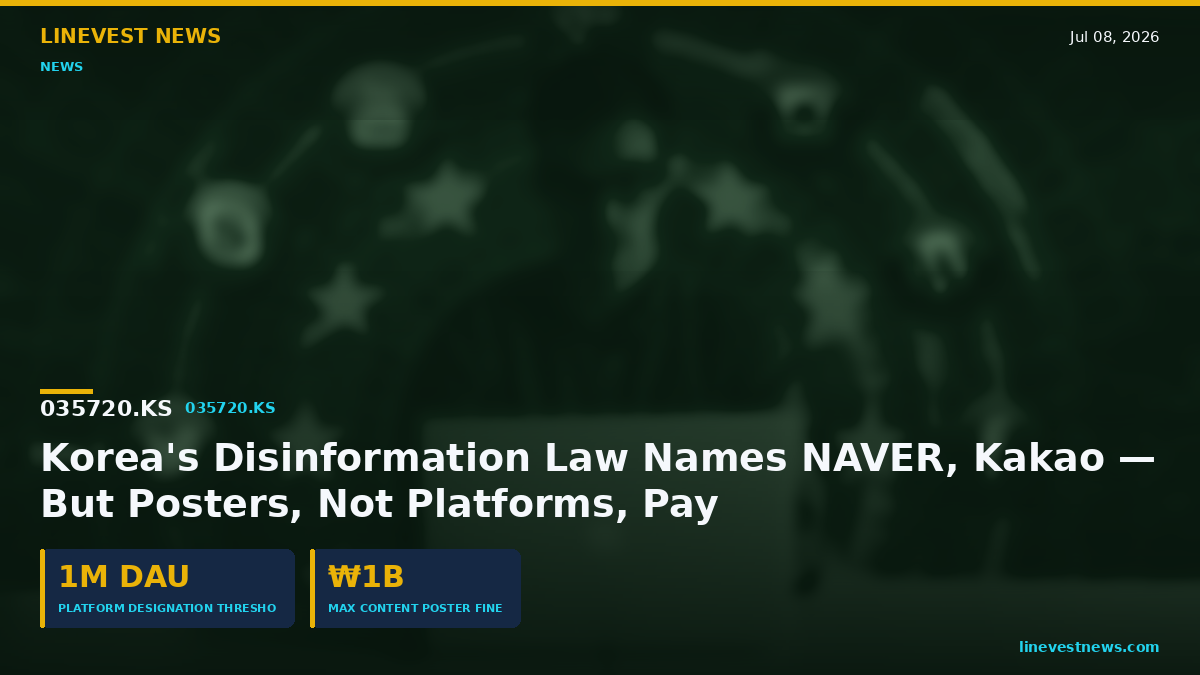
Designation attaches to any platform averaging 1 million or more daily active users over the final three months of the prior year (Chosun Biz; Korea Times). Those operators must build systems for users to report allegedly false content, run their own moderation policies, act on reports, and publish transparency reports to the public every six months detailing complaints and actions taken (Korea Times; Euronews). The Korea Communications Commission (KCC, Korea's broadcasting and telecom regulator) can issue corrective orders for non-compliance, and criminal penalties apply only if a platform refuses to comply without legitimate reason (Korea Times). The law leaves the initial takedown call to the platforms themselves rather than mandating automatic deletion on receipt of a report — operators must "take measures such as removing content or suspending user accounts" after review (Fortune/AP).
Where the money penalties land
The headline deterrents — punitive damages of up to five times actual harm, and an administrative fine of up to ₩1 billion ($660,000) — apply to content posters, not to NAVER or Kakao. Chosun Biz reports that lawmakers considered levying fines on platform operators during deliberations but the final bill made only the person who posted the content subject to the fine. The fine targets those who distributed two or more items later ruled unlawful; the enhanced-damages regime applies to a "person who posts information as a business," defined as someone who ran at least three monetized posts in the prior three months and has either 100,000-plus subscribers or an average of 100,000-plus monthly views (Chosun Biz). Where harm is hard to quantify, courts may set damages up to ₩50 million ($33,000) (Chosun Biz). At a July 8 briefing, KCC consumer-policy bureau director-general Shin Young-gyu said platforms would make the first call on whether posts — including satire and parodies — violate their internal guidelines, with courts holding final authority on whether specific content breaches the law (Korea Times).
Regulatory fine conversions use the July 8, 2026 spot rate of about ₩1,508 per dollar (Trading Economics); platform revenue figures below are drawn from BigGo Finance and may reflect different conversion dates.
Sizing it against the platforms' economics
The compliance cost of standing up a reporting pipeline and biannual transparency reports is immaterial next to platform revenue: NAVER reported Q1 2026 consolidated revenue of ₩3.24 trillion ($2.14 billion) and operating profit of ₩541.8 billion ($357 million), while Kakao posted revenue of ₩1.94 trillion ($1.28 billion) and operating profit of ₩211.4 billion ($139 million), per figures reported by BigGo Finance from the companies' Q1 disclosures. The more consequential risk is second-order: because platforms make the first call on takedowns before any court ruling, critics warn operators will over-remove content to limit liability — a moderation-cost and reputational overhang rather than a line-item fine.
The precedent that hangs over it
Korea has tried platform-level speech rules before. A 2007 "real-name" verification requirement — initially covering sites with 300,000-plus daily visits and lowered to 100,000 in 2009 — forced operators to identify posters; in August 2012 the Constitutional Court struck it down unanimously, finding it chilled free expression while failing to reduce illegal postings and pushing users to overseas services (Global Voices). That history is directly relevant now: opposition politicians have signaled a constitutional complaint, and a National Assembly petition to withdraw the law had drawn more than 140,000 signatures, according to Chosun Biz.
The open question
The near-term catalyst is not an earnings line but a legal one: whether a constitutional challenge is filed and how the KCC's first designation of "fact-checking" partners resolves. Chosun Biz notes that only one domestic body, broadcaster JTBC, currently holds International Fact-Checking Network (IFCN) certification, with three more applicants pending — a bottleneck that will shape how much discretion actually sits with platforms versus government-supported reviewers. That structure, more than any single fine, is what determines the compliance weight NAVER and Kakao ultimately carry.
The backdrop is a wobbly one for both names: through May 2026 the KOSPI had surged roughly 87% year-to-date while Kakao fell about 27% and NAVER about 16%, with foreign and institutional investors reducing holdings in both, per BigGo Finance.
This article is journalism, not investment advice. LineVest is not a registered investment adviser. Figures are drawn from the cited sources as of July 8, 2026; currency conversions are approximate.