Apple Seeks Injunction to Block OpenAI From Using Alleged Trade Secrets as Silicon Valley's AI Talent War Turns Legal
TL;DR - Apple is pursuing a preliminary injunction to stop OpenAI from developing AI products based on alleged stolen proprietary data - At least three former Apple employees now at OpenAI named: Chang Liu (Sr. Systems Engineer), Tang Yew Tan (Chief Hardware Officer), and Yu-Ting Peng - Apple alleges Liu photographed confidential documents about an unannounced product before his OpenAI interview; 11+ additional employees identified - OpenAI fired back with a public blog post: "Apple is getting this wrong" — calling the suit "careless, aggressive and oddly personal" - OpenAI claims Apple's lawyers "emailed the wrong person after confusing two Asian last names"; Apple allegedly concedes a key claimed meeting "never happened" - The commercial tension is stark: Apple Intelligence routes Siri queries to ChatGPT, making OpenAI both defendant and key AI supplier
Part A: The Lawsuit
Apple has escalated its trade secret litigation against OpenAI, filing a motion for preliminary injunction asking a federal judge to bar OpenAI from developing artificial intelligence devices or products that rely on Apple's allegedly stolen technology. The company simultaneously requested expedited discovery from named defendants and their current employer.
According to court filings, Apple's trade secret allegations center on three categories of alleged misconduct:
Alleged Conduct
| Allegation | Named Individual | Details |
|---|---|---|
| Screenshots of confidential docs | Chang Liu | Taken before Liu's OpenAI interview; docs related to an unannounced Apple hardware product |
| Proprietary info shared in meetings | Multiple former employees | Discussions about unreleased products between ex-Apple staff and OpenAI personnel |
| Retained Apple-issued devices | Multiple employees | Departing employees allegedly kept company hardware and continued to access Apple files |
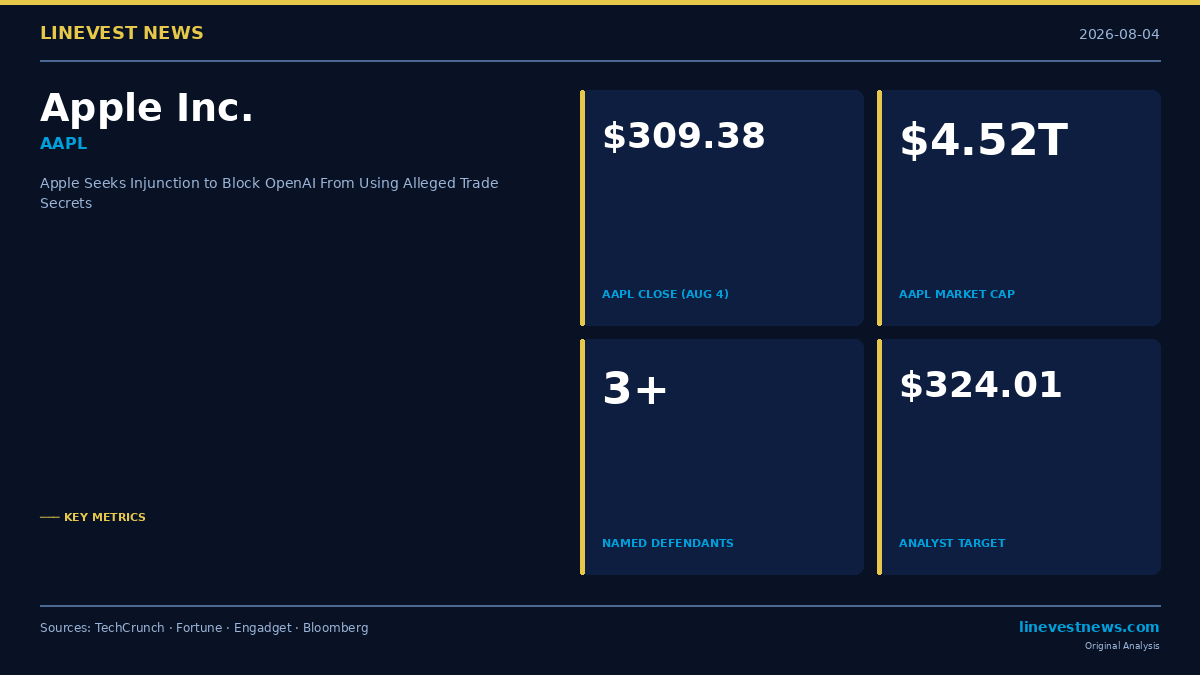
Apple named three primary defendants: Chang Liu, formerly a Senior Systems Engineer at Apple; Tang Yew Tan, who now serves as Chief Hardware Officer at OpenAI; and Yu-Ting Peng, also now at OpenAI. Apple's filing identifies at least 11 additional former employees as potential witnesses or additional parties.
The filing alleges that "another former Apple employee seems to have met with Mr. Liu and Ms. Peng" to discuss "proprietary information relating to unannounced products."
If granted, the preliminary injunction would constitute an extraordinary judicial intervention — effectively pausing aspects of OpenAI's hardware AI development pending final adjudication of the underlying claims.
Part B: OpenAI's Counteroffensive and Investor Implications
OpenAI took the unusual step of fighting the litigation publicly. In a blog post headlined "Apple is getting this wrong," the company methodically attacked the factual basis of Apple's claims.
OpenAI's Core Rebuttals
1. Procedural errors Apple's complaint alleged it reached out to OpenAI in February and received no response. OpenAI countered that Apple's outside counsel had "emailed the wrong person after confusing two Asian last names — only after we brought this to their attention." More strikingly, Apple's own filings allegedly concede that a claimed meeting between OpenAI's General Counsel and an Apple representative "never happened."
2. Apple's own access-management failure For employees accused of accessing Apple files after departure, OpenAI pointed the finger back at Apple. The company argued that these former employees retained access because Apple exhibited "poor access management when people leave," and that some accessed files only because "Apple asked them to" when Apple itself could not locate the documents independently.
3. Defendant statements On Tang Yew Tan, OpenAI stated the executive "has always been clear with his team that the company doesn't want and must not use any confidential information from other firms." The company's position: "We do not have, nor want, any of their trade secrets."
4. OpenAI's characterization The company described the litigation as "careless, aggressive and oddly personal" — blunt language directed at a company that remains an active commercial partner. OpenAI also released internal text messages and emails to support its rebuttal, including exchanges described by one former Apple engineer as revealing what it is like working at an AI-centric workplace.
The Apple Intelligence Paradox
AAPL investors face a structural irony embedded in this dispute. Apple Intelligence — the AI feature suite built into iOS 18 and later — routes complex Siri queries to ChatGPT with user permission, making OpenAI a core component of Apple's own AI strategy. Apple's App Store distribution also features OpenAI's apps. The company is in effect suing its primary AI supplier while commercially depending on it.
This creates a bifurcated risk scenario:
- If Apple wins an injunction: OpenAI's AI hardware roadmap could face court-ordered constraints, which might complicate or chill the commercial partnership Apple has built and promoted
- If OpenAI's rebuttal gains traction: Apple's aggressive litigation posture could damage the relationship without legal remedy — and Apple's unannounced product details may be exposed further in discovery
AAPL Stock and Watch Points
Apple shares closed at $309.38 on August 4, 2026, up 1.96% on the day, with a market capitalization of approximately $4.52 trillion. The consensus analyst price target stands at $324.01, implying roughly 4.7% upside from current levels.
Trade secret litigation of this scale rarely moves large-cap stocks immediately, but investors tracking AAPL should monitor three developments:
| Watch Point | Significance |
|---|---|
| Preliminary injunction ruling | If granted, constrains OpenAI hardware AI development; could strain the Apple-OpenAI commercial relationship |
| Discovery scope | Court-ordered disclosure about Apple's "unannounced products" could reveal more of Apple's AI hardware roadmap than management would voluntarily share |
| AI talent war escalation | Apple's aggressive legal posture signals it views AI hardware as a core competitive moat — expect similar suits to become an industry pattern |
The broader context: the race to hire AI engineers is generating legal friction at the highest levels of the technology sector. Apple and OpenAI's dispute is likely the most visible instance of a pattern that will define competitive dynamics in AI for years.
This article is for informational purposes only and does not constitute investment advice. LineVest News is an independent financial journalism publication.
Sources - TechCrunch, "Apple says more ex-employees may have taken confidential data to OpenAI," Aug. 4, 2026 - Fortune, "Sam Altman's OpenAI publishes brutal critique of Apple lawsuit: 'Apple is getting this wrong'," Aug. 4, 2026 - Engadget, "Apple Asks Judge to Bar OpenAI From Using Alleged Trade Secrets," Aug. 4, 2026 - Engadget, "OpenAI says Apple 'is getting this wrong' after trade secret lawsuit," Aug. 4, 2026 - Forbes, "OpenAI Shares Chats And Emails To Rebut Apple's Suit," Aug. 4, 2026 - Bloomberg Technology, "Apple Asks Judge to Bar OpenAI From Using Alleged Trade Secrets," Aug. 4, 2026 - Yahoo Finance, AAPL quote data, Aug. 4, 2026