TL;DR
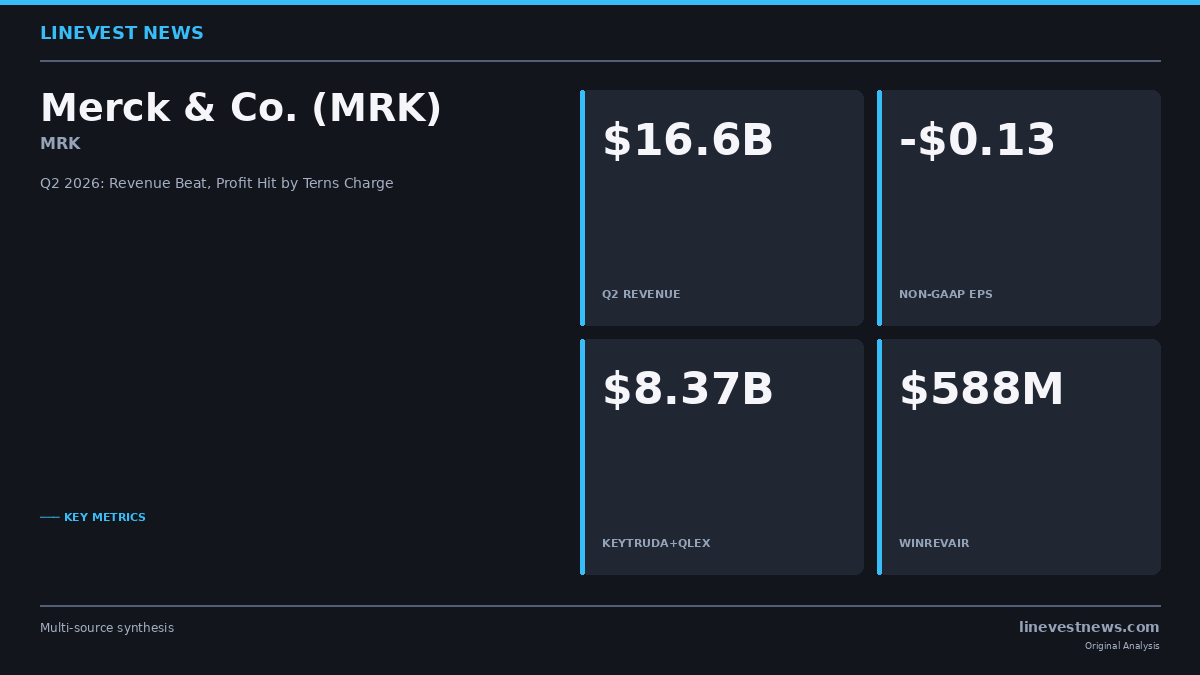
- Q2 2026 worldwide sales: USD 16.6B (+5% YoY vs USD 15.806B in Q2 2025), beat consensus USD 16.37B
- Non-GAAP EPS: -USD 0.13, beating the -USD 0.26 consensus; Terns acquisition IPRD charge of -USD 2.31/share is the sole driver of the loss
- GAAP EPS: -USD 0.54 (net loss USD 1.335B)
- Keytruda + Keytruda Qlex: USD 8.366B (+5% YoY); new injectable Qlex contributed USD 463M
- Winrevair: USD 588M (+75% YoY) — fastest-growing key product
- FY2026 revenue guidance raised to USD 66.3-67.3B (from USD 65.8-67.0B)
- FY2026 non-GAAP EPS guidance cut to USD 2.66-2.76 (from USD 5.04-5.16) — entirely due to Terns charge
Part A — Q2 2026 Results at a Glance (SEC 8-K, Item 2.02, filed August 4, 2026)
Top-Line Performance
Merck & Co., Inc. (NYSE: MRK) reported second-quarter 2026 worldwide sales of USD 16.6 billion, a 5% increase year-over-year (4% excluding foreign exchange). The result cleared the Wall Street consensus of approximately USD 16.37 billion by roughly USD 230 million.
| Metric | Q2 2026 | Q2 2025 | YoY |
|---|---|---|---|
| Total Worldwide Sales | USD 16.6B | USD 15.806B | +5% |
| Pharmaceutical Segment | USD 14.760B | - | +5% |
| Animal Health Segment | USD 1.775B | - | +8% |
| Non-GAAP EPS | -USD 0.13 | USD 2.13 | n/m |
| GAAP EPS | -USD 0.54 | USD 1.76 | n/m |
| Net Loss | -USD 1.335B | Profit | n/m |
n/m = not meaningful due to one-time acquisition charge. Sources: SEC EDGAR 8-K Exhibit 99.1 (accession 0001104659-26-090045); MarketBeat.
Key Product Sales
| Product | Q2 2026 Sales | YoY |
|---|---|---|
| Keytruda + Keytruda Qlex | USD 8.366B | +5% |
| of which Keytruda Qlex (injectable) | USD 463M | New |
| Winrevair (sotatercept) | USD 588M | +75% |
| Gardasil / Gardasil 9 | USD 1.169B | +4% |
| Welireg (belzutifan) | USD 271M | +67% |
| Januvia / Janumet | USD 429M | -31% |
Source: SEC 8-K Exhibit 99.1.
The Terns Charge Explained
The USD 1.335 billion net loss stems entirely from a non-cash, one-time in-process research and development (IPRD) charge of approximately USD 5.7 billion (USD 2.31 per share) related to Merck's acquisition of Terns Pharmaceuticals, which closed in May 2026 at USD 53.00/share (approximately USD 6.7 billion equity value). The charge reflects the fair-value write-up of Terns' pipeline at the acquisition date — a standard GAAP accounting treatment for assets not yet commercially launched.
Updated FY2026 Guidance
| Metric | Prior Guidance | Updated Guidance | Direction |
|---|---|---|---|
| Full-Year Revenue | USD 65.8-67.0B | USD 66.3-67.3B | Raised |
| Non-GAAP EPS (incl. Terns charge) | USD 5.04-5.16 | USD 2.66-2.76 | Cut (Terns only) |
| Terns charge on EPS | - | -USD 2.31/share | One-time |
| Underlying EPS (ex-Terns) | USD 5.04-5.16 | ~USD 4.97-5.07 | Roughly flat |
Part B — What This Means for Investors
1. The Core Business Is Growing — Charges Are Accounting Noise
Strip out the Terns IPRD charge and Merck's second quarter tells a straightforward growth story: revenue up 5%, Animal Health at +8%, and multiple pipeline products accelerating. The underlying non-GAAP EPS — adjusting for the charge — would be approximately USD 2.18/share for Q2, annualizing to roughly USD 5.00, consistent with Merck's unchanged core profitability guidance of approximately USD 4.97-5.07.
Investors who focus on the headline EPS loss risk misreading a standard deal-accounting entry as evidence of operational weakness. The IPRD charge is non-cash and non-recurring. The operating machine is intact.
2. Keytruda Qlex: The 2028 Cliff Mitigation No One Is Pricing In
Keytruda's subcutaneous injectable formulation — Keytruda Qlex — contributed USD 463 million in its early quarters of commercialization, out of a total Keytruda franchise of USD 8.366 billion. That represents approximately 5.5% of Keytruda revenue from a form factor that reduces infusion chair time from 30-120 minutes to a brief subcutaneous injection. More importantly, Keytruda Qlex carries distinct IP — its formulation patents extend beyond Keytruda's 2028 small-molecule expiry.
The market has treated Keytruda's patent cliff as a binary event. Keytruda Qlex is the most direct rebuttal: biosimilar entrants cannot replicate a reformulated product on day one of patent expiry. Merck is building runway quietly.
3. Winrevair and Welireg: Two Blockbusters in the Making
Winrevair (sotatercept), approved in March 2024 for pulmonary arterial hypertension, reached USD 588 million in Q2 2026 at a +75% growth rate. At this pace, Winrevair is on track to annualize above USD 2.2 billion, approaching the low end of consensus peak sales estimates of USD 4-7 billion. Welireg (belzutifan), Merck's HIF-2alpha inhibitor for advanced renal cell carcinoma, posted USD 271 million (+67%). With its label expanding and first-line RCC data maturing, Welireg is tracking toward blockbuster status independent of Keytruda.
4. The M&A Ledger: Heavy But Strategic
Merck has booked two massive IPRD charges in 2026 alone: USD 9.0 billion from Cidara Therapeutics in Q1 and USD 5.7 billion from Terns Pharmaceuticals in Q2. Together these represent USD 14.7 billion in H1 GAAP charges.
Terns brings TERN-701, an oral RAS inhibitor with late-stage data in chronic myeloid leukemia — a direct adjacency to Merck's oncology franchise. Cidara Therapeutics added rezafungin, a once-weekly antifungal with differentiated dosing. Both assets have clear near-term commercial timelines. Gardasil's resilience (+4% despite ongoing China demand normalization) further signals that Merck's non-Keytruda franchise is stabilizing.
5. Januvia's Decline Is Priced In
Januvia/Janumet revenue fell 31% year-over-year to USD 429 million as generic sitagliptin competition intensifies globally. This is a known dynamic, fully embedded in sell-side models. The decline is not accelerating in a disorderly way. GLP-1 class displacement has not materially altered the pace of sitagliptin erosion — Januvia is aging out on schedule.
Analyst Consensus and Stock Setup
Heading into Q2 earnings, 28 analysts covered MRK: 16 Strong Buy, 2 Moderate Buy, and 10 Hold, with an average price target of approximately USD 135.19. MRK closed at USD 127.72 on August 3, 2026, implying roughly 6% upside to consensus before today's results. The revenue beat and raised revenue guidance provide near-term support. The profit guidance cut is a mechanical consequence of the Terns IPRD charge and should not alter investment decisions for investors modeling on ex-IPRD EPS.
Key Risks
- Keytruda 2028 biosimilar entry: Even with Qlex, multiple biosimilar entrants will capture share. The Qlex strategy buys time but does not eliminate the cliff.
- Gardasil China dependency: Q2 saw +4% growth, but China demand remains structurally lower post-COVID and amid declining birth rates. Any further China policy shift is a single-product risk.
- Integration execution: Both Cidara and Terns are pre-commercial or early-commercial assets. Clinical or regulatory setbacks would sharply reprice the acquisition premium.
- Balance sheet loading: USD 14.7 billion in H1 IPRD charges plus ongoing Verona Pharma integration costs increase leverage risk if the pipeline disappoints.
Sources:
- SEC EDGAR 8-K, Merck & Co., Inc., accession 0001104659-26-090045, filed August 4, 2026
- CNBC: "Merck hikes revenue outlook as new drug sales grow, but cuts profit guidance due to deal charges" (August 4, 2026)
- MarketBeat: MRK Q2 2026 Earnings Report
- Insider Monkey: "Merck (MRK) Tops Quarterly Sales Forecasts as Keytruda Drives Growth"
This article is for informational purposes only and does not constitute investment advice. LineVest is not a registered investment adviser.