TL;DR
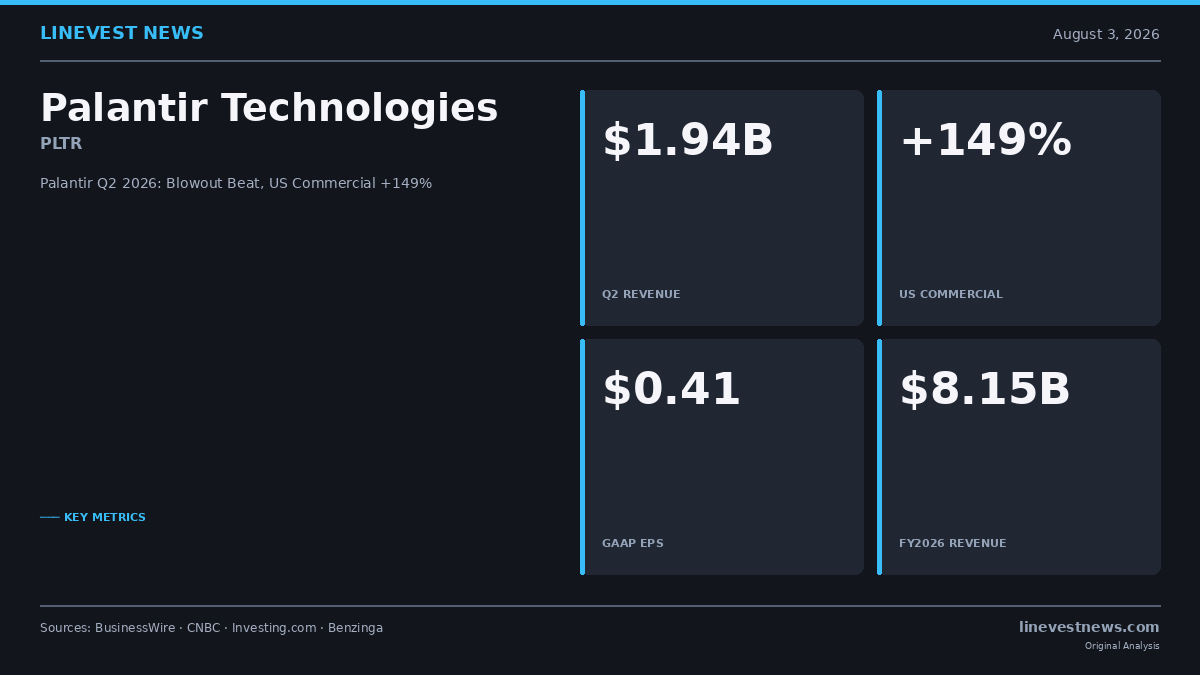
- Q2 revenue $1.935B (+93% YoY), beating $1.812B consensus by 6.8%
- US commercial revenue $764M (+149% YoY, +28% QoQ)—CEO Alex Karp called demand "otherworldly"
- GAAP EPS $0.41, beating $0.34 consensus by $0.07 (+21%); ninth consecutive quarterly EPS beat
- Full-year 2026 revenue guidance raised to $8.15B from $7.66B—a $490M upgrade in one quarter
- Stock jumped +7.7% after hours to $135.32
Part A — Q2 2026 Results Summary
Palantir Technologies (NASDAQ: PLTR) delivered its second-quarter 2026 results on August 3, 2026, posting its ninth consecutive earnings beat and raising full-year guidance sharply above Wall Street expectations. CEO Alex Karp described commercial demand as "otherworldly" and declared that "demand for AI sovereignty has now been unleashed."
Revenue Breakdown
| Segment | Q2 2026 | YoY Growth | QoQ Growth |
|---|---|---|---|
| Total Revenue | $1.935B | +93% | +19% |
| US Revenue (total) | $1.573B | +115% | +23% |
| — US Commercial | $764M | +149% | +28% |
| — US Government | $809M | +90% | +18% |
| International Revenue | ~$362M | ~+34% | — |
Profitability at a Glance
| Metric | Q2 2026 | Margin |
|---|---|---|
| GAAP Operating Income | $912M | 47% |
| Adjusted Operating Income | $1.194B | 62% |
| GAAP Net Income | $1.062B | 55% |
| Cash from Operations | $1.216B | 63% |
| Adjusted Free Cash Flow | $1.220B | 63% |
GAAP diluted EPS came in at $0.41, beating the $0.34 consensus by 24%. Year-ago GAAP EPS was $0.16, implying +156% YoY growth.
Pipeline and Deal Metrics
- Total Contract Value (TCV) closed: $3.373B (+49% YoY)
- US Commercial TCV: $2.132B (+153% YoY)
- US Commercial Remaining Deal Value: $6.238B (+124% YoY, +27% QoQ)
- Deal count: 220 deals ≥$1M; 98 deals ≥$5M; 73 deals ≥$10M
- Rule of 40 score: 155%
Updated 2026 Guidance
| Metric | Q3 2026 Guidance | FY2026 (Updated) | FY2026 (Prior) |
|---|---|---|---|
| Revenue | $2.160–2.164B | $8.150–8.158B | $7.65–7.66B |
| US Commercial Revenue | — | >$3.424B (+134%+) | >$3.224B (+120%+) |
| Adj. Operating Income | $1.292–1.296B | $4.889–4.897B | — |
| Adj. Free Cash Flow | — | $4.5–4.7B | — |
Part B — What This Means for U.S. Investors
1. The Commercial Flywheel Is Now Undeniable
For years, Palantir's bull case rested on US commercial revenue becoming self-sustaining. Q2 2026 made that case irrefutable. At $764M (+149% YoY), US commercial revenue is now nearly as large as the US government segment ($809M)—a balance that seemed years away twelve months ago when government revenue was nearly 2× commercial.
The $6.238B in US Commercial Remaining Deal Value—up 27% sequentially—acts as a forward revenue floor. These are signed contracts already converting to recognized revenue. Even with zero new commercial deal wins from today, Palantir's near-term commercial trajectory is largely locked in.
2. AIP Is Reaching Mid-Market Scale
Palantir's Artificial Intelligence Platform, launched via boot camps in 2023, is the primary commercial engine. The 220 deals at $1M+ in a single quarter (vs. fewer than 100 two years ago) demonstrates AIP is no longer an enterprise-only product. The $2.132B in US commercial TCV closed this quarter—up 153%—suggests mid-market adoption is accelerating alongside the Fortune 500 expansion.
Karp positioned this as a structural, not cyclical, shift: "Palantir is the only company that has demonstrated it can transform tokens into actual economic value." The claim is bold, but the 28% sequential commercial revenue growth supports it operationally.
3. Rule of 40 at 155%: The Efficiency Debate Is Over
Software analysts use the Rule of 40 (revenue growth rate + FCF margin) to measure growth-efficiency balance. A score above 40% is elite; above 100% is rare. Palantir's 155% places it among the most efficient software companies ever at this scale. With $1.22B in quarterly free cash flow at a 63% margin, the "burning cash for growth" criticism is obsolete. The company is generating substantial cash while growing revenue at triple-digit rates.
4. Valuation: The Persistent Tension
After the after-hours move to ~$135, Palantir trades at roughly 42× forward revenue on the new $8.15B guidance—a premium that remains extreme by historical standards. Analyst median targets (~$200) imply ~48% upside, but these will likely be revised upward following tonight's guidance raise.
The structural risk is straightforward: at 42× revenue, Palantir is priced for continued acceleration. Any deceleration—a large government contract loss, AIP adoption slowdown, or rotation away from AI spending—would compress the multiple sharply. The stock has already fallen 30%+ from its peak despite consistent earnings beats, reflecting how demanding the embedded expectations are.
5. Government at 90%: Healthy Diversification, but Watch the Mix
US Government at $809M (+90%) is impressive, but the trend is deliberate: Palantir is structurally reducing its dependency on government contracts subject to continuing resolutions and procurement cycles. This is positive for revenue quality and predictability. The risk is that government revenue, while durable, carries longer sales cycles. If commercial momentum slows, government remains the reliable backstop—but at lower multiples than commercial SaaS.
Key Signals to Monitor
- Q3 sequential growth: $2.16B implies +67% YoY—a natural deceleration from 93%, but management's track record of conservatism suggests actual results could again exceed guidance
- US commercial remaining deal value: Needs to sustain 20%+ QoQ pace to support $3.424B+ full-year target
- NHS UK controversy: The £330M FDP contract—where NHS England was publicly reprimanded for misrepresenting patient data access—is an unresolved overhang on international government business
- Analyst target revisions: Expect multiple upgrades and price target increases over the next 48 hours following the guidance raise
Disclosure: This article is for informational purposes only and does not constitute investment advice. Palantir Technologies (PLTR) is listed on NASDAQ. All figures sourced from Palantir's Q2 2026 earnings press release (BusinessWire, August 3, 2026), CNBC, Investing.com, and Benzinga. International revenue is derived as the difference between total and US revenue.