PayPal Holdings (PYPL) Q2 2026 10-Q Analysis: Revenue Growth Stalls as Margin Pressure Mounts
Executive Summary
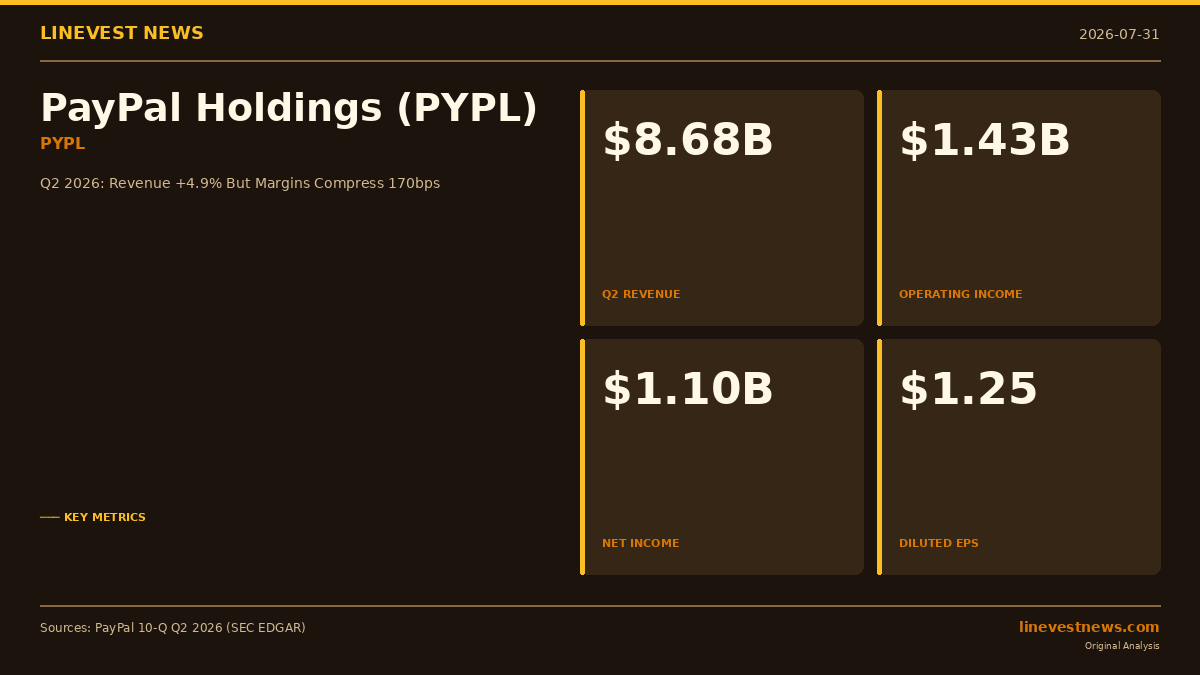
PayPal Holdings delivered a mixed Q2 2026 performance that underscores the intensifying challenges facing the digital payments giant. While revenue grew 4.9% year-over-year to $8,682 million, operating income declined 5.1% to $1,427 million as margin compression accelerated. Operating margins contracted 170 basis points to 16.4%, driven primarily by transaction expenses growing at more than double the rate of revenue growth. Net income fell 12.4% to $1,104 million, though aggressive share buybacks limited diluted EPS decline to just 3.1%, reaching $1.25.
The quarter's standout feature was robust cash generation, with first-half operating cash flow surging 51.5% to $3,117 million—significantly outpacing reported earnings and suggesting underlying business quality. Management deployed capital aggressively through $3,052 million in H1 buybacks and initiated the company's first-ever dividend ($0.14 quarterly). The July rejection of Stripe's $60.50 per share acquisition bid signals board confidence in valuations materially above current trading levels near $58, establishing an implicit floor for intrinsic value discussions. For foreign investors, PayPal presents a paradox: deteriorating operational performance offset by strong cash characteristics and potential M&A upside, all while navigating CEO transition under new leader Enrique Lores.
Financial Performance Overview
PayPal's Q2 2026 top-line growth of 4.9% to $8,682 million represents a deceleration that should concern growth-oriented investors, particularly given the company's historical positioning as a secular beneficiary of e-commerce expansion. The $394 million year-over-year revenue increase barely outpaced inflation, raising questions about market share dynamics and competitive positioning against rivals like Block, Stripe, and traditional card networks.
On a six-month basis, revenues reached $17,035 million, up 5.9% year-over-year—modestly better than the quarterly performance but still representing anemic growth for a technology platform. This slowdown comes despite ongoing investment in new initiatives including the PYUSD stablecoin, Venmo monetization efforts, and international expansion. The revenue trajectory suggests PayPal may be experiencing saturation in core markets or facing intensified pricing pressure from competitors.
Operating income declined 5.1% to $1,427 million in Q2, with operating margins compressing to 16.4% from 18.1% in the prior-year quarter. This 170-basis-point margin contraction represents a concerning reversal of operating leverage, where the incremental profitability of additional revenue is declining rather than improving. For the first half, operating income fell 3.9% to $2,915 million, indicating persistent rather than temporary margin pressure.
Net income fell more sharply, declining 12.4% to $1,104 million in Q2 and 13.0% to $2,217 million for the half-year. The steeper net income decline relative to operating income stemmed largely from a significant swing in other income and expenses, which moved from a $25 million gain in Q2 2025 to a $117 million loss in Q2 2026—a $142 million adverse swing detailed further below.
Despite the double-digit net income decline, diluted EPS fell only 3.1% to $1.25 (from $1.29), with the six-month figure declining 4.7% to $2.46. This significant divergence between earnings and EPS stems from aggressive capital return: share count decreased 9.5% year-over-year from 969 million basic shares to 877 million. The mathematics are straightforward but powerful—by shrinking the denominator faster than numerator erosion, management created EPS growth that masks underlying profit weakness. Whether this represents financial engineering or prudent capital allocation depends largely on whether current share prices represent genuine value. The quarterly EPS of $1.25 reportedly exceeded consensus estimates of approximately $1.19-1.22, though the beat was modest and primarily buyback-driven rather than operationally generated.
From a foreign investor perspective, the 4.9% revenue growth and contracting margins suggest PayPal is navigating a challenging transitional period where legacy business maturation outpaces newer initiative contributions. The company is no longer exhibiting the growth characteristics that justified premium valuations during the 2020-2021 fintech boom, when shares traded above $300 compared to current levels near $58.
Margin Analysis: Where Did the Money Go?
The margin compression story centers on transaction expenses, which grew 10.5% year-over-year to $4,385 million while revenues increased only 4.9%. This represents a fundamental deterioration in unit economics—PayPal is paying progressively more to process each dollar of payment volume. Transaction expenses now consume 50.5% of revenues compared to 47.9% in Q2 2025, a 260-basis-point increase in this cost ratio alone.
Several factors likely contribute to this adverse trend. First, the competitive landscape has intensified, with competitors offering lower take rates that pressure PayPal's pricing power. Second, the revenue mix may be shifting toward lower-margin products—for instance, Venmo peer-to-peer transactions traditionally carry lower monetization than merchant checkout. Third, payment network interchange costs from Visa and Mastercard may be escalating faster than PayPal can pass through to customers. The 10-Q filing does not break out these components granularly, but the magnitude of the divergence between transaction cost growth and revenue growth represents the single largest driver of margin compression.
Conversely, one bright spot emerged in transaction and credit losses, which declined 16.6% to $397 million from $476 million. This $79 million year-over-year improvement suggests PayPal's credit quality and fraud detection capabilities are improving meaningfully. The decline in credit losses indicates either better underwriting in PayPal's credit products, improved collection rates, or reduced exposure to risky segments. This represents genuine operational improvement that partially offsets the transaction expense pressure, though the offset is incomplete.
Other operating expense categories showed mixed performance. Sales and marketing declined 6.3% to $546 million, suggesting either improved efficiency or potentially concerning underinvestment in customer acquisition during a period when growth is already slowing. Technology and development increased 10.7% to $849 million, reflecting ongoing investment in platform modernization, security, and new product development including blockchain initiatives like PYUSD. Customer support and operations rose 11.8% to $462 million, growing faster than revenue and indicating potential scaling challenges. General and administrative expenses increased 9.1% to $503 million.
Restructuring charges of $113 million in Q2 2026 (versus $116 million in Q2 2025) highlight ongoing organizational changes, though the year-over-year consistency suggests these have become quasi-permanent rather than one-time events. Cumulative restructuring costs signal management is actively reshaping the cost base, yet the continued need for such charges raises questions about strategic clarity and organizational effectiveness.
The other income/expense line delivered an unwelcome surprise, swinging from a $25 million gain in Q2 2025 to a $117 million loss in Q2 2026. Breaking down the components: interest income of $104 million was more than offset by interest expense of $126 million (reflecting the company's $10.9 billion debt load), net losses on strategic investments of $74 million, and foreign exchange derivative losses of $42 million. The strategic investment losses warrant particular attention—a $74 million quarterly hit suggests PayPal holds stakes in privately-held fintech companies whose valuations have deteriorated. Given the broader 2025-2026 private market repricing, further such charges may emerge in future quarters.
The combined effect of these factors compressed pre-tax income by 14.3% to $1,310 million. The effective tax rate declined to 15.7% from 17.5%, providing modest relief that prevented an even steeper net income decline. The lower tax rate may reflect geographic profit mix or discrete items, though the filing does not provide extensive detail.
Cash Flow & Capital Allocation
While income statement performance disappointed, cash flow generation proved surprisingly robust. Operating cash flow reached $3,117 million for the first half of 2026, up 51.5% from $2,058 million in H1 2025. This $3,117 million operating cash flow substantially exceeded the $2,217 million in reported net income, creating a $900 million divergence that signals earnings quality strength rather than weakness.
This cash-to-earnings divergence typically stems from non-cash charges (restructuring, investment write-downs, depreciation) and working capital benefits. The strong operating cash flow suggests PayPal's underlying business generates cash more reliably than GAAP earnings suggest, a positive signal for investors concerned about profit quality. After deducting $439 million in capital expenditures, free cash flow reached approximately $2,678 million for the first half—a conversion rate of roughly 121% of net income.
Management deployed this cash aggressively. Share repurchases totaled $3,052 million in H1 2026, averaging approximately $1,514 million per quarter. This buyback intensity represents roughly 113% of H1 net income, meaning PayPal repurchased more in shares than it earned—a deficit financed by cash generation and incremental borrowing. The repurchase activity reduced shares outstanding from 920 million at December 31, 2025, to 862 million at June 30, 2026—a 7% reduction in six months or approximately 13% annualized.
At current share prices near $58, the $1,514 million quarterly buyback pace represents roughly 2.6% of market capitalization quarterly or approximately 10% annually. This buyback intensity ranks among the most aggressive in large-cap technology. Whether this represents value creation or value destruction depends entirely on intrinsic value assessments. Bulls would argue buying at $58 following Stripe's $60.50 rejected bid is opportunistic; bears would counter that slowing growth and margin compression make even these levels potentially expensive.
Adding to capital return, PayPal initiated its first-ever quarterly dividend in early 2026 at $0.14 per share, distributing $252 million in dividends during the first half. The dividend initiation signals management confidence in cash generation sustainability and creates a new total return component for income-oriented investors, though the approximately 0.97% annual yield ($0.56 annualized on $58 stock price) remains modest.
The combined capital return of $3,304 million ($3,052 million buybacks plus $252 million dividends) substantially exceeded free cash flow generation of roughly $2,678 million, creating a deficit of approximately $626 million. PayPal bridged this gap partially through increased borrowing—long-term debt rose from $9,987 million at year-end 2025 to $10,895 million at June 30, 2026, an increase of $908 million. Total equity declined from $20,256 million to $19,820 million despite earnings generation, reflecting the capital return intensity.
This capital allocation framework raises strategic questions. PayPal is simultaneously returning more cash than generated, increasing leverage, managing operational challenges, and navigating CEO transition. The aggressive buyback stance suggests either confidence that operational challenges are temporary or a view that current valuations are compelling regardless of near-term headwinds.
Strategic Context & M&A Backdrop
The Q2 2026 quarter unfolded against significant strategic backdrop developments that materially affect investment considerations. In March 2026, PayPal appointed Enrique Lores as CEO, replacing Alex Chriss. Lores previously served as CEO of HP Inc., bringing enterprise technology leadership experience but limited fintech-specific background. CEO transitions invariably create uncertainty, and investors should expect strategic review, potential organizational changes, and possible course corrections during coming quarters.
Most significantly, on July 15, 2026, Stripe (in partnership with private equity firm Advent International) submitted an acquisition proposal valuing PayPal at $60.50 per share, representing an approximately $53 billion total enterprise value. PayPal's board rejected the proposal on July 20, 2026, characterizing it as "inadequate." This public rejection carries important implications.
First, the rejection establishes an implicit floor for board valuation expectations. By dismissing $60.50 as inadequate, the board signals belief in intrinsic value materially higher—likely in the $70-80 range or above, representing 20-35% premiums to the rejected bid. Whether this confidence is justified depends on execution capability and market condition evolution, but it establishes parameters for takeout speculation.
Second, the approach itself validates strategic value. Stripe, widely regarded as PayPal's most formidable competitor, clearly sees combination value sufficient to justify premium pricing. The consolidation logic likely centers on cost synergies, merchant network effects, and competitive positioning against traditional card networks. That Stripe found strategic merit at $60.50 suggests underlying business value may exceed what near-term financial performance suggests.
Third, the bid establishes resistance levels for the stock. Absent significant operational deterioration, shares are unlikely to trade materially below the $60.50 approach level, as traders will anticipate either revised bids or alternative suitors. This creates asymmetric risk/reward where downside appears somewhat bounded while upside remains open if either operations improve or M&A speculation intensifies.
Beyond M&A, PayPal continues investing in strategic initiatives that may drive future growth. The PYUSD stablecoin represents an ambitious entry into digital currency infrastructure, potentially positioning PayPal as a bridge between traditional finance and crypto ecosystems. Venmo monetization efforts continue, though specifics remain limited in quarterly disclosures. International expansion, particularly in developing markets where digital payments are rapidly displacing cash, offers long-term runway though execution risk is substantial.
The competitive environment remains intense. Block (formerly Square) continues pressuring small merchant segments; Stripe dominates developer-friendly integration; Apple Pay and Google Pay control mobile wallet experiences; traditional processors like Fiserv and FIS compete for enterprise relationships. PayPal's competitive moat—network effects from its large merchant and consumer base—faces erosion as payments increasingly commoditize.
Investment Implications
PayPal presents a complex risk/reward proposition for foreign investors evaluating US fintech exposure. The bull case rests on several pillars: strong free cash flow generation ($2.7 billion first-half run rate), aggressive capital return reducing share count approximately 13% annualized, improving credit quality evidenced by declining transaction losses, M&A valuation floor near $60-70 established by the rejected Stripe bid, and potential operational improvement under new CEO leadership.
Bulls would argue current valuation near $58 represents maximum pessimism pricing, with the stock trading roughly 81% below its 2021 peak of $305. At approximately 23x trailing free cash flow (based on $2.5 billion annual run rate) and modest single-digit revenue growth, valuation appears reasonable if margins stabilize. The combination of buybacks and modest dividend creates attractive total return framework if operational performance merely stabilizes rather than improves.
The bear case centers on deteriorating fundamentals: revenue growth decelerating to sub-5% levels inappropriate for technology platforms, persistent margin compression with operating margins declining 170 basis points as transaction costs outpace revenue growth, competitive intensity preventing pricing power recovery, strategic uncertainty under new CEO during critical transition period, and capital return intensity that exceeds cash generation requiring increased leverage.
Bears would counter that even at $58, PayPal is expensive relative to low-single-digit growth and declining margins. The aggressive buybacks may represent capital misallocation if growth doesn't reaccelerate, effectively destroying value by reducing financial flexibility. The rejected $60.50 bid, rather than establishing a floor, might represent the maximum any rational buyer would pay for an asset with deteriorating metrics.
Balanced assessment suggests PayPal occupies an uncomfortable middle ground—too mature and slow-growing to justify growth premiums, yet too dynamic and cash-generative to dismiss as value trap. The M&A dimension adds complexity, creating event-driven speculation overlay on fundamental analysis.
From a foreign investor perspective, several additional considerations merit attention. Currency exposure is significant given PayPal's international operations, with FX volatility evidenced by $42 million in quarterly derivative losses. Regulatory risk remains elevated, particularly regarding Consumer Financial Protection Bureau (CFPB) oversight of digital wallets and potential regulatory changes affecting interchange economics or data usage. US political developments regarding fintech regulation, antitrust enforcement, and tax policy could materially impact operations and valuations.
The share price context provides perspective: at $58, PayPal trades at approximately 1.0x annual revenues ($17 billion H1 annualized to roughly $34 billion), compared to historical peaks when fintech multiples exceeded 8-10x revenues. Whether current valuation represents normalization or overcorrection depends substantially on whether margin compression proves temporary or permanent.
Conclusion
PayPal's Q2 2026 10-Q filing reveals a company at strategic crossroads, generating strong cash while struggling with operational momentum. The 4.9% revenue growth and 170-basis-point operating margin compression signal competitive pressure and business model challenges that new CEO Enrique Lores must address urgently. Transaction expenses growing at 10.5% while revenue grows at 4.9% represents an unsustainable trajectory requiring either pricing power recovery or cost structure transformation.
Yet robust cash generation—$3.1 billion in H1 operating cash flow representing 51% growth—combined with aggressive capital return and M&A valuation support near $60-70, creates investment merit despite operational headwinds. For foreign investors seeking US fintech exposure, PayPal offers defensive characteristics (established brand, recurring revenues, positive free cash flow) with optionality (M&A potential, strategic initiatives, margin recovery possibility) at valuations materially compressed from historical peaks.
The investment decision ultimately hinges on time horizon and conviction regarding management's ability to stabilize margins and reignite growth. Near-term, further operational challenges appear likely as competitive dynamics and cost pressures persist. Medium-term, combination of buybacks, potential M&A, and strategic initiatives creates multiple paths to value realization. The rejected Stripe bid establishes that sophisticated strategic buyers see value substantially above current trading levels, providing important validation for patient investors willing to endure continued volatility.
Sources
- PayPal Holdings, Inc. Form 10-Q for Quarterly Period Ended June 30, 2026 (SEC EDGAR, CIK 0001633917, filed July 28, 2026)
- PayPal Holdings, Inc. Q2 2026 Earnings Release (July 2026)
- SEC EDGAR Database (www.sec.gov)