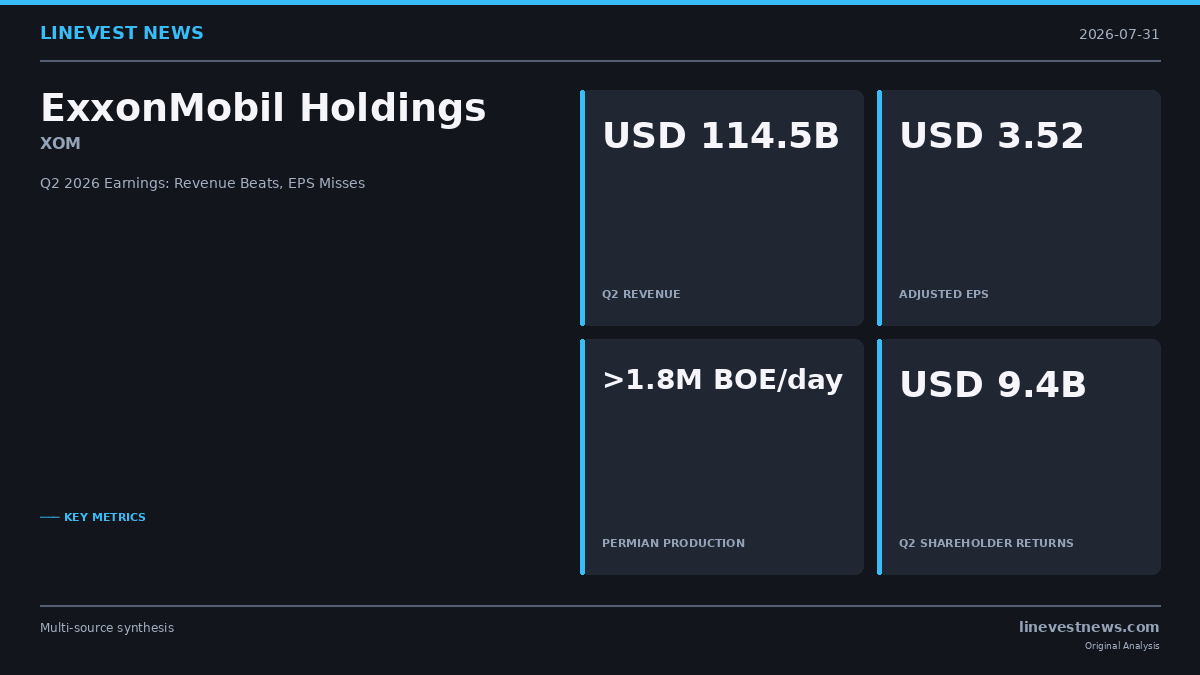
ExxonMobil Holdings Corp (NYSE: XOM) on July 31, 2026, reported second-quarter earnings that told two stories at once: a record-breaking top line and a profit figure that fell short of what analysts had expected. Revenue of USD 114.5 billion dramatically exceeded consensus estimates, yet adjusted earnings of USD 14.7 billion — though the highest quarterly profit in four years — came in roughly USD 1 billion below the USD 15.7 billion Wall Street had penciled in. Compressed downstream margins, softening chemical spreads, and cooling crude prices after an oil-price spike eroded the benefit of record upstream volumes.
TL;DR - Q2 2026 sales and operating revenue: USD 114.5 billion (vs. ~USD 95.8–98.4B consensus) - Adjusted earnings: USD 14.7 billion; adjusted EPS USD 3.52 (consensus USD 3.68–3.87) — miss - GAAP earnings: USD 14.5 billion; GAAP EPS USD 3.48 - Permian Basin production: >1.8 million BOE/day — record - Q2 shareholder returns: USD 9.4 billion (USD 4.3B dividends + USD 5.1B buybacks) - Q3 dividend declared at USD 1.03/share - XOM pre-market: -2.82% to USD 152.55 following the earnings miss
Part A — What the 8-K Said
Revenue and Earnings
ExxonMobil's 8-K (Item 2.02, filed July 31, 2026; SEC accession 0002115436-26-000006) shows Q2 2026 total revenues and other income of USD 116.0 billion, of which sales and operating revenue were USD 114.5 billion. That number blew past the highest pre-earnings estimate on Wall Street (~USD 98.4 billion), driven by an average Brent crude price of approximately USD 96.68 per barrel in Q2 — up 23% sequentially as U.S.-Iran geopolitical tensions briefly pushed Brent above USD 100.
Despite the top-line strength, adjusted net income of USD 14.7 billion (adjusted EPS USD 3.52) missed the sell-side consensus of approximately USD 15.7 billion. GAAP net income was USD 14.5 billion (GAAP EPS USD 3.48). ExxonMobil described this as "the biggest quarterly profit in four years," yet the market focused on the shortfall versus expectations.
| Metric | Q2 2026 Actual | Consensus Estimate |
|---|---|---|
| Sales and Operating Revenue | USD 114.5B | USD 95.8–98.4B |
| Adjusted Earnings | USD 14.7B | ~USD 15.7B |
| Adjusted EPS | USD 3.52 | USD 3.63–3.87 |
| GAAP EPS | USD 3.48 | — |
Production
Oil-equivalent production reached 4,514 thousand BOE/day in Q2 2026, reflecting continued ramp-up from the 2024 Pioneer Natural Resources integration. Crude oil and liquids output was 3,373 thousand barrels/day; natural gas averaged 6,849 MMcf/day. The Permian Basin surpassed 1.8 million BOE/day in Q2, marking a new quarterly record and on track for the company's 9% annual CAGR target through 2030.
Worldwide refinery throughput stood at 3,562 thousand barrels/day. Downstream (Energy Products) volumes totaled 5,664 thousand barrels/day, with the company citing record Q2 diesel production.
Cash Flow and Capital Allocation
Q2 operating cash flow was USD 23.6 billion, with cash capex of USD 6.8 billion, implying an approximate quarterly free cash flow of USD 16.8 billion. On a first-half basis, operating cash flow totaled USD 32.3 billion against capex of USD 13.0 billion, yielding H1 2026 free cash flow of USD 19.9 billion.
ExxonMobil returned USD 9.4 billion to shareholders in the quarter — USD 4.3 billion in dividends and USD 5.1 billion in share repurchases. The company declared a Q3 dividend of USD 1.03 per share.
Cumulative structural cost savings since 2019 reached USD 16.3 billion, underscoring the multi-year efficiency program that has widened margins independent of commodity price swings.
CEO Commentary
"The second quarter was shaped by disruption, but defined by execution... ExxonMobil is not built for one market, one quarter, or one set of conditions. It is built to lead as markets evolve."
— Darren Woods, Chairman & CEO
Part B — Market and Investor Implications
Why Revenue Beat but Earnings Missed
The roughly USD 1 billion earnings shortfall against a backdrop of record revenue is primarily attributable to downstream margin compression. Brent's sharp spike above USD 100/barrel in April and May initially boosted crude price realizations; however, the same price surge widened the cost disadvantage in refining and chemical feedstocks, squeezing margins in the Energy Products and Chemical Products segments. When ceasefire developments eased geopolitical tensions in late June and crude retreated toward USD 85/barrel, timing effects on inventory hedges worked against downstream profitability.
Chemical Products GAAP earnings of USD 1.2 billion in Q2 reflect narrowing global petrochemical spreads. Specialty Products held steadier at USD 1.6 billion in segment GAAP earnings, supported by the company's ongoing shift toward higher-margin, differentiated products. The divergence between these two downstream segments is a signal that ExxonMobil's specialty pivot is progressing, even as commodity-grade chemical spreads remain under pressure.
Upstream Strength Is the Real Story
Strip away downstream noise and ExxonMobil's upstream engine is running at near-peak efficiency. H1 2026 adjusted earnings of USD 23.5 billion are up 61% year-over-year from USD 14.6 billion in H1 2025 — the fastest half-year earnings growth since the Pioneer acquisition closed. That pace of growth, driven by Pioneer volumes, Permian scale, and elevated Brent, demonstrates the structural uplift from what management calls "advantaged assets."
The >1.8 million BOE/day Permian production milestone validates the economics of the Pioneer deal and ExxonMobil's bet that large-scale, low-breakeven Permian acreage would generate superior returns across price cycles. With a 9% CAGR target through 2030, the Permian basin alone is set to add meaningful incremental volumes each year, regardless of short-term oil price fluctuations.
The fifth Guyana FPSO (Floating Production, Storage and Offloading vessel) is expected to begin production in Q4 2026, adding capacity of approximately 250 thousand barrels/day and representing another leg of low-cost, high-margin upstream growth.
Shareholder Returns — A Key Signal to Income Investors
The Q2 shareholder return of USD 9.4 billion, combined with the Q3 dividend of USD 1.03/share, maintains ExxonMobil's identity as a premier energy income stock. At the prevailing share price of ~USD 157, the annualized dividend of ~USD 4.12 implies a yield of approximately 2.6%, backed by a forward P/E of 12.6x.
The USD 16.3 billion cumulative cost savings since 2019 are critical to this story: they mean ExxonMobil can sustain its dividend and buyback program at lower oil price points than pre-transformation levels. Management has repeatedly emphasized that the shareholder return program is funded out of structural cash flows, not commodity-price windfalls alone — a claim this quarter's USD 16.8 billion quarterly free cash flow broadly supports.
Stock Reaction and Analyst Landscape
XOM closed July 31 at USD 156.97 (+0.14%) as markets initially digested the record revenue. However, pre-market trading indicated USD 152.55 (-2.82%) as investors absorbed the EPS miss against elevated expectations. The market's reaction reflects a risk-reward recalibration: the stock had already surged approximately +14.9% over the prior 30 days (from USD 136.54 on June 26 to USD 156.94 on July 24) on the back of Iran-tension-driven oil prices, and the earnings report confirmed that peak-oil-price margins did not fully materialize in the bottom line.
Wall Street's 25-analyst consensus remains Buy with an average price target of USD 167.23, representing approximately 6.5% upside from the July 31 close. Bank of America recently downgraded the stock to Neutral with a USD 158 price target, citing limited near-term upside after the recent run.
The key tension for investors is whether the June-July oil price spike was cyclical noise or the start of a sustained higher-oil-price environment. If Brent stabilizes above USD 85–90, ExxonMobil's full-year earnings picture could still significantly exceed 2025 levels. If crude retreats to the USD 70–75 range — a scenario some macro bears have flagged — downstream margin recovery may be insufficient to offset upstream price-realization headwinds.
What to Watch in Q3 2026
| Watch Item | Significance |
|---|---|
| Guyana FPSO startup (Q4 2026) | +250 Kbd — Q3 is last quarter before this capacity step-change |
| Downstream margin recovery | Petrochemical spread widening is the single largest earnings swing factor |
| Brent crude trajectory | Q2 avg USD 96.68 vs. current ~USD 85 — meaningful H2 realization risk |
| Pioneer synergy realization | Additional cost and production efficiencies targeted through 2026 |
| Structural cost savings pace | USD 16.3B cumulative through Q2; full-year 2026 target update expected |
The data in this article is sourced directly from ExxonMobil's 8-K filing (SEC accession 0002115436-26-000006, Item 2.02, July 31, 2026) and investor.exxonmobil.com. This article is for informational purposes only and does not constitute investment advice. LineVest News is an independent financial publication and is not affiliated with ExxonMobil Holdings Corp.
Sources: - ExxonMobil 8-K Press Release (SEC EDGAR) - ExxonMobil Investor Data Summary (SEC EDGAR) - ExxonMobil Earnings Page - StockAnalysis — XOM Overview - Motley Fool — XOM Q2 2026 Preview