Part A — What SK Hynix Reported
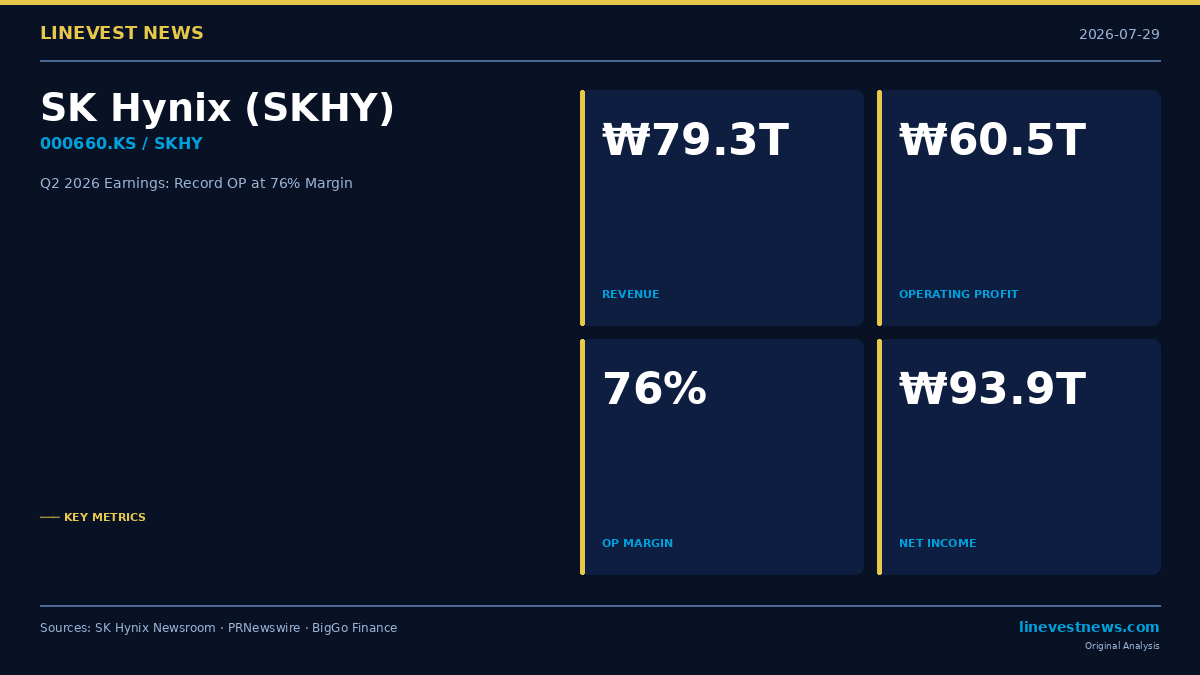
SK Hynix (KRX: 000660.KS / Nasdaq: SKHY) reported its strongest-ever quarterly results on July 29, 2026, driven by relentless AI server memory demand and a structural shortage of high-bandwidth memory.
| Metric | Q2 2026 | Q1 2026 | Q2 2025 | YoY |
|---|---|---|---|---|
| Revenue | KRW 79.32T (USD 54.3B) | KRW 52.58T | KRW 22.23T | +257% |
| Operating Profit | KRW 60.54T (USD 41.5B) | KRW 37.61T | KRW 9.21T | +557% |
| OP Margin | 76% | 72% | 41% | +35pp |
| Net Income | KRW 93.92T | KRW 27.78T | — | — |
H1 2026 milestone: Combined first-half revenue exceeded KRW 100 trillion for the first time in the company's history.
Product Highlights
- DRAM: Average selling prices rose approximately 30% quarter-on-quarter, driven by AI server DRAM and HBM allocation premiums.
- NAND: ASPs increased mid-50% QoQ. Enterprise SSD revenue doubled; Solidigm high-capacity SSD revenue tripled.
- HBM4: Mass shipments commenced in Q2 2026, achieving customer-required operating speeds with industry-leading power efficiency. Yields are approaching mature HBM3E levels. HBM4E samples shipped; volume production targeted for 2027.
- NAND technology: 321-layer products now represent the largest production share; 50% domestic capacity target by year-end. Shipments of 10nm-class 6th-generation (1c) NAND process began.
Balance Sheet
Net cash reached KRW 69.4 trillion (approximately USD 47.5B), up KRW 33.6T from Q1. Gross debt stands at KRW 18.6T. CFO Kim Woo-hyun confirmed a shareholder-return program will be communicated "within the year once finalized."
Net Income Note
Net income of KRW 93.9T substantially exceeds operating profit of KRW 60.5T. The gap reflects approximately KRW 33.4T in non-operating gains — primarily mark-to-market revaluation of SK Hynix's 14% stake in Kioxia Holdings (TYO: 285A), which has surged over 4,800% since its December 2024 IPO. Investors should evaluate core performance on operating profit.
Part B — Analysis: Record Results, Falling Stock
The Consensus-Miss Paradox
SKHY closed at USD 130.17, down 8.98%, and SK Hynix's Seoul shares fell over 9% to approximately KRW 1.407 million — despite a 557% operating profit surge. Sell-side consensus had modeled operating profit of KRW 64.1T and revenue of KRW 84.1T. Actual results missed both by roughly 5-6%.
Three factors explain the shortfall:
1. Product mix concentration. SK Hynix's revenue base is heavily weighted toward HBM and AI server DRAM, where pricing power is structural but growth is measured. The largest incremental price gains this cycle came in commodity DRAM and NAND — segments where Samsung and Micron carry larger allocations. HBM concentration captures supernormal AI-facing pricing but misses the full commodity rebound amplifier.
2. Conservative Q3 guidance. Management guided DRAM bit shipments approximately +10% sequentially and NAND +low single digits — both below consensus assumptions. Full-year DRAM demand growth: mid-20% YoY. NAND: high-teens YoY.
3. No shareholder return announcement. With KRW 69.4T in net cash, investors expected a buyback or special dividend. CFO Kim's "within the year" language disappointed those expecting July clarity.
The Long-Term Bull Case
Barclays initiated coverage with an Overweight rating and USD 330 price target (approximately 153% upside), citing worsening supply tightness expected to intensify through 2027.
Song Hyeon-jong, president of SK Hynix's Corporate Center, rebutted AI-slowdown concerns: "We view these developments not as a sign of AI investment slowdown, but more as a transition toward higher utilization of infrastructure." Kim Ki-tae, head of HBM sales, cited "time-to-market, product performance, mass production yield, quality, and customer trust" as durable differentiators — implicitly contrasting with Samsung's ongoing HBM4 yield challenges.
Long-term supply agreements have been finalized with approximately 10 key customers, signaling revenue visibility extending to 2027-2028.
SKHY Valuation Snapshot
| Metric | Value |
|---|---|
| SKHY Price (7/29 close) | USD 130.17 |
| SKHY IPO Price (7/10) | USD 149.00 |
| Seoul share implied ADS parity | USD 96.4 |
| SKHY premium vs. Seoul parity | ~35% |
| 37-analyst Seoul consensus target | KRW 3.41M = USD 233/ADS |
| 3 US-focused analyst avg. target | USD 281.67 |
SKHY now trades below its July 10 IPO price of USD 149. The stock opened at USD 170 on day one (+14%), compressed during the mid-July KOSPI sell-off, briefly recovered, and has now broken below the IPO floor again.
Key Risks
- HBM4E timeline: Volume production targeted for 2027. Any delay would pressure forward margin estimates.
- Conventional memory demand: Management noted smartphone and PC sales "temporarily adjusted" due to memory-volume constraints. If end-demand rather than supply allocation is the driver, the NAND Q3 low-single-digit bit guide signals structural softness.
- Kioxia mark-to-market: The 14% Kioxia stake introduces quarterly P&L volatility. A Kioxia correction would reverse Q2's approximately KRW 33.4T non-operating boost.
- CapEx escalation: Full-year capex raised to the high KRW 40T range (approximately USD 27-28B). Necessary for HBM4 leadership but constrains free cash flow into 2027.
- Shareholder return timing: Any buyback or dividend announcement — when it arrives — could be a significant positive catalyst.
Next Catalysts
- Samsung Electronics full Q2 segment results (July 30): DS Division HBM4 yield progress — the direct competitive read-across.
- Nvidia Q2 FY2027 earnings (August 27): HBM4 supply-allocation pace and Blackwell Ultra ramp.
- SK Hynix H2 capital decisions: M17 NAND facility and P&T7 advanced packaging timelines.
Sources: SK Hynix Newsroom · PRNewswire · BigGo Finance · Seoul Economic Daily · TradingKey
This article is for informational purposes only and does not constitute investment advice.