Hyundai Motor Takes 100% Control of Boston Dynamics for $325M as SoftBank Exits — 25,000 Atlas Robots Cleared for Korean and U.S. Plants by 2028
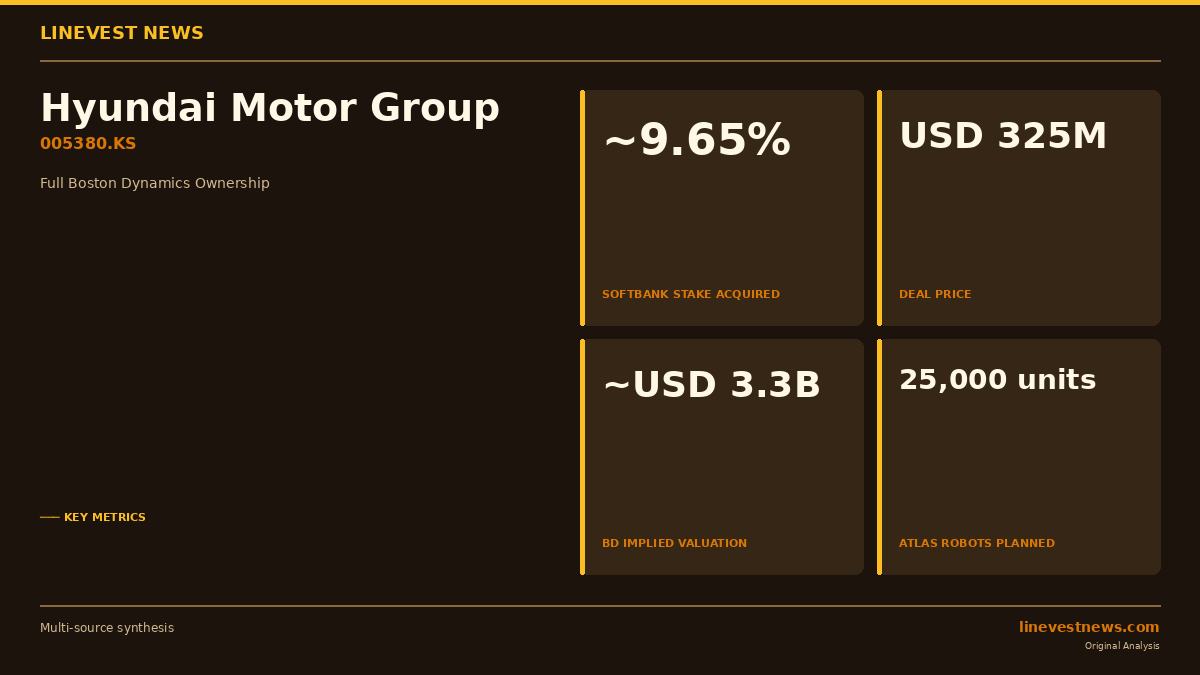
TL;DR - Hyundai Motor Group agreed on July 16 to buy SoftBank's remaining ~9.65% stake in Boston Dynamics for $325 million, making the U.S. robotics pioneer a wholly owned subsidiary. - The deal implies Boston Dynamics at roughly $3.3 billion — the same valuation Hyundai paid in 2021 and unchanged despite the global AI boom. - Hyundai plans to deploy 25,000 Atlas humanoid robots across its and Kia's factories, starting at Hyundai Motor Group Metaplant America (HMGMA) in Georgia by 2028. - The buyout came one day after Hyundai's South Korean workers ended a three-day partial strike that cited AI-automation job fears — a tension that now frames the company's full ownership of the robot they feared.
Part A: The Deal
SoftBank's Put Option Comes Due
Under the terms of the original 2021 acquisition agreement, SoftBank Group retained a contractual put option that allowed it to sell its remaining stake back to Hyundai if Boston Dynamics remained a private company through 2026. With no IPO in sight, SoftBank exercised that option, and the two parties agreed on a purchase price of approximately $325 million for SoftBank's roughly 9.65% holding.
The transaction values Boston Dynamics at approximately $3.3 billion on a fully diluted basis — consistent with the valuation embedded in the original deal, when Hyundai paid roughly $921 million to $1.1 billion for an 80% controlling interest in the Cambridge, Massachusetts-based company. Subsequent capital increases diluted SoftBank's holding to around 10%.
Hyundai Motor Group Executive Chairman Chung Euisun also held a personal equity stake in the 2021 deal, part of a governance restructuring arrangement. Boston Dynamics will now sit as a wholly owned subsidiary under Hyundai Motor Group's umbrella.
Deal Snapshot
| Item | Detail |
|---|---|
| Seller | SoftBank Group Corp. |
| Stake acquired | ~9.65% |
| Price | ~$325 million |
| Boston Dynamics implied valuation | ~$3.3 billion |
| Hyundai's ownership post-deal | 100% |
| Announcement date | July 16, 2026 |
| Advisors | Not publicly disclosed |
Part B: Korea Market Analysis — Why Full Ownership Matters Now
Atlas Economics: From the Factory Floor Up
Full ownership removes any governance friction and accelerates Boston Dynamics' integration into Hyundai Motor Group's manufacturing operations. The numbers are striking.
Atlas unit economics (current phase):
| Metric | Value |
|---|---|
| Production cost (early mass production) | ~$130,000–$140,000 per unit |
| Projected cost at scale (>50,000 cumulative) | ~$30,000 per unit |
| Customer price target | Below $320,000 (≈ 2 years U.S. manufacturing payroll) |
| Payback period for buyer | ~2 years through labor savings |
| Specs | 6'2", 198 lbs, 4-hour battery, 110 lb lift capacity |
Hyundai Motor Group's target is to manufacture up to 30,000 Atlas units per year by 2028, with a new robotics production complex being built as part of the group's $26 billion U.S. investment commitment. Of those 30,000 units, 83% — roughly 25,000 robots — are earmarked for deployment across Hyundai's and Kia's own plants.
The deployment roadmap: - 2028: HMGMA in Bryan County, Georgia — initial tasks: parts sequencing - 2029: Kia's Georgia plant - 2030+: Component assembly and broader factory integration
The Labor Paradox
The timing of the acquisition is politically charged. On July 13–15, Hyundai's South Korean workers staged a partial three-day strike — four-hour work stoppages per shift — demanding a ₩149,600 per month ($108) base pay increase against management's ₩89,000 ($65) counter. One of the union's explicit concerns was AI-driven automation displacing hourly workers.
Hyundai announced full ownership of Boston Dynamics the following day, July 16.
The union's response has been to pivot: rather than blocking robots outright, workers are now negotiating a structural shift "from an hourly pay model to a fixed salary for production workers, so they can still earn a living wage even if automation trims their hours." This transition — from time-based to output-based compensation — is a significant shift for one of Korea's most powerful industrial unions, and the outcome of those negotiations will determine how quickly Atlas reaches Korean factory floors.
Why $3.3 Billion in the AI Era?
A $3.3 billion valuation for Boston Dynamics in mid-2026 might appear conservative. Humanoid robotics startups — Figure AI, Physical Intelligence (Pi), 1X Technologies — have raised at multiples far higher on much thinner revenue bases. Yet Hyundai and SoftBank were contractually bound to the 2021 put-option strike price, insulating the deal from market euphoria.
From Hyundai Motor's perspective, this is a significant below-market asset lock-in: Boston Dynamics possesses proprietary locomotion algorithms, Physical AI capabilities, and manufacturing know-how that no Korean company — and almost no global automaker — can replicate. For an automaker undergoing a structural transformation from traditional vehicles to smart mobility and robotics, paying the 2021 price in 2026 is, in effect, a discount.
Investment Angle for KOSPI Investors
For holders of Hyundai Motor (005380.KS) and Kia (000270.KS), the acquisition signals three things:
Capital allocation clarity: At $325 million, the deal is modest relative to Hyundai Motor Group's scale. It removes overhang from the unresolved SoftBank put option and gives management a clean slate to pursue potential Boston Dynamics monetization — including an eventual IPO.
Margin evolution: Near-term, robotics integration adds CapEx. Longer term, Atlas deployment at a $130K–$140K cost for a unit that can generate $160K+ in annual labor savings per shift could structurally improve manufacturing margins — particularly at U.S. plants where labor costs are significantly higher than Korea.
Governance watch: With 100% ownership, Hyundai retains all upside from any future Boston Dynamics monetization events. If the group eventually pursues a public listing for Boston Dynamics — as has been speculated — Hyundai's equity holders would be the direct beneficiaries.
For comparison, Tesla's robotics ambitions (Optimus) remain at prototype stage with no commercial timeline, while Hyundai Motor already has committed factory deployment scheduled for 2028 at its own U.S. facility — a head start measured in years, not quarters.
Hyundai Motor (005380.KS) and Kia (000270.KS) shares were not traded on July 17 due to Constitution Day and markets were closed July 18-19 for the weekend. The full market reaction to the announcement will be visible when KRX reopens on Monday, July 21.
This article is for informational purposes only and does not constitute investment advice. LineVest News is an independent financial publication and is not affiliated with any brokerage.
Sources: Bloomberg · KED Global · Korea Herald · Korea JoongAng Daily · Tech Times · Carscoops