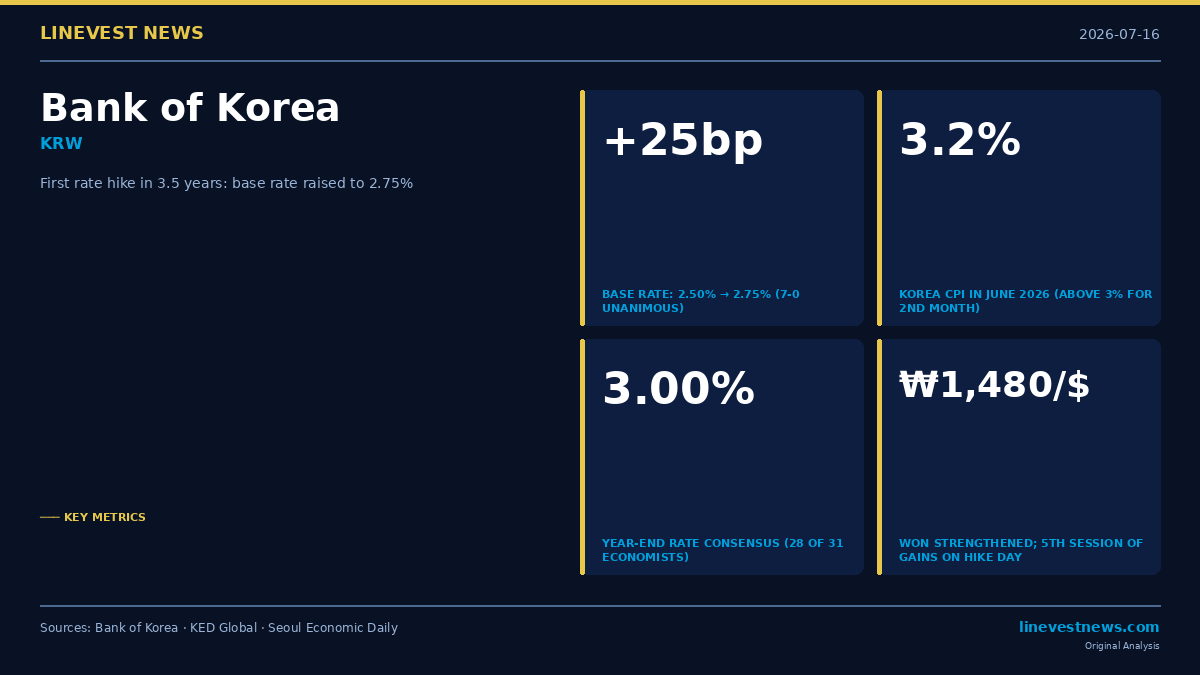
TL;DR - BoK raised the base rate 25bp to 2.75% on July 16 — first hike in 3.5 years, unanimous 7-0 vote - New Governor Hyun Song Shin (ex-BIS head of research) signaled further hikes "until confident" CPI converges toward 2% - October hike widely expected; 28 of 31 economists surveyed see benchmark at 3.00% by year-end - Won strengthened to ₩1,480/$; bank stocks (Shinhan +6%, KB +4%) rallied while KOSPI fell 6.4% on semiconductor fears
Part A: The Decision
What Was Decided
The Bank of Korea's Monetary Policy Board on July 16 unanimously raised the base rate by 25 basis points from 2.50% to 2.75%, ending a 14-month hold that began after a rate cut in May 2025. It was the first rate increase since January 2023 — a 3.5-year gap.
Governor Shin's First Major Call
The decision was the first monetary policy vote under Hyun Song Shin (신현송), who took office on April 21, 2026. Before becoming BoK Governor, Shin spent more than a decade at the Bank for International Settlements as Economic Adviser and Head of Research, and held the Hughes-Rogers Professorship of Economics at Princeton University. He is known for his academic work on global financial cycles and risk-taking in banking.
At the post-decision press conference, Shin stated: "We will continue to respond with monetary policy until we are confident that inflation is converging sustainably toward our target." He added that "all of our upcoming policy meetings are live meetings," explicitly refusing to rule out any future date.
Economic Backdrop
| Indicator | Latest Reading | Prior | BoK's Forecast |
|---|---|---|---|
| CPI (YoY) | 3.2% (Jun 2026) | 3.1% (May) | 2.7% FY2026 |
| Core CPI (ex food & energy) | 2.5% (Jun) | — | Revised above 2.4% |
| GDP growth | Considerably above forecast | — | Beats May's 2.6% |
Three factors pushed the board to act unanimously:
- Inflation above target for two consecutive months — CPI hit 3.2% in June after 3.1% in May, both above the 2.0% target. Core CPI at 2.5% indicates the pressure is broad-based.
- Stronger-than-expected growth — Korea's chip-driven export momentum accelerated into June, reaching levels the BoK described as exceeding prior projections. The board said full-year 2026 growth will "considerably exceed" the May forecast of 2.6%.
- Household lending acceleration — Household loans are expanding at ₩8–9 trillion per month, a pace the board flagged as a financial stability concern.
The US–Korea policy rate gap also narrowed to 100 basis points (Fed: 3.75%, BoK: 2.75%) — its tightest level in 3.5 years — easing the capital outflow pressure that had weighed on the won.
Part B: Market Reaction and What It Means for Investors
Immediate Moves on July 16
| Asset | July 16 Change | Driver |
|---|---|---|
| USD/KRW | ₩1,480.4 (won strengthened ~4 won vs. prior session) | Hawkish BoK; 5th straight session of won gains |
| KOSPI | −6.4% | Semiconductor selloff on AI-capex fears |
| Shinhan Financial (055550.KS) | +6% | NIM expansion expectations |
| KB Financial (105560.KS) | +4% | NIM expansion expectations |
Crucially, the KOSPI's 6.4% session drop was driven by semiconductor fears — SK Hynix (000660.KS) had sold off sharply in the preceding sessions on AI capex slowdown concerns — not by the rate hike itself. In fact, bank stocks bucked the broader selloff precisely because higher rates directly widen their net interest margins.
The Rate Path: October Is the Consensus
A survey of 31 economists compiled before the July 16 decision found 28 of 31 forecasting a year-end rate of 3.00%, implying at least one more 25bp move. The October 16 Monetary Policy Board meeting is the consensus anchor for that next hike.
| Meeting | Expected Rate | Move |
|---|---|---|
| Jul 16, 2026 (done) | 2.75% | +25bp |
| Oct 16, 2026 (est.) | 3.00% | +25bp |
| FY2026 year-end | 3.00% | — |
| H1 2027 (est.) | 3.25% | +25bp |
Why October rather than sooner? The BoK will have two more months of CPI data (July, August), an updated GDP forecast (due August), and US Federal Reserve guidance from Jackson Hole before making its next call. If CPI stays above 3% through August and household credit growth remains at ₩8–9T/month, the board is unlikely to hesitate.
What Rate Hikes Mean for Korean Bank Stocks
Each 25bp increase in the base rate mechanically reprices variable-rate loans in Korea, expanding lenders' net interest margins within 1–2 quarters:
- KB Financial (105560.KS) — Group NIM stood at 1.99% in Q1 2026. Management has guided that each 25bp hike adds approximately ₩180–200 billion to annual net interest income on a full-year basis.
- Shinhan Financial (055550.KS) — Group NIM at 1.93% in Q1 2026; bank-only NIM at 1.60%.
- Hana Financial (086790.KS) — Group NIM at 1.82% in Q1 2026.
Non-bank subsidiaries (insurance arms, credit card units) also benefit through floating-rate asset repricing. The rate hike cycle is a structural tailwind for Korean financials that was absent during the 2023–2025 easing period.
Won Dynamics and FX Implication
The won's five-session winning streak into the July 16 decision reflected markets pricing the tightening cycle ahead of the announcement. At ₩1,480/$, the won is recovering from the ₩1,500+ levels seen during the SK Hynix shock week (July 14–15). If the October hike narrows the US–Korea gap to 75bp, KTB (Korean Treasury Bond) yields become more competitive for global fixed-income investors, supporting further won appreciation.
For USD-based investors holding Korean equities: a stronger won at ₩1,480 vs. ₩1,500 represents approximately a 1.35% FX tailwind on a fully unhedged position. If the won moves toward ₩1,400 by year-end (as some strategists project), the cumulative FX gain could offset a portion of KOSPI underperformance.
Household Debt: The Risk to Watch
The BoK's own data showing ₩8–9 trillion in monthly household loan growth cuts both ways. Higher rates are intended to cool this borrowing, but the near-term effect is higher debt service costs for existing variable-rate mortgages. Korea's household debt-to-GDP ratio is among the highest in the OECD. If debt service ratios deteriorate sharply as rates approach 3%, the BoK may slow the pace of hikes in 2027 to avoid a consumer spending contraction.
Investor Playbook
- Korean bank stocks (KB Financial, Shinhan, Hana) remain constructive heading into the October meeting as NIM repricing continues through H2.
- KTB (Korean Treasury Bonds) — short-end yields will reprice toward 2.75–3.00%; longer tenors may steepen if growth outperforms.
- Won-sensitive equities — exporters (Samsung, Hyundai Motor) face mild FX headwinds if won strengthens further, while import-dependent firms benefit.
- Consumer discretionary and highly-leveraged names — watch for margin compression as household borrowing costs rise through H2 2026 into H1 2027.
Sources
- Bank of Korea: Monetary Policy Decision Statement (July 16, 2026)
- Korea JoongAng Daily: BoK signals further rate hikes after first increase in 3.5 years
- Seoul Economic Daily: BoK Governor vows rate hikes until 2% inflation confidence
- KED Global: BoK seen raising in July, with another move in October (survey)
- CNBC: Bank of Korea raises rates to 2.75% in first hike in over three years
- Kyunghyang Shinmun: Rate gap with US narrows to 1 percentage point for first time in 3.5 years
This article is for informational and educational purposes only and does not constitute investment advice. LineVest News is an independent financial news publication and is not a registered investment adviser.