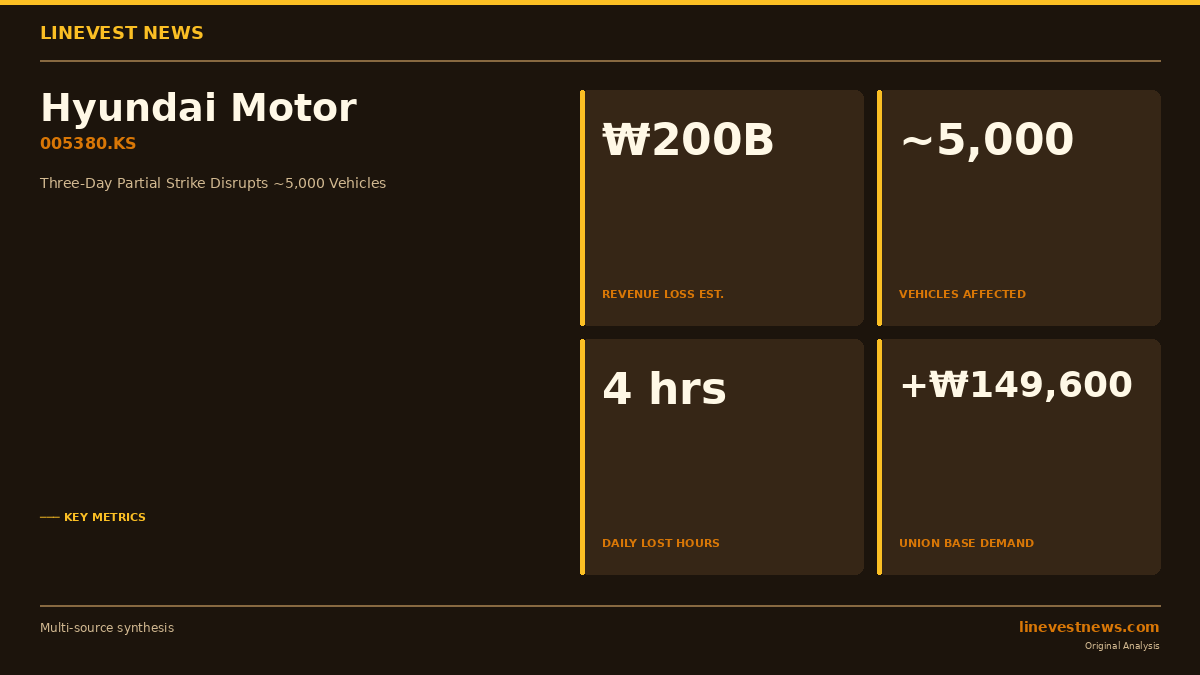
TL;DR - Hyundai Motor's union began a three-day partial walkout on July 13 after 15 rounds of wage talks collapsed - Workers cut shifts short by two hours each, totaling ~4 hours of lost production per day; ~5,000 vehicles affected - Estimated ₩200 billion (≈USD 140M) revenue impact from the three-day action - Gap: union demands ₩149,600/month base increase vs. management's ₩89,000 offer - AI-driven automation — Atlas humanoid robots at U.S. plants in 2028 — is fueling structural job-security anxiety
Part A: What Happened
Hyundai Motor Company (005380.KS), South Korea's largest automaker, saw its union workers launch a three-day partial strike on July 13, 2026 — the second consecutive year the Korea Metal Workers' Union Hyundai Motor Chapter has taken industrial action during the annual wage round.
Workers are leaving two hours early per shift (day and night), cutting total daily production time by roughly four hours. The Asia Business Daily estimates ~5,000 vehicles will be disrupted and the company could lose around ₩200 billion (≈USD 140 million) in revenue over the three days — a figure that compares to ₩300 billion lost during 16 hours of stoppages in 2025.
Critically, production disruption began before the formal walkout: the union refused weekday overtime and Saturday shifts starting July 6, compressing effective output ahead of the July 13 escalation.
Negotiating positions (as of 15th round of talks, July 8)
| Item | Union Demand | Management 3rd Offer |
|---|---|---|
| Monthly base salary increase | ₩149,600 | ₩89,000 |
| Performance bonus | 30% of prior-year net profit | 350% of monthly base + ₩10M |
| Additional bonus | 800% | — |
| Company shares | — | 15 shares |
| Retirement age | Extension requested | Not agreed |
| Dismissed workers | Reinstatement | Not agreed |
Management cited H1 2026 earnings weakness and a prior-year decline in operating profit in resisting the union's demands.
Part B: Market and Investment Implications
Production Losses — Cumulative Risk
The three-day partial walkout headline masks a longer disruption window. Between July 6 (overtime/Saturday refusal) and July 15, Hyundai will have lost multiple shifts of incremental output. The Asia Business Daily's ₩200 billion figure covers July 13–15 only; actual cumulative losses are larger.
For context, Hyundai Motor's consolidated revenue runs at approximately ₩43–45 trillion per quarter. ₩200 billion over three days represents roughly 0.5% of quarterly revenue — material but not catastrophic. The bigger risk is escalation.
H2 2026 Launch Window at Risk
The timing raises more concern than the quantum. Hyundai has staked its domestic market recovery on a series of high-profile H2 2026 launches: the Genesis GV90 (its first three-row full-size electric SUV), a redesigned Avante, and a next-generation Tucson. All three are intended to reverse a sharp domestic sales decline in H1 2026.
If the union votes for expanded action after the three-day walkout ends Wednesday (July 15) — as it has signaled — Hyundai faces a genuine production scheduling risk heading into the August–September ramp-up window for those models. A multi-week campaign, similar to tactics used in prior years, could delay deliveries and undermine the H2 recovery thesis management has been signaling to investors.
AI and Automation: The Structural Subtext
Beyond wages, the union's demands around retirement age extension and reinstatement of dismissed workers signal a broader anxiety: Hyundai Motor confirmed plans to deploy Boston Dynamics' Atlas humanoid robots at its U.S. manufacturing facilities starting in 2028. While no equivalent announcement has been made for Korean plants, analysts widely expect automation to move into domestic factories over the same horizon.
This puts the 2026 wage round in a structurally different category than past cycles. Korean manufacturing unions are increasingly treating annual wage talks as a proxy battle over long-term headcount protection — a dynamic that makes settlements harder to reach quickly and could widen the demand-offer gap in future years.
What Investors Should Watch
- July 15 (Wednesday): Union leadership votes on whether to expand, continue, or end industrial action. A "no escalation" outcome would be a near-term relief signal; a vote for additional action is the key risk event.
- Q2 2026 earnings: Hyundai Motor is expected to report Q2 results in coming weeks. H2 guidance against the labor backdrop will be closely watched.
- Supply chain read-through: Strikes at Hyundai Motor historically reduce orders across Korean parts suppliers — companies like Hyundai Mobis (012330.KS) and Hyundai Wia (011210.KS) share production exposure.
- OTC ADR (HYMTF): Hyundai Motor trades on U.S. OTC markets as HYMTF; foreign investors will watch for pre-market reaction before the union decision Wednesday.
Hyundai Motor (005380.KS) is a KOSPI top-10 constituent by market capitalization and Korea's largest automotive exporter. Its annual labor negotiations typically set a reference point for wages across Korea's broader auto supply chain.
Sources: - Asia Business Daily — Hyundai Motor Union Launches Strike for Second Consecutive Year - Manila Times — Hyundai Motor Begins Three-Day Strike After Wage Talks Fail - Bloomberg — Hyundai Motor Workers Strike Over Bonuses, AI Job Security - Channels Television — Hyundai Motor Begins Three-Day Strike
This article is for informational purposes only and does not constitute investment advice. LineVest is not a registered investment adviser.
"