TL;DR
- The Bank of Korea's Monetary Policy Board meets Thursday, July 16, with the decision due around 10:00 AM KST (9:00 PM ET Wednesday) and the governor's press conference at about 11:20 AM.
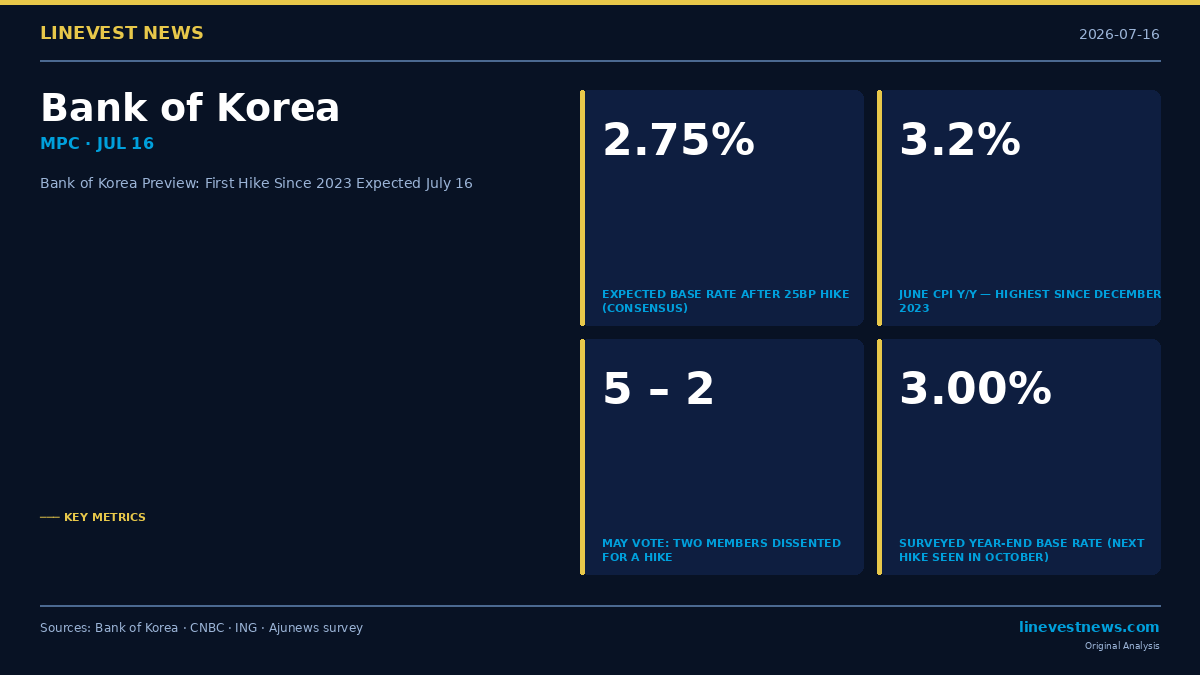
- Consensus expects a 25bp hike, from 2.50% to 2.75% — the first rate move of any kind in 14 months and the first hike since January 2023. Market-implied odds sit near 70%; several forecasters expect a unanimous vote.
- The trigger: June CPI hit 3.2% year-over-year, the highest since December 2023, with a weak won (around ₩1,500 per dollar) feeding import prices.
- Surveyed economists see a follow-up hike in October, putting the base rate at 3.00% by year-end.
What Is Happening
The July 16 meeting arrives with the most hawkish setup Korea has seen in years. At the last decision on May 28, the board held at 2.50% but split 5–2, with two members dissenting in favor of an immediate 25bp hike — the first open hawkish dissent of this cycle. Since then, the case for tightening has only hardened: consumer inflation ran at 3.1% in May and 3.2% in June, a two-and-a-half-year high, and the central bank has raised its own 2026 forecasts to 2.7% inflation and 2.6% GDP growth.
Governor Shin Hyun-song has publicly flagged that a hike is near, and the market has listened. A local survey of analysts found a large majority expecting a 25bp increase on July 16 — many of them projecting a unanimous vote — with BNP Paribas likewise calling for a unanimous hike and a 3.00% base rate by year-end. DBS points to resilient exports and AI-linked investment as evidence the economy can absorb tighter policy.
The historical framing matters for anyone positioning around the event. The BOK cut four times between October 2024 and May 2025, parking the rate at 2.50%, and has held for eight consecutive meetings since. A hike on Thursday would end a 14-month freeze — and would be the first increase since the tightening cycle that peaked at 3.50% in January 2023.
Why Raise Rates with the Won at ₩1,500?
The counterintuitive part — tightening into a currency already at ₩1,500 per dollar — is actually the point. The weak won is importing inflation: fuel, food, and intermediate goods are all pricier in won terms, and that pass-through is what pushed CPI above 3% for two straight months. A hike works on both ends of the problem at once. It cools domestic demand, and it narrows the rate gap with a US Federal Reserve that has stayed on a hawkish hold — reducing the carry incentive that has weighed on the currency.
For foreign investors, the second channel is the interesting one. A BOK that defends the won is, in effect, defending the dollar value of every Korean asset a foreign fund holds. Korea's equity market has run hard this year on the AI trade; the currency has not kept up. If July 16 marks the start of a genuine tightening cycle — October and 3.00% by December, as the consensus now has it — the won leg of the Korea trade starts to matter as much as the equity leg.
Sector Math for Korean Equities
Rate hikes redistribute; they do not punish uniformly. The obvious beneficiaries are banks and insurers: KB Financial, Shinhan, Hana, and the life insurers price loans and reinvest float at higher rates, and net interest margins that compressed through the 2024–25 cutting cycle get their first tailwind in three years. K Bank's latest quarter already showed net interest margin rebounding; a hike extends that runway.
The pressure points are the usual suspects: highly leveraged growth names, construction, and anything priced off long-duration cash flows. Korea's household debt — among the highest in the OECD relative to income — makes consumer-facing lenders and card companies a second-order watch. A 25bp move is small in absolute terms; the signal that the cutting cycle is definitively over is what re-rates these sectors.
One cross-market wrinkle worth tracking: the SK Hynix ADR premium. As we detailed in our SKHY options coverage, the Nasdaq-listed ADR trades roughly 15% above the Seoul line, and that spread is computed through the won. A BOK surprise in either direction moves the currency, and a stronger won mechanically narrows the ADR premium even if neither stock price moves. Thursday is the first macro event the new ADR — and its freshly listed options — will trade through.
What to Watch on Thursday
Three things beyond the headline decision. First, the vote count: a unanimous hike validates the aggressive year-end consensus; a divided one suggests 3.00% by December is not a done deal. Second, the governor's language on October — the survey consensus has the next hike there, and Shin's press conference at 11:20 AM KST will be parsed for confirmation. Third, the won's reaction: if the currency fails to strengthen on a delivered hike, the market is telling you the FX problem is bigger than 25 basis points — and that more tightening, not less, is coming.
A hold, at this point, would be the genuine surprise — roughly a three-in-ten outcome by market pricing — and would likely hit the won, bank stocks, and rate-sensitive positioning hardest precisely because so much of the street has converged on the hike.
Sources: CNBC (May 28 hold, 5–2 split); ING (June CPI 3.2%, forecast upgrades); DBS via FXStreet; 아주경제 survey (unanimous-hike consensus, October follow-up, 3.00% year-end); 글로벌이코노믹 (BNP Paribas call); Bank of Korea (rate history).
This article is journalism, not investment advice. LineVest is not a registered investment adviser.