Part A: Facility Overview
Hyundai Motor Group inaugurated HTWO Energy Cheongju on July 9, 2026 — Korea's first privately operated, waste-to-hydrogen production and refueling complex. The 7,500-square-meter installation sits within a public sewage treatment facility in Cheongju, North Chungcheong Province, and marks the commercial debut of Hyundai's circular-hydrogen model it calls W2H (Waste-to-Hydrogen).
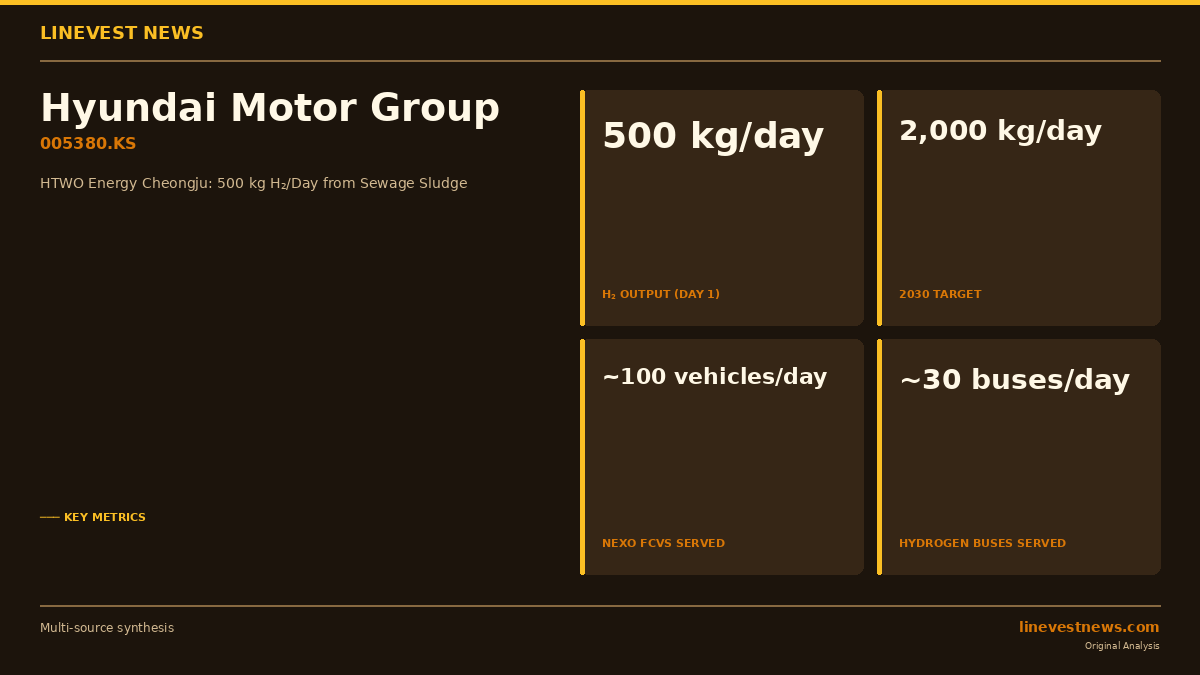
The plant extracts biogas from municipal sewage sludge, upgrades it, and reforms it into compressed hydrogen. As a byproduct, CO₂ is recovered and liquefied on-site rather than vented. Daily output stands at 500 kilograms of hydrogen — enough to refuel roughly 100 Hyundai Nexo fuel-cell passenger vehicles or 30 hydrogen buses. By 2030, Hyundai plans to expand capacity to 2 metric tons per day, a fourfold increase, as demand from the broader regional fleet scales up.
"HTWO Energy Cheongju is an example of a circular economy model that converts local waste into clean hydrogen energy," said Seo Gang-hyun, President of Hyundai Motor Group's Planning and Coordination Division, at Thursday's opening ceremony.
Part B: Market Implications and Investment Angle
Why Sewage Sludge Matters for Hydrogen Economics
Green hydrogen produced via electrolysis from renewable electricity remains expensive — typically USD 4–7 per kilogram in Korea. Waste-to-hydrogen from biogas, by contrast, leverages an input stream that municipalities are obligated to treat anyway, compressing the marginal feedstock cost to near zero. For investors tracking Hyundai Motor's (005380.KS) non-automotive revenue lines, this model represents a structurally lower-cost route to hydrogen supply than either electrolysis or grey hydrogen imports.
Korea's Ministry of Climate, Energy and Environment has endorsed circular hydrogen as a national priority, framing urban sewage facilities as distributed hydrogen hubs that simultaneously advance carbon neutrality and energy security. The government has indicated it will support replication of the Cheongju model at treatment plants nationwide.
HTWO Brand: Hyundai's Hydrogen Infrastructure Play
HTWO — pronounced "H-two" — is Hyundai Motor Group's dedicated hydrogen brand, encompassing fuel-cell systems, mobility applications, and now stationary production and refueling infrastructure. The Cheongju commissioning represents the first time HTWO has operated a production asset end-to-end: from raw feedstock intake through compression, storage, and vehicle dispensing.
Hyundai has two additional domestic projects underway in Chungju and Paju, with similar sewage-sludge feedstocks. Internationally, HTWO Energy is developing hydrogen ecosystem projects in Indonesia and Hong Kong, targeting metropolitan sewage networks in both markets. The international pipeline signals that Hyundai views W2H not merely as a domestic PR effort but as a potentially exportable infrastructure template to densely populated Asian cities that face both waste management and clean-fuel challenges.
Fleet and Logistics Context
The Nexo (Hyundai's FCEV sedan) and hydrogen bus lines are the immediate off-takers. Korea's hydrogen bus fleet — deployed under government subsidy programs — has expanded to several thousand units nationwide, yet refueling infrastructure has lagged vehicle rollout. A locally embedded, sewage-sourced production point addresses a specific pain point: long truck routes from central grey-hydrogen terminals to dispersed urban bus depots. If the Cheongju model proves operationally stable, replication at the roughly 550 public sewage treatment plants across Korea would constitute a meaningful densification of Korea's hydrogen refueling map without requiring new land acquisition.
Stock Context: Hyundai Motor (005380.KS)
Hyundai Motor Group reported combined H1 2026 U.S. sales of 920,383 units (+3% year-over-year), with hybrid penetration reaching 31.2% of the mix. The shares trade near the upper range of a 52-week band that has been supported by record combined margins. The hydrogen infrastructure buildout is unlikely to move near-term earnings given its current scale, but it expands the medium-term revenue narrative beyond light vehicles: HTWO's fuel-cell system business supplies trucking, maritime, and stationary-power customers in addition to passenger vehicles.
Analysts covering the hydrogen segment have previously noted that vertically integrating production and refueling — rather than relying solely on third-party hydrogen suppliers — gives Hyundai tighter control over delivered hydrogen cost and quality, both of which directly affect Nexo's total-cost-of-ownership argument against BEV alternatives.
Sources: Korea Herald · MK Economy · ETNews · Yonhap