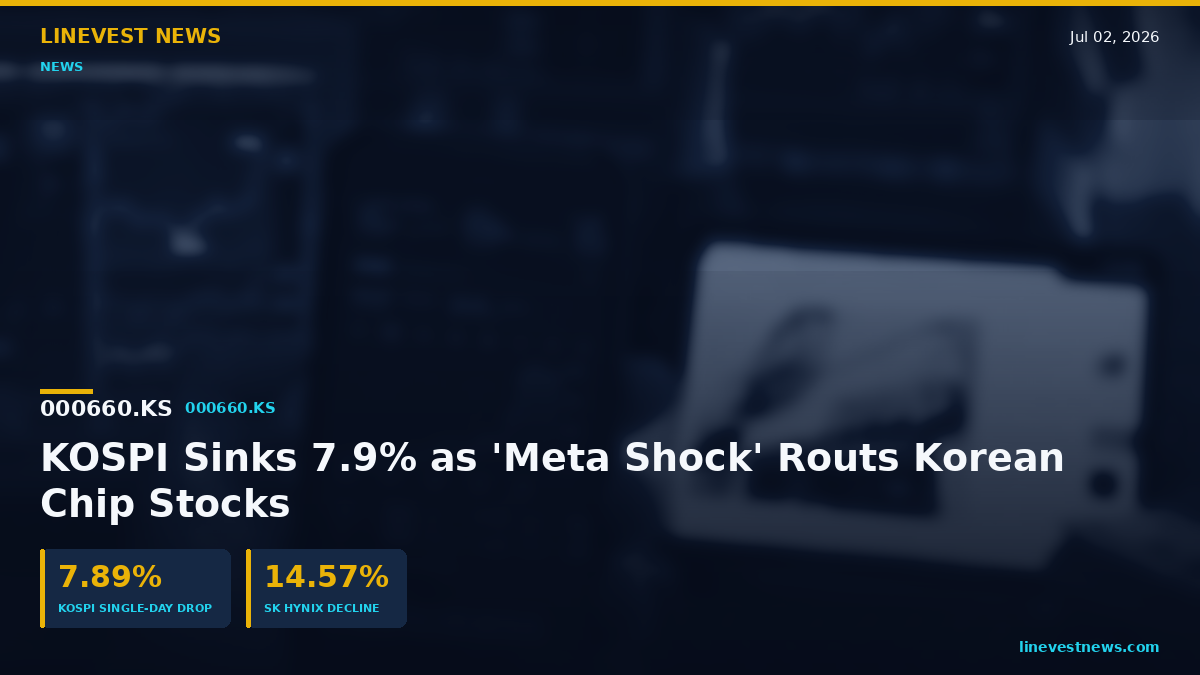
The KOSPI, Korea's benchmark stock index, closed down 655.32 points, or 7.89%, at 7,648.09 on Thursday, July 2, 2026 — a one-day rout that reopened the single question hanging over every AI-exposed portfolio: is this the start of a genuine break in AI hardware demand, or a violent shakeout in an overheated chip rally? The answer will not come from Thursday's tape. It hinges on numbers Korea is about to report.
What broke the market
The trigger was external and specific. After the U.S. close on July 1, media reports said Meta Platforms (META) is preparing a cloud-infrastructure business to sell access to surplus AI computing capacity — dubbed "Meta Compute" in coverage of the plan. Markets read a hyperscaler leasing out spare compute as evidence that AI computing supply may be running ahead of demand, puncturing the "compute-scarcity" narrative that drove memory-chip valuations. The Philadelphia Semiconductor Index (SOX), the benchmark U.S. chip gauge, fell 6.27% overnight (Axios); Meta itself rose about 8.8% (closing at $612.91), as investors welcomed a way to monetize idle infrastructure (BigGo Finance).
Seoul opened into that shock and worsened. The KOSPI began at 7,933.10, already down 4.46%, then breached a 5% intraday drop that tripped a sell-side "sidecar" — a five-minute halt on program-sell orders (Korea JoongAng Daily). The tech-heavy KOSDAQ secondary bourse closed down 62.63 points, or 6.74%, at 866.72, triggering its own sidecar at 12:47 p.m. (Chosun Biz).
Sizing the damage
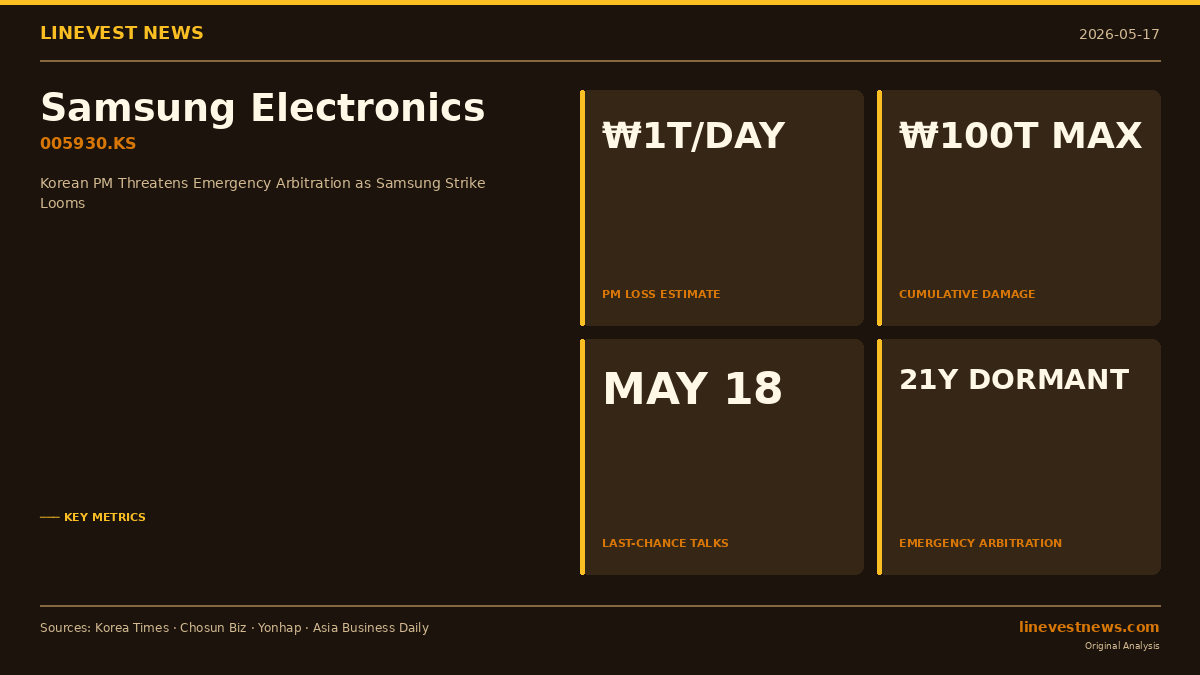
The pain concentrated in the two stocks that dominate the index. Samsung Electronics (005930.KS), the world's largest memory chipmaker, fell 9.06% to ₩286,000 (USD 209). SK Hynix (000660.KS), the leading supplier of high-bandwidth memory (HBM) for AI accelerators, dropped 14.57% to about ₩2.19 million (USD 1,600). SK Square, SK Group's semiconductor investment holding company, and Samsung Electro-Mechanics, Samsung's chip-components affiliate, each fell more than 12% (Seoul Economic Daily).
The selling was foreign-led. On the main board, foreign investors were the dominant net sellers — reported net selling ranged from about ₩4.4 trillion to ₩5.2 trillion (USD 3.2–3.8 billion) depending on the source and cutoff — while institutions also net-sold and retail investors net-bought heavily, enough to blunt the fall but not reverse it (Korea JoongAng Daily; Seoul Economic Daily).
The counter-case
Strategists in Seoul argued the demand read was overdone. Samsung Securities analyst Cho A-in framed Meta's move as raising utilization of existing capacity and easing capex strain — improving cash flow rather than signaling retreat from AI spending. Cho also noted the SOX had climbed about 88% in the second quarter, a record quarterly gain, leaving the sector primed for a sharp technical unwind rather than a fundamental one (Chosun Biz).
History offers a template. The last comparable shock — an 8.77% KOSPI plunge on Aug. 5, 2024, its biggest single-day point loss on record and the exchange's eighth-ever circuit breaker (KED Global) — was driven by U.S. recession fears, and the index rebounded in the sessions that followed.
The number that settles it
The honest answer is that Thursday's move sized fear, not fundamentals. The confirming data point is dated: Samsung Electronics reports preliminary second-quarter earnings on July 7. Daishin Securities analyst Lee Kyoung-min flagged that print as the read on whether demand is actually softening — an above-consensus result would undercut the compute-glut thesis, while a miss would give it teeth (Seoul Economic Daily). Until then, the debate over whether AI capital spending has peaked stays unresolved.
Sources: Chosun Biz · Korea JoongAng Daily · Seoul Economic Daily · Axios · BigGo Finance · KED Global
This article is for informational purposes only and does not constitute investment advice. Figures are as reported on July 2, 2026; currency conversions use an approximate rate of 1 USD = 1,370 KRW.