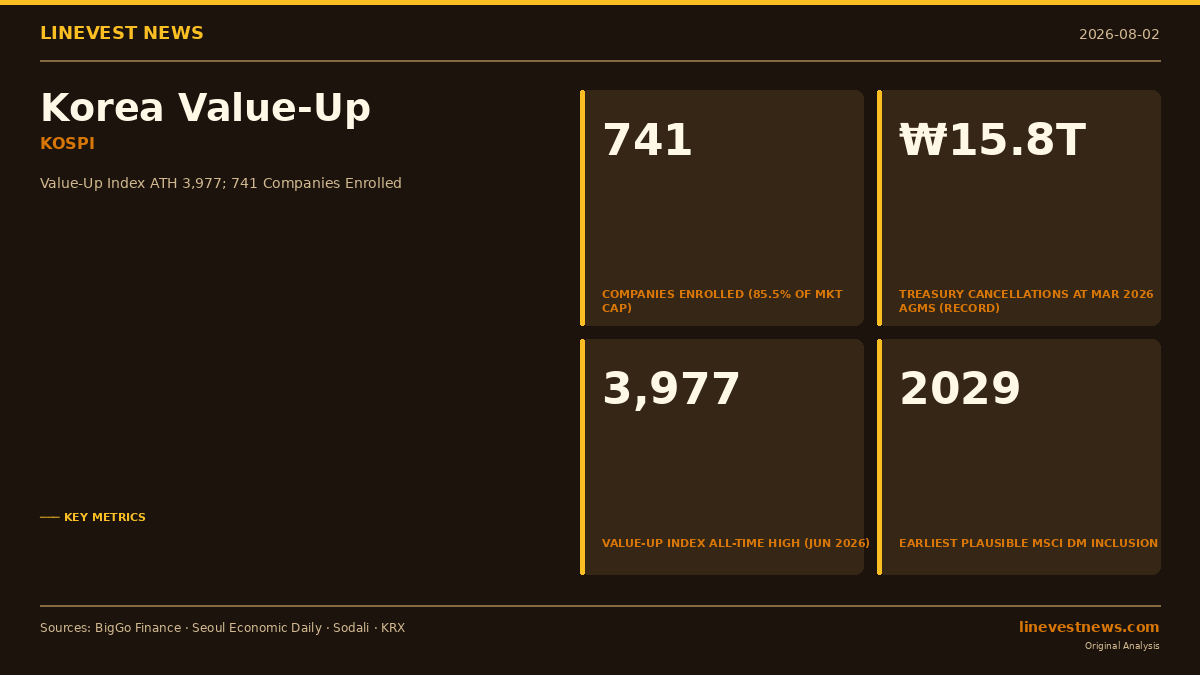
TL;DR - 741 companies (85.5% of South Korea's KOSPI market cap) have filed Corporate Value-Up disclosures as of early July 2026 (KRX) - Korea Value-Up Index hit an all-time high of 3,977 in late June 2026; 13 tracking ETFs hold ₩4.3 trillion in combined net assets - Commercial Act amendment (passed February 2026, effective March 2026) mandates treasury share cancellation — 102 companies proactively cancelled ₩15.8 trillion at March 2026 AGMs in response to the new law, described by Sodali as a record single-season total (159% above the prior AGM season) - MSCI Developed Market upgrade: MSCI's June 2026 review flagged unresolved hurdles; given watchlist and review timing requirements, the earliest plausible Developed Market inclusion is 2029
What Is the Korea Value-Up Program?
South Korea's Financial Services Commission (FSC) announced the Corporate Value Enhancement Program in February 2024 — widely called the "Value-Up Program" — to address the "Korea Discount": the persistent tendency for Korean equities to trade at lower price-to-earnings (P/E) and price-to-book (P/B) multiples than comparable companies in developed markets. KRX published the final disclosure guidelines in May 2024.
For enrolled companies, the program operates on a "comply-or-explain" disclosure framework: participating listed companies disclose plans to improve key metrics — price-to-book ratio, return on equity (ROE), dividend policy, and shareholder return programs — or explain why they are not currently doing so. Enrollment is voluntary; disclosed plans carry reputational but not statutory enforcement weight. Companies file on KIND (kind.krx.co.kr), the Korea Exchange's corporate disclosure platform.
As of August 2026, the program has moved well beyond its voluntary 2024 origins, with binding legislation, a dedicated tradeable index, and an ongoing MSCI Developed Market candidacy process.
2026 Participation: By the Numbers
| Metric | Figure | Date | Source |
|---|---|---|---|
| Total enrolled companies | 741 | Early July 2026 | KRX / Newspim |
| KOSPI participants | 347 | Early July 2026 | KRX |
| KOSDAQ participants | 394 | Early July 2026 | KRX |
| Total market cap coverage | 85.5% | Early July 2026 | KRX |
| Periodic update filings submitted | 116 | June 2026 | KRX |
| Value-Up Index all-time high | 3,977 | Late June 2026 | Digital Times |
| Value-Up ETF net assets (13 ETFs combined) | ₩4.3T | Mid-2026 | BigGo Finance |
Note: KOSDAQ lists approximately 1,700 companies versus roughly 850 on KOSPI. KOSPI's enrollment rate (~40% of listed companies) is approximately double KOSDAQ's enrollment rate (~23%), reflecting the higher average size of KOSPI-listed companies. KOSDAQ's higher raw count (394 vs. 347) reflects its much larger number of listed companies despite lower individual enrollment rates.
In March 2026, a record 409 new Value-Up disclosures were filed in a single month — a surge directly coinciding with the Commercial Act amendment that took effect that same month. Companies moved to document shareholder return plans ahead of the new treasury share cancellation requirements. Cumulative enrollment reached 731 by May 2026 (BigGo Finance) and 741 by early July 2026 (KRX / Newspim). After March, the pace of new disclosures slowed significantly.
The 116 periodic update filings (companies reporting back on their initial commitments) are a key accountability signal and a more rigorous test of program follow-through than enrollment counts alone.
The Korea Value-Up Index
The Korea Value-Up Index is a KRX index constructed around Value-Up Program eligibility criteria. Its base date is January 2, 2024 (base value 1,000), and KRX began real-time dissemination of the index on September 30, 2024.
Composition (100 companies): - Selection pool: Top-400 KOSPI/KOSDAQ companies by market capitalization - Eligibility filters: Two consecutive years of profitability, consistent dividend or buyback history, above-median price-to-book ratio among peers, above-median ROE - Breakdown: 67 KOSPI + 33 KOSDAQ companies
Performance milestones:
| Date | Value-Up Index Level | Note |
|---|---|---|
| Jan 2, 2024 | 1,000 | Base date |
| Sep 30, 2024 | — | KRX begins real-time dissemination |
| Apr 28, 2026 | 3,006 | First close above 3,000; +200.6% above base |
| Late June 2026 | 3,977 | All-time high; +297.7% above base |
For context, the broader KOSPI benchmark crossed 5,500 for the first time on February 12, 2026.
ETFs tracking the index: 13 ETFs now invest in the Korea Value-Up Index. According to the RISE ETF factsheet, the RISE Korea Value-Up ETF recorded a one-year return of +117% as of mid-2026. Combined net assets across all 13 ETFs reached ₩4.3 trillion (BigGo Finance, mid-2026), reflecting capital appreciation and successive fund launches since late 2024.
The 2026 Legislative Shift: From Voluntary to Mandatory
Two Commercial Act changes (2025–2026) and one tax reform have added binding provisions to the Value-Up Program framework.
1. Commercial Act Amendment — Mandatory Treasury Share Cancellation
Passed: February 2026; Effective: March 2026 (per Sodali, effective date March 6, 2026)
Previously, Korean companies could buy back shares and hold them as treasury stock indefinitely — creating a supply overhang that depressed valuations and enabled controlling shareholders to maintain de facto control without formal ownership.
Core changes: - Shares acquired after the amendment: must be cancelled within one year of acquisition - Shares held before the amendment: must be cancelled, or placed under a Treasury Share Holding and Disposal Plan, within six months of the effective date (deadline: approximately September 2026) - Treasury Share Holding and Disposal Plan (retention exception): A shareholder-approved plan may be filed, limited to employee compensation/ESOP programs and specific business objectives in the articles of incorporation; plan must disclose purpose, share count, and disposal timeline; disposal must be on equal, pro-rata terms to all shareholders - Penalty for non-compliance: Administrative fines up to ₩50 million per violation (Sodali)
Market response (March 2026 AGMs): - 102 companies proactively cancelled treasury shares at March 2026 AGMs in response to the new law — before most cancellation deadlines legally fell due - Total: ₩15.8 trillion — described by Sodali as a record single-AGM-season total, 159% above the prior AGM season
2. Director Fiduciary Duty — All Shareholders (July 2025 Amendment)
A July 2025 Commercial Act amendment clarified that directors must act in the best interests of all shareholders, not just the corporate entity. If a director benefits a controlling parent company at minority shareholders' expense, those shareholders may now bring litigation under lowered evidentiary thresholds.
This directly addresses a structural feature of chaebol governance: intra-group transactions that transfer value from publicly listed subsidiaries to unlisted holding companies.
3. Dividend Tax Reform
Individual investors receiving dividends from companies that meet the legislated payout ratio threshold benefit from a substantially reduced personal tax rate on dividend income. The prior top marginal personal dividend income tax rate (approximately 49.5% including local surtax) created a structural disincentive for controlling-family shareholders to receive large dividends. This reform, introduced in the context of the Value-Up Program, removes that barrier.
MSCI Developed Market Upgrade: The Roadmap
South Korea's potential MSCI reclassification from Emerging to Developed Market is closely watched by investors. MSCI EM funds would reduce Korea exposure upon reclassification (Korea carries roughly 9–10% weight in MSCI EM), while MSCI DM funds would add it (Korea would likely be 1–2% of MSCI World). The net passive flow impact is debated; the long-run visibility benefit of Developed Market status is generally viewed as positive for Korean equity valuations. The Value-Up Program, alongside market-access reforms, is central to Korea's candidacy.
Key reforms and MSCI timeline:
| Reform / Milestone | Status |
|---|---|
| Onshore FX extended to 02:00 KST (registered foreign institutions) | ✅ Live since July 2024 |
| Short-selling lifted after 2023 ban | ✅ Short-selling reinstated: March 31, 2025 |
| Mandatory English disclosure for KOSPI companies (phased expansion) | Phase-in ongoing; expanded mandate by March 2027 |
| MSCI formal reclassification decision | Requires ≥1 year on watchlist first |
Obstacles flagged by MSCI (June 2026 Annual Market Classification Review): 1. Offshore KRW market: A fully deliverable offshore Korean won market is not yet available — the July 2024 domestic trading-hours extension does not create a 24-hour offshore KRW market 2. Short-selling settlement: Post-reinstatement settlement processes were flagged as insufficiently standardized for Developed Market classification
MSCI's Annual Market Classification Review is typically held each June. The review process requires a market to remain on the MSCI watchlist for at least one year before a formal reclassification decision. Because the June 2026 review flagged unresolved obstacles rather than confirming watchlist placement, the soonest plausible sequence is: watchlist added June 2027 → reclassification decision June 2028 → index inclusion 2029. The actual timeline depends on Korea resolving the flagged structural issues.
How to Use Value-Up Disclosures as an Investor
Where to find them: - KIND — Korea Exchange Corporate Disclosure Platform — search for "기업가치 제고 계획" (Corporate Value Enhancement Plan) to find all enrolled company filings
What to look for in a disclosure:
| Element | Why It Matters |
|---|---|
| Quantified P/B or ROE targets with deadlines | Vague plans without numbers = low accountability |
| Specific buyback or dividend amounts | Committed amounts are harder to walk back |
| Dividend payout ratio target ≥ 40% | Triggers personal dividend tax reform benefit |
| Annual milestones and checkpoints | Multi-year plans with milestones are more credible |
| Periodic update filing | 116 update filings submitted to date — track follow-through |
| Treasury Share Holding and Disposal Plan (post-March 2026) | Absence means mandatory cancellation applies |
What Value-Up does NOT guarantee: - Enrollment is voluntary — non-enrolled companies face no statutory obligation - Enrolled companies are expected to follow through on their own disclosed plans, but there is no statutory penalty for poor execution of a voluntary commitment (the mandatory rules apply only to the Commercial Act's treasury-share cancellation requirement) - "Explain" filings are permissible — some companies explain non-compliance without structural change - Activist shareholders have influenced behavior but have not won proxy battles at leading chaebol AGMs (Glass Lewis, 2026) - Circular shareholding structures at major chaebol remain largely intact; Hyundai Motor Group's 2018 restructuring proposal — which would have partially addressed this at one major chaebol — was withdrawn after shareholder opposition
Korea Discount: Where Things Stand
| Metric | ~2023 (Pre-Program) | H1 2026 (Est.) |
|---|---|---|
| KOSPI trailing P/B | ~0.85× | ~1.3–1.5× (improving) |
| Firms with ROE below 7% historical average | ~65% | ~60% |
Estimates compiled from Glass Lewis and Franvia research (H1 2026). Individual company metrics vary significantly.
The Commercial Act amendment structurally changes the capital allocation calculus for the first time in decades. However, deep structural issues — circular shareholding, related-party transactions — require broader reforms that the Value-Up Program's disclosure mechanism alone cannot resolve.
Key Upcoming Dates
| Date | Event |
|---|---|
| ~September 2026 | Six-month grace period expires for pre-March 2026 treasury shares — cancel or file a Treasury Share Holding and Disposal Plan |
| March 2027 | Expanded English-language disclosure mandate for KOSPI-listed companies |
| June 2027 (target) | MSCI watchlist placement (if obstacles resolved by then) |
| 2029 at earliest | Earliest plausible MSCI Developed Market inclusion (watchlist June 2027 → decision June 2028 → inclusion 2029) |
Sources
- BigGo Finance — Value-Up: 731 Companies, Index ATH, ETF Net Assets (May–Jun 2026)
- Seoul Economic Daily (English) — Value-Up Index Tops 3,000, Disclosures Surge 12-Fold (Apr 28, 2026)
- Franvia — Korea Discount Is Fading: 2026 Value-Up Reforms (Apr 2026)
- Sodali — Korea's New Treasury Share Rules and What They Mean for Companies (2026)
- Glass Lewis — Navigating South Korea's Corporate Value-Up Program (2026)
- Money Today — 3월 신규 밸류업 공시 409개 (Apr 7, 2026)
- Newspim — 밸류업 공시 확산…시총 비중 85.5% (Jul 7, 2026)
- Digital Times — 밸류업 공시 기업 741곳…지수도 사상 최고
- RISE ETF — RISE Korea Value-Up ETF factsheet
Disclaimer: This article is for informational and journalistic purposes only. LineVest News is not a registered investment advisor. Nothing in this article constitutes investment advice or a recommendation to buy or sell any security. Data is sourced from public filings, exchange reports, and financial research; some figures are estimates. Always conduct your own research before making investment decisions.
Last updated: August 2, 2026