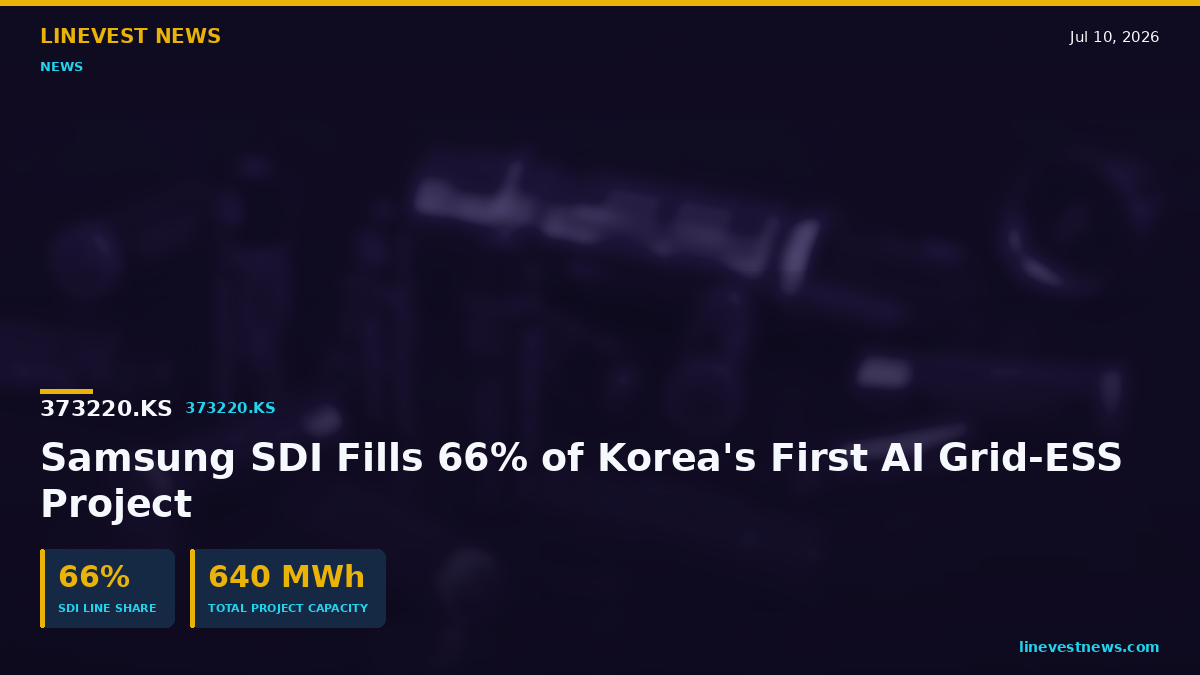
South Korea on July 10 awarded its first government-backed grid-ESS project — 640 MWh across 32 distribution lines — with Samsung SDI (006400.KS), Korea's prismatic-cell battery specialist, claiming 66% of the capacity, while LG Energy Solution (373220.KS), Korea's largest battery maker, won the single biggest operator slot.
The Ministry of Climate, Energy and Environment (MCEE) — the ministry that absorbed energy policy from MOTIE (the Ministry of Trade, Industry and Energy) in an October 2025 government reorganization — selected nine consortiums across 32 distribution lines for its "AI-Utilizing ESS Construction Support Project," per Newsis and Chosun Biz. Fourteen virtual-power-plant operators had applied for 82 lines, Newsis reported.
Samsung SDI cells were adopted in 21 of the 32 lines — about 66% of the project, or 84 megawatts and 420 megawatt-hours of capacity — because six of the nine winning consortiums chose its batteries, according to Chosun Biz. LG Energy Solution took seven lines (140 MWh), the maximum a single operator can hold, and SK On — the EV-battery unit of SK Innovation — supplied four lines, roughly 12%, Chosun Biz reported. Each line carries a 4 MW / 20 MWh unit that lets about 5.7 MW of queued solar connect early, per Newsis.
How big is this, really?
In absolute terms, small. The entire project spans roughly 640 MWh. For scale, Samsung SDI alone won a July 2025 government-led ESS tender covering 465 MW and 2,574 MWh worth about ₩1 trillion ($726 million), taking six of eight projects while LG Energy Solution took two and SK On won none, The Korea Times reported. Against that, Samsung SDI's 420 MWh here is a fraction — so the significance is strategic and directional rather than revenue-moving.
That is why the industry read matters more than the megawatt-hours. Battery makers view this AI grid project as a warm-up for the third ESS Central Contract Market auction expected in September, which is set to be far larger; the first two rounds already drew fierce competition among Korea's three battery makers, Chosun Biz noted. The distribution of cell wins here — Samsung SDI dominant, LG Energy Solution second, SK On a distant third — mirrors the July 2025 outcome and offers an early tell on how the September contest could break.
Two different bets
The two front-runners are playing different positions. Samsung SDI is supplying its "SBB 1.5" (Samsung Battery Box) — a 20-foot container packing high-nickel NCA prismatic cells, modules and safety systems as a plug-in unit, per Chosun Biz — a pure cell-and-hardware sale. LG Energy Solution went further up the value chain: partnering with Shinhan Asset Management, a Korean fund manager handling the financial structuring, it will supply batteries and run AI-based operation as a virtual-power-plant operator, a step beyond selling cells, according to Chosun Biz and The Korea Herald. Its consortium will connect 40 MW of solar awaiting grid access in the Honam region of Korea's southwest and accommodate an additional 52.4 GWh of renewables annually, with commercial operation starting in 2027 over a 20-year term, The Korea Herald reported.
The policy goal is grid relief without costly transmission builds: MCEE aims to deploy about 700 MW of storage and connect an extra 1 GW of renewables by 2030, adding roughly 1,350 GWh of solar output a year, concentrated in the solar-heavy Honam and Jeju regions, per Newsis. The project is also framed as support for power supply to the Honam semiconductor cluster.
What to watch
The September Central Contract Market auction is the confirming data point. If Samsung SDI's cell dominance carries into that far larger tender, the pattern set on July 10 hardens; if SK On — which is trying to widen beyond EV batteries into grid storage — closes the gap, the September result would mark a shift. LG Energy Solution's 2027 commercial-operation start is the next milestone for judging whether its operator-and-VPP model, rather than cell supply alone, delivers.
Sources: Chosun Biz — Samsung SDI 66% · Chosun Biz — LGES Operator · Newsis — Climate Ministry MOU · Korea Herald
This article is journalism, not investment advice. LineVest is not a registered investment adviser. Figures are drawn from Korean-language coverage (Newsis, Chosun Biz), The Korea Herald and The Korea Times as cited; currency conversions are approximate.