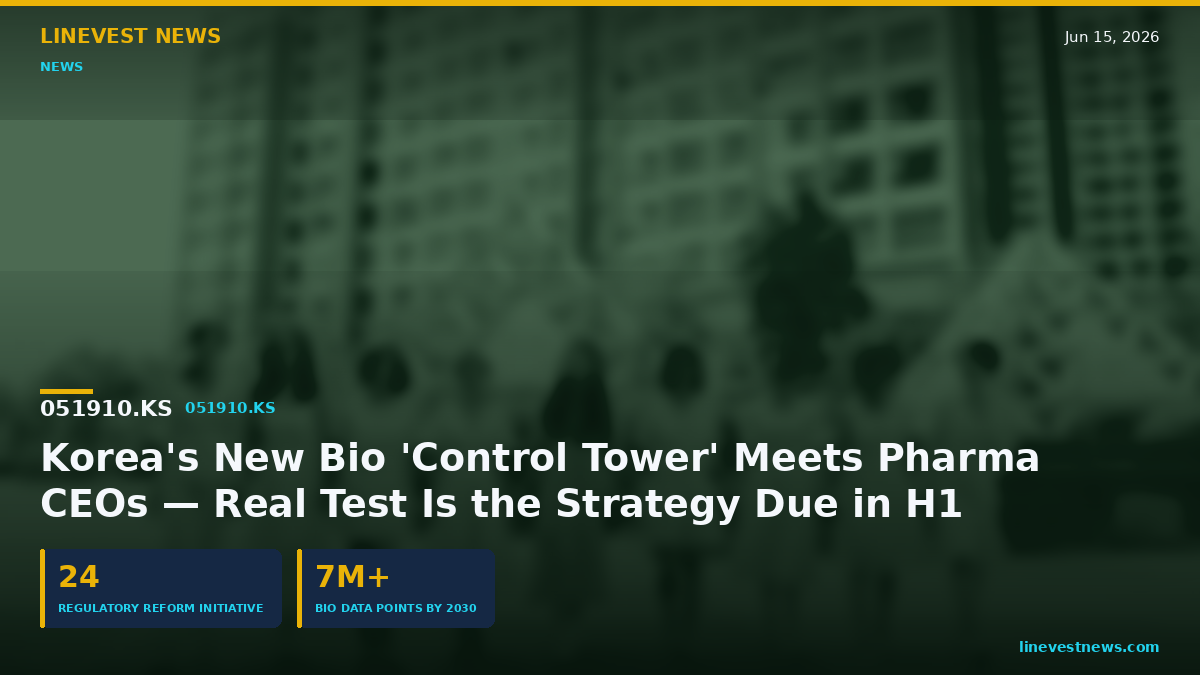
Korea's National Bioinnovation Committee (the merged government body that now coordinates all national bio and biohealth policy) held its first formal dialogue with pharmaceutical CEOs on June 15, sitting down with the board of the Korea Pharmaceutical and Bio-Pharma Manufacturers Association (KPBMA, the country's main drug-industry trade group) at Seoul Square in central Seoul (chosunbiz, etnews, June 15, 2026).
For a fund manager, the immediate question is what actually changes and for whom. The honest answer: nothing binding changed at this meeting. It was a consultation — CEOs aired R&D pain points, the committee promised to fold them into policy. The signal worth tracking is what the committee does next, because it was built to act rather than merely deliberate.
What the committee is, and why it has teeth
The National Bioinnovation Committee launched on April 16, 2026 at the Government Complex in Sejong, chaired by Prime Minister Kim Minseok, and was designed as "a practical policy control tower with decision-making authority" rather than an advisory panel (Asia Business Daily, April 16, 2026). It was created by merging two previous bodies — the National Bio Committee and the Biohealth Innovation Committee — after officials found overlapping mandates and noted the National Bio Committee had been "inactive for over six months" (World Bio Market Insights). That history is the cautionary precedent: Korean bio-governance bodies have stalled before, which is precisely why the consolidation happened.
The committee seats 16 government members (ministers and vice ministers), two private-sector vice chairs — Seoul National University distinguished professor Won Hee-mok and Park Yong-jin — and 23 additional private members drawn from major companies and industry associations (Asia Business Daily). Its stated pipeline includes a Korea Bio Innovation Strategy in the first half of 2026, 24 regulatory-rationalization initiatives in biohealth, and a National Bio Data Integration Platform targeting "over 7 million data points by 2030" (Asia Business Daily; World Bio Market Insights).
Who was in the room
Vice Chairman Won Hee-mok led the committee side alongside its regulatory, technology-innovation, investment-strategy and industry-promotion bureau heads (chosunbiz). On the industry side, KPBMA chairman Noh Yeon-hong was joined by CEOs from across listed Korean pharma — including Son Ji-woong, president of the Life Sciences division of LG Chem (051910.KS, Korea's largest chemicals maker, whose smaller life-sciences arm develops drugs); Hwang Sang-yeon, CEO of Hanmi Pharmaceutical (128940.KS); and the heads of Chong Kun Dang, JW Pharmaceutical, SK Bioscience, Yuhan, Dong-A ST, Ildong Pharmaceutical and Huons Group (chosunbiz, etnews).
The agenda the executives put forward was directional, not financial: accelerating R&D and building a new-drug innovation ecosystem, expanding open innovation, improving the R&D investment environment, strengthening global production and export competitiveness, and securing stable supply of essential medicines — with AI-driven drug discovery threaded through the discussion (chosunbiz).
"The National Bioinnovation Committee is the single governance body that oversees and coordinates pharmaceutical and bio policy, so it will act as a platform for industry innovation," Won said (chosunbiz). KPBMA's Noh framed the session as a chance to "share field-level views with the government and find solutions together" (chosunbiz).
The data point that confirms or refutes the thesis
The meeting itself is a process milestone, not a policy outcome — and it touches LG Chem only at the margin, through a life-sciences unit that is a small slice of a chemicals-and-battery group. What turns this from talk into substance is the Korea Bio Innovation Strategy, which the committee has said will arrive in the first half of 2026 (Asia Business Daily). With H1 ending in roughly two weeks, that document — and whether it names concrete items among the promised 24 regulatory-rationalization initiatives — is the first hard test of whether the merged "control tower" moves faster than the body it replaced.
This article is for informational purposes only and does not constitute investment advice. Figures and quotations are attributed to the sources cited; readers should verify against primary disclosures before making any decision.