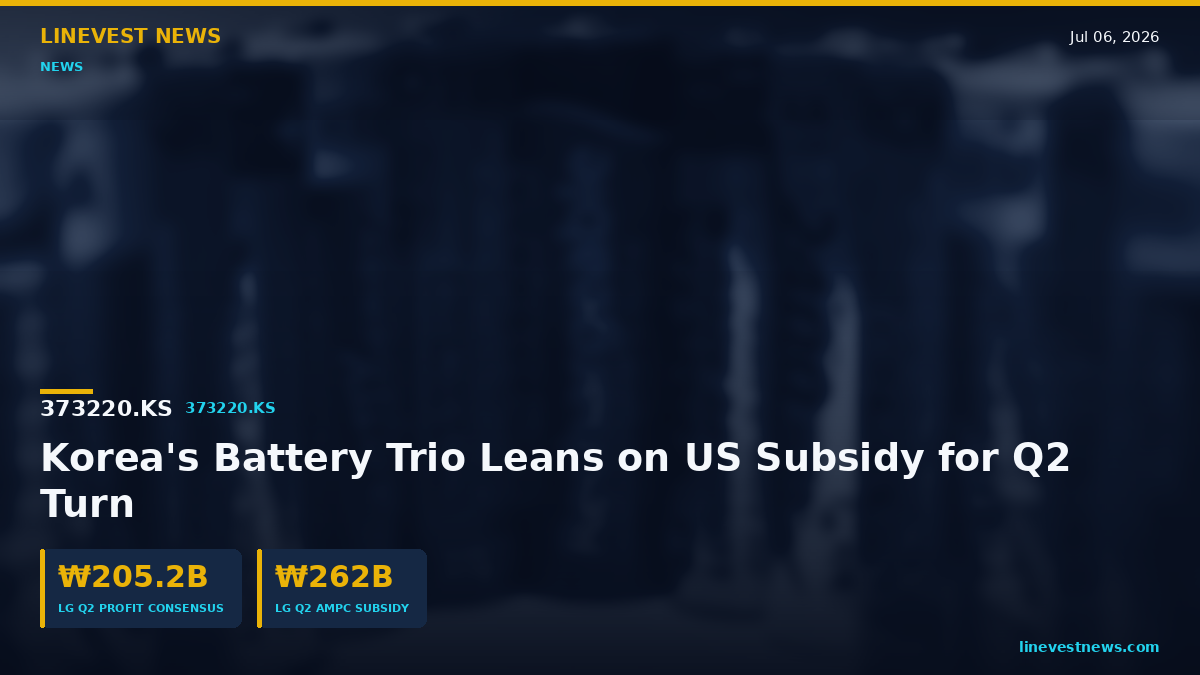
LG Energy Solution (373220.KS), the largest of Korea's three lithium-battery makers, is expected to swing back into the black when it reports second-quarter results on July 7, according to industry sources cited by Chosun Biz. The consensus operating-profit estimate compiled by FnGuide, a Korean financial-data provider, stands at 205.2 billion won ($150 million) — a sharp reversal from the 207.8 billion won ($152 million) operating loss the company booked in the first quarter and the 122 billion won ($89 million) loss in the fourth quarter of last year.
The question for anyone reading that headline is whether this marks a genuine earnings inflection for Korea's battery sector or merely a subsidy-flattered rebound. The answer, on the numbers available, is: some of both — and the subsidy is doing more of the work than the operating line suggests.
The AMPC math
The driver behind LG's swing is energy storage systems (ESS), the grid- and commercial-scale battery packs increasingly bought to stabilize power supply for AI data centers. Larger US ESS output raises LG's take under the AMPC (Advanced Manufacturing Production Credit) — the per-cell cash-refundable subsidy the US pays domestic battery manufacturers under the Inflation Reduction Act.
Here is the tell: Shinhan Investment analyst Lee Jin-myung estimates LG's second-quarter AMPC at 262 billion won ($191 million), up 38% from 189.8 billion won ($139 million) the prior quarter (per Chosun Biz). Meritz Securities and Korea Investment & Securities peg it lower, at 228.4 billion won ($167 million) and 226 billion won ($165 million) respectively. On every one of those estimates, the subsidy alone exceeds the 205.2 billion won operating-profit consensus — meaning that, stripped of the US credit, LG's core battery business was most likely still loss-making in the quarter. A separate one-off also helps: LG has applied for roughly 300 billion won ($219 million) in tariff refunds tied to a US Supreme Court ruling against reciprocal tariffs and has received about 100 billion won ($73 million) so far, per Chosun Biz.
That framing matters for context. In the second quarter of 2025, LG posted operating profit of 492.2 billion won ($359 million) (LG Energy Solution press release, July 2025) — so this quarter's expected profit, even inclusive of subsidy, remains well below the year-ago level. The turn is real in direction but modest in scale.
Samsung SDI turns, SK On still lags
Samsung SDI (006400.KS) is expected to post its first operating profit in seven quarters, with iM Securities estimating a thin 7 billion won ($5 million), Chosun Biz reported. The trajectory has been one of shrinking losses — from a 591.3 billion won ($432 million) operating loss in the third quarter of last year to 155.6 billion won ($114 million) in the first quarter of 2026. Samsung SDI's improvement is attributed to converting part of its StarPlus Energy line — its Indiana joint venture with Stellantis — to nickel-based (NCA) ESS cells, plus rising demand for battery backup units in AI servers.
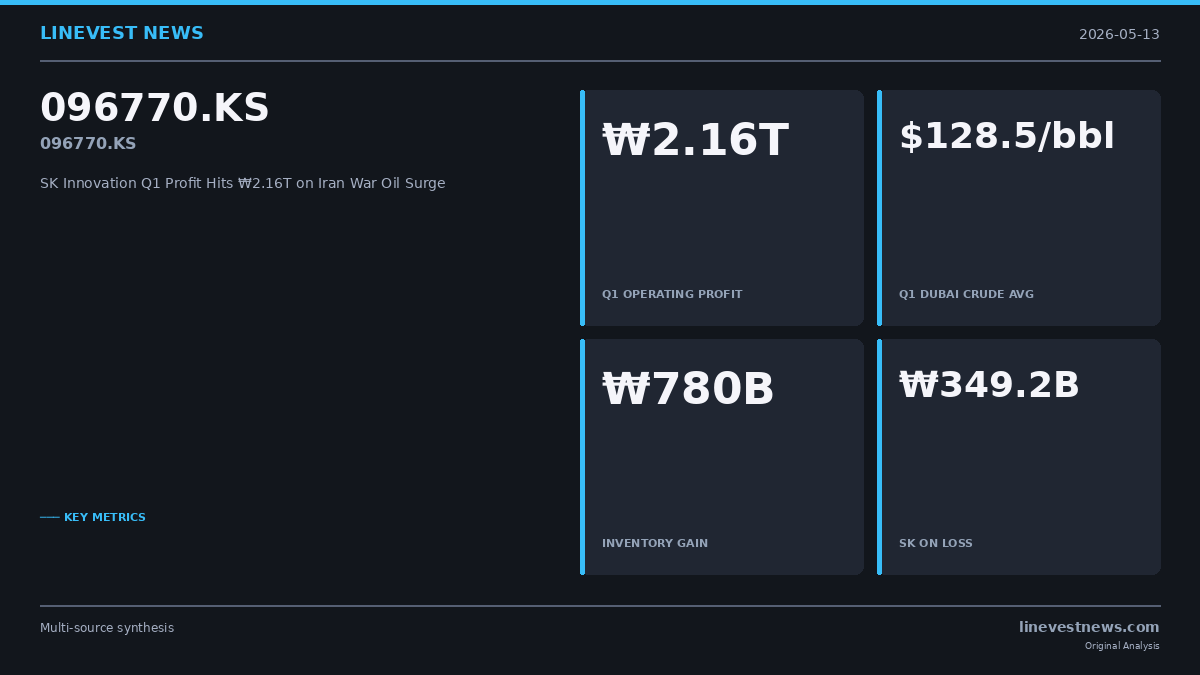
SK On, the battery unit of SK Innovation (096770.KS), is the laggard: still loss-making, with the deficit merely narrowing. KB Securities estimates a second-quarter battery operating loss of 215 billion won ($157 million) including AMPC, versus a 349.2 billion won ($255 million) loss in the first quarter, per Chosun Biz. Notably, SK On books no ESS sales this quarter — its improvement rests on higher EV-battery volumes — and only begins US-based ESS production from the third quarter, targeting more than 20 GWh of global ESS orders this year. That sequencing means SK On is roughly a quarter behind its two rivals on the ESS pivot.
Why storage, and why now
The demand backdrop is strong and independently documented. US energy-storage installations hit 3.3 GW / 8.4 GWh in the first quarter of 2026, the best first quarter on record and 54% above the prior Q1 mark, according to the American Clean Power Association (ACP) and Wood Mackenzie (ACP; Utility Dive). Chinese research firm GGII (Gaogong Industry Institute) projects ESS battery shipments for AI data centers to grow from 12 GWh in 2025 to 272 GWh by 2030, per Chosun Biz.
The opening for Korean suppliers is largely a policy artifact: US tariffs on Chinese-made ESS and Foreign Entity of Concern (FEOC) rules restricting Chinese-sourced components and critical minerals have effectively cleared shelf space for non-Chinese makers. That is also the sector's vulnerability — as one industry official told Chosun Biz, Korean battery earnings "tend to depend on external policy variables" such as the US IRA and Europe's industrial-acceleration rules, and manufacturers are pressing Seoul for direct cash refunds on tax credits since most domestic cell and materials firms have no taxable profit to offset.
What confirms the thesis
The first hard data point is LG's July 7 print: whether reported operating profit lands near the 205.2 billion won consensus, and — more revealing — how much of it the company attributes to AMPC versus underlying margin. Samsung SDI and SK On, which Chosun Biz reports are coordinating results releases for the last week of July, will show whether the ESS-led recovery broadens or stays concentrated in the two firms already shipping US storage cells. Until those figures land, the sector's return to profit reads as directionally encouraging but heavily reliant on US subsidy flows that are themselves a moving policy target.
This article is journalism, not investment advice. LineVest is not a registered investment adviser. Figures are drawn from cited primary sources and brokerage estimates as noted; consensus and analyst estimates are projections that may differ from reported results. Won-to-dollar conversions use an approximate rate of 1,370 won per US dollar.
Sources: Chosun Biz · American Clean Power Association · Utility Dive · LG Energy Solution Press Release