載入市場數據中...
2026年7月23日星期四
回到首頁News

China's CXMT Completes $8.6B IPO — Asia's Biggest Listing of 2026 Reshapes DRAM Competition for Samsung and SK Hynix

作者 MinJeKim0 次瀏覽
語言:English한국어日本語繁體中文

本文的中文翻譯準備中。以下為英文原文。

China's CXMT Completes $8.6B IPO — Asia's Biggest Listing of 2026 Reshapes DRAM Competition for Samsung and SK Hynix

TL;DR

  • China's ChangXin Memory Technologies (CXMT) raised $8.6 billion in Shanghai's STAR Market IPO — Asia's largest listing of 2026 and the biggest Chinese semiconductor offering since SMIC debuted in 2020
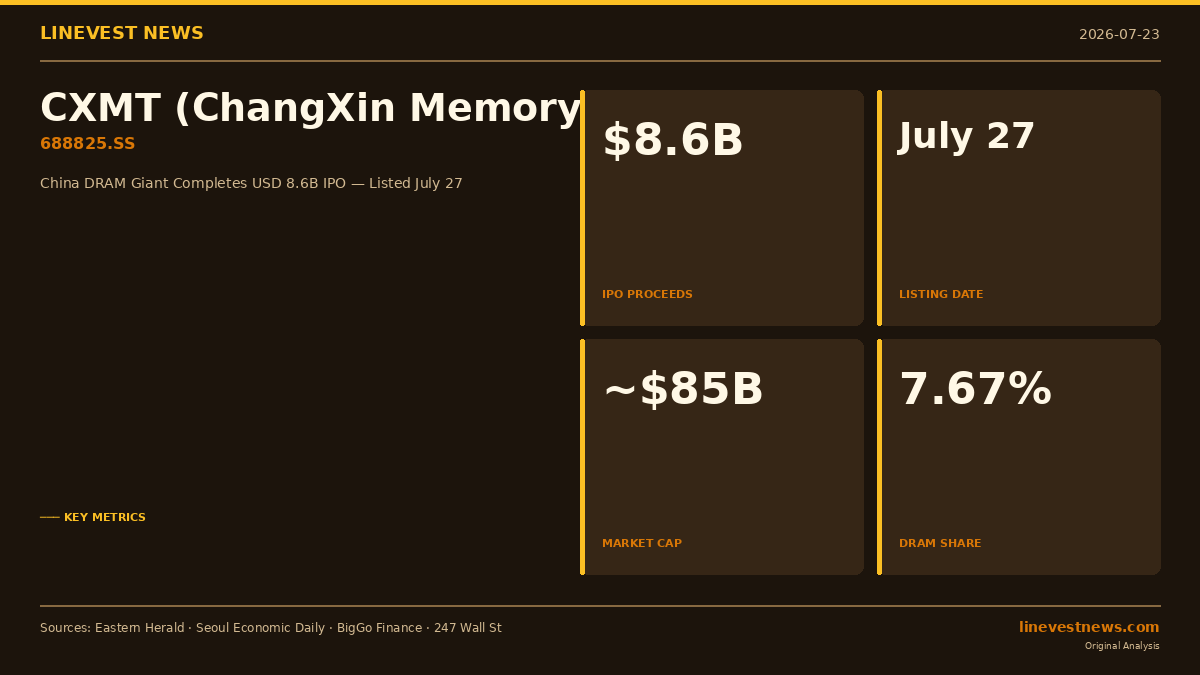
  • Shares begin trading Monday, July 27; the 212× oversubscribed deal values CXMT at roughly $85 billion, on par with SK Hynix by market capitalisation despite far lower revenues
  • CXMT's Q1 2026 revenue surged +719% year-on-year to RMB 50.8 billion (~$7.5 billion); net profit rose +1,688% to RMB 33.0 billion (~$4.9 billion) — nearly erasing all historical losses in a single quarter
  • KB Securities maintains its ₩600,000 target on Samsung Electronics (005930.KS) and forecasts Q3 2026 operating profit of ₩110 trillion (+805% YoY), arguing CXMT's listing is a revaluation catalyst, not a threat
  • The structural risk sits in commodity DRAM, not HBM — CXMT's 97.3% commodity revenue exposure means the AI memory battle remains a Samsung–SK Hynix two-horse race for now

Part A — The IPO: Anatomy of China's Memory Bet

Subscription and Pricing

ChangXin Memory Technologies priced its initial public offering at RMB 8.66 per share, raising RMB 57.9 billion (approximately $8.6 billion) on Shanghai's STAR Market (ticker: 688825). A greenshoe option could lift total proceeds to RMB 66.6 billion (~$9.9 billion). Retail demand was 212 times the available allocation — the strongest oversubscription ratio for a Chinese semiconductor listing this decade.

The deal prices CXMT at a market capitalisation of roughly $85 billion, broadly comparable to SK Hynix (000660.KS) by market value — a remarkable milestone for a company that reported a net loss as recently as Q1 2025.

Company Profile

Founded in 2016 in Hefei, Anhui Province, CXMT (昌鑫存储, Changxin Memory Technologies) manufactures dynamic random-access memory (DRAM) for servers, PCs, and consumer electronics. Omdia ranked the company as the world's fourth-largest DRAM producer by revenue share, at 7.67% in Q4 2025, displacing the three-player oligopoly — Samsung, SK Hynix, and Micron — that had controlled the market for decades.

MetricCXMTSamsung DSSK HynixMicron
Global DRAM share (Q4 2025)7.67%~38%~28%~22%
Market cap at IPO~$85B~$85-90B~$100B
HBM generationHBM3E target (2027E)HBM4 (mass production)HBM4 (mass production)HBM3E
Inventory turnover (2025)1.44×2×+2×+2×+

Sources: Omdia via SED; Eastern Herald; BigGo Finance

Financial Turnaround

CXMT's Q1 2026 results, disclosed in its IPO prospectus, show a company that transformed itself in a single year of the AI memory supercycle:

Q1 2025Q1 2026Change
RevenueRMB 6.2BRMB 50.8B (~$7.5B)+719% YoY
Net profit–RMB 2.83BRMB 33.0B (~$4.9B)+1,688% YoY

Mainstream DRAM contract prices rose approximately 83% between September 2025 and January 2026, and CXMT, as one of the few manufacturers able to scale output quickly, captured an outsized share of Chinese server-memory demand that previously flowed to Samsung and Micron.

IPO Proceeds Deployment

CXMT said it will use listing proceeds primarily to upgrade production lines and advance its process-node roadmap. Analysts at SemiAnalysis estimate the company's current process technology is one to two generations behind Samsung and SK Hynix in leading-edge DRAM.

Key customer wins disclosed or reported in the pre-IPO period: - Tencent: long-term DRAM supply agreement reported at approximately $3 billion (RMB 21 billion / ~₩4.5 trillion) — Reuters - Apple: the Financial Times reported Apple has been testing CXMT chips for China-only devices, with a U.S. Commerce Department approval process underway


Part B — Korea Market Analysis: Threat or Catalyst?

KB Securities: "Revaluation, Not Threat"

In a note published July 23, KB Securities analyst Kim Dong-won maintained a ₩600,000 price target on Samsung Electronics with a Buy rating and forecast Q3 2026 operating profit of ₩110 trillion, representing +805% year-on-year growth. The bank projects second-half 2026 operating profit exceeding ₩234 trillion — more than sevenfold the prior-year level.

KB Securities' core argument: CXMT's IPO highlights the scarcity of investable, advanced-memory exposure, directing institutional attention toward the two companies that actually manufacture high-bandwidth memory — Samsung and SK Hynix. The bank notes Samsung is now the top HBM supplier to Google.

Samsung Chairman Lee Jae-yong acknowledged at an internal meeting that the company had "failed to widen the gap with Chinese rivals" in commodity DRAM — but this admission underscores that management's attention is firmly fixed on the technology widening in HBM, not on defending a commodity market that generates a fraction of DRAM profits.

Where CXMT Threatens — and Where It Doesn't

Area of real risk: commodity DRAM

CXMT's revenue mix is 97.3% commodity DRAM (DDR4/DDR5, LPDDR4/5). In this segment, it has already won volume from Chinese hyperscalers who were previously buying Samsung DRAM for domestic deployments. This channel erosion will continue.

The technology gap, while real, is narrowing: - DDR5: analysts estimate CXMT is 2–3 years behind Korean producers - Production stability (inventory turnover 1.44× vs. 2×+ for Korean peers) indicates yield and ramp maturity remains a work in progress - DRAM price discipline: CXMT management has been quoted saying "there is no reason to sell cheaply" in the current supply-short environment — the company is not pursuing a price-war strategy

Area of limited near-term risk: HBM

High-bandwidth memory — the product line that powers AI accelerators from Nvidia, AMD, and Google — is where Samsung and SK Hynix generate their highest margins. CXMT's HBM ambition is real: the company has targeted HBM3E production for 2027. However:

  1. Samsung and SK Hynix are already mass-producing HBM4, one generation ahead
  2. HBM requires a through-silicon via (TSV) stacking capability that CXMT has yet to demonstrate at commercial yield
  3. Big-tech AI-cluster certification (Google, Microsoft, Meta) for a new HBM supplier requires 12–18 months of qualification — CXMT will not be a meaningful HBM revenue contributor before 2028 at the earliest

Investment Implications for Seoul

Samsung Electronics (005930.KS)

The paradox of CXMT's IPO is that it may attract more capital toward Samsung. KB Securities' thesis — that CXMT's listing prompts investors to quantify the technology moat of the HBM incumbents — is not unreasonable. Samsung Q2 2026 full-segment earnings are due July 30 (DS Division preliminary OP: ₩89.4 trillion, announced July 7). The question for Q3 and beyond is whether CXMT's market share gains in commodity DRAM suppress spot prices enough to crimp Samsung's legacy DRAM margin.

SK Hynix (000660.KS)

With approximately 70–80% of revenue now tied to B2B AI and HBM, SK Hynix carries less commodity DRAM exposure than Samsung, making it structurally more insulated from CXMT competition in the short term. Full Q2 2026 results are due July 29; consensus operating profit of ₩64.8 trillion (+604% YoY) reflects the HBM premium pricing environment that CXMT cannot yet access.

Micron (MU)

Outside Korea's scope but worth flagging: Micron faces more immediate CXMT risk. Chinese government procurement guidelines actively direct state enterprises toward CXMT and away from Micron following the 2023 security review. Micron's China exposure (~10% of revenue) has already been partially displaced.

The 2029 Scenario

Industry projections suggest CXMT could capture approximately 15% of global DRAM revenue by 2029, assuming its technology roadmap executes on schedule and yield improvements continue. At that scale, commodity DRAM pricing would face meaningful downward pressure. Korean semiconductor companies are responding by accelerating the capacity pivot toward HBM — SK Hynix's ₩7.09 trillion Cheongju P&T7 packaging complex (board-approved July 22) and Samsung's HBM4E roadmap through H1 2028 are, in part, structural hedges against exactly this scenario.

The CXMT IPO is a milestone in China's semiconductor self-sufficiency drive, not a moment of parity with Korean producers. For investors in Samsung or SK Hynix, Monday's listing is worth watching — but the more important date on the Seoul calendar this week remains July 29, when SK Hynix publishes what may be the largest quarterly profit in Korean semiconductor history.


This article is for informational purposes only and does not constitute investment advice. LineVest News is an independent financial news publication and is not affiliated with any brokerage.

Sources: - Eastern Herald: CXMT Raises $8.6B in Record Shanghai IPO - Seoul Economic Daily: CXMT Nears IPO, Threat to Samsung SK Hynix May Be Overstated - Seoul Economic Daily: KB Securities Keeps 600,000 Won Target on Samsung - BigGo Finance: China's CXMT Rides Memory Supercycle With $4.9B Quarterly Profit - 247 Wall St: SK Hynix and SanDisk Sink 7% as CXMT Readies $8.6B IPO - The Edge Malaysia / Reuters: CXMT Sets July 27 Listing for Asia's Biggest IPO of 2026

深入標題背後

您剛讀到發生了什麼。接下來,讀懂它意味著什麼。

免費每日簡報

每天早晨的韓國市場 — 免費

LineVest Daily在首爾開盤前送達您的信箱:KOSPI與KOSDAQ關鍵報導、財報、披露與外資流向 — 以簡明英文呈現。免費,無需信用卡。

免費獲取LineVest Daily →
這家公司

Samsung Electronics完整報告

我們完整閱讀Samsung Electronics的最新DART披露 — K-IFRS財務、公司治理,以及對股價的意義。3小時內PDF送達您的信箱。

$12 · 單次

獲取Samsung Electronics報告
所有您關注的股票

掌握整個市場

每週研究多檔韓股?所有分析文章發布即讀 — 每日KOSPI與KOSDAQ完整報導加90天檔案庫。

$9.99 · 每月

訂閱

基於DART原始披露的獨立新聞報導 — 非投資建議。與任何券商無關。