Morgan Stanley's Joseph Moore: Memory Selloff Is a Buy — DRAM to Rise 13–20% in Q3, Shortage Through 2028
TL;DR - Morgan Stanley analyst Joseph Moore (July 20): "We view this weakness as an opportunity to buy" on memory stocks - Q3 2026 memory price forecasts raised sharply: PC DRAM +15–20%, Server DRAM +13–18%, Enterprise SSDs +18–23% - Key framework: DRAM over NAND; original manufacturers over module makers - KOSPI rebounded 2.47% on July 21 to 6,677; Samsung Electronics +3.89%, SK Hynix +2.38%; foreign net buying ₩200B - SK Hynix preliminary Q2 2026 results due July 22 (sell-side consensus OP ₩64.8T, +604% YoY)
Part A: The Morgan Stanley Note
On July 20, 2026, Morgan Stanley semiconductor analyst Joseph Moore published an investor note arguing that the recent memory stock selloff — during which the global semiconductor sector shed roughly USD 1.5 trillion in market capitalisation between June 25 and July 7 — has created a compelling entry point for long-term investors.
Moore's core thesis is structural rather than cyclical: data centre memory demand continues to outpace supply in ways that show "no signs of abating," with shortages expected to intensify through 2027–2028, not ease.
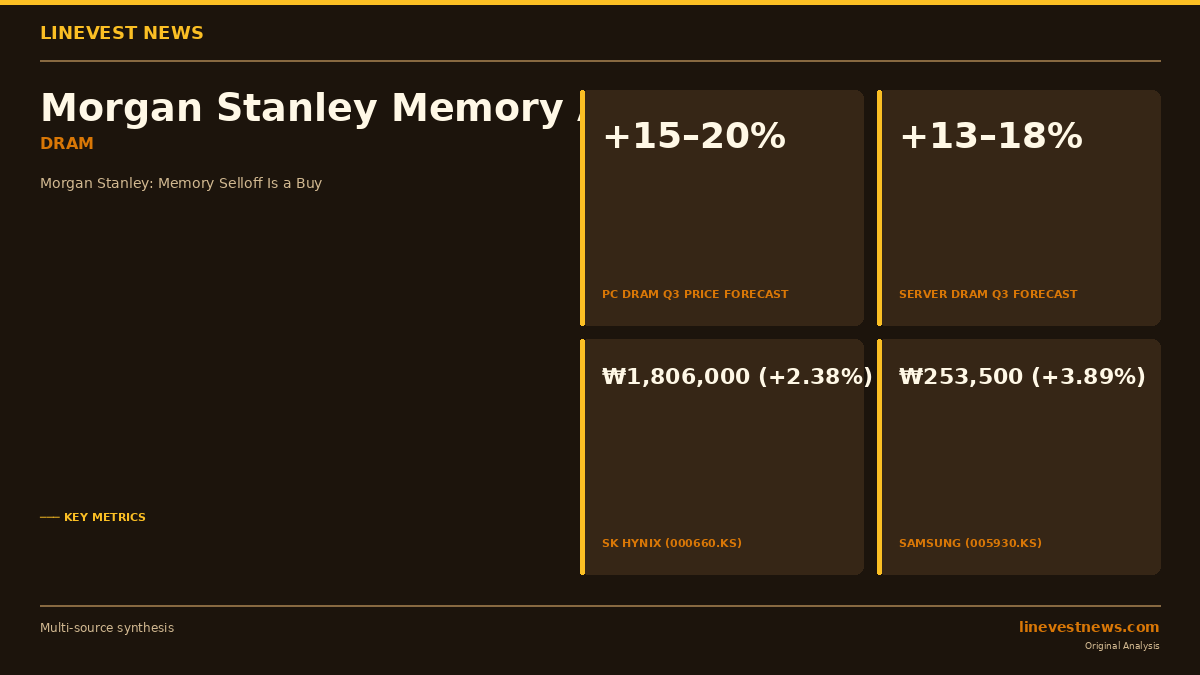
Q3 2026 Memory Price Forecasts (Morgan Stanley Revised Upward)
| Memory Type | Q3 2026 Price Change Forecast | Prior Forecast |
|---|---|---|
| PC DRAM | +15–20% | +3–8% |
| Server DRAM | +13–18% | — |
| GDDR6 / GDDR7 | +15–20% | — |
| Enterprise SSDs | +18–23% | — |
Source: Morgan Stanley Research, July 2026
The upgrade to PC DRAM — from +3–8% to +15–20% — is particularly notable given that PC demand has been weaker than AI server demand, suggesting broader memory price support than previously modelled.
The Selectivity Framework: DRAM Over NAND
Morgan Stanley is not unconditionally bullish on the memory sector. The bank draws a clear hierarchy:
- DRAM over NAND: Server DRAM demand from AI training and inference workloads is price-inelastic and structurally driven. Enterprise NAND benefits from an AI-driven surge in solid-state storage, but consumer NAND markets remain sluggish.
- Original chip manufacturers over module makers: Companies that design and fabricate memory chips capture long-term agreement (LTA) pricing security; module assemblers face inventory variability and thinner margins.
- Near-term caution acknowledged: Moore noted that "memory prices, earnings expectations, and investor positioning are already at elevated levels," suggesting limited near-term momentum — but reiterated that the structural bull case is intact.
Part B: Korea Market Implications
KOSPI Semiconductor Stocks Stage July 21 Rebound
Korean semiconductor equities responded decisively to the Morgan Stanley note on July 21. The KOSPI climbed to 6,677.10 (+2.47%) by mid-morning, reversing a portion of Monday's 4.48% intraday plunge.
| Stock | July 21 Morning Price | Day Change |
|---|---|---|
| Samsung Electronics (005930.KS) | ₩253,500 | +3.89% |
| SK Hynix (000660.KS) | ₩1,806,000 | +2.38% |
| KOSPI Index | 6,677.10 | +2.47% |
Foreign institutional investors turned net buyers, purchasing approximately ₩200 billion (~USD 135M) on the KOSPI by mid-morning — a notable reversal from the heavy net selling of the prior two weeks.
Analysts cited Korea's KOSPI forward P/E ratio of below 6× as a valuation support, arguing that the recent correction overshot fundamentals.
Why DRAM-Over-NAND Maps Directly to Korean Chipmakers
SK Hynix (000660.KS) is the global market leader in high-bandwidth memory (HBM), which is built on DRAM architecture. Its Q1 2026 operating profit reached ₩37.6 trillion (+405% year-on-year), powered by HBM3E shipments to Nvidia, AMD, and other AI accelerator designers. HBM3E supply is reportedly sold out through 2027, with HBM4 samples currently in distribution. Morgan Stanley's DRAM-bullish, shortage-through-2028 thesis aligns directly with SK Hynix's forward earnings trajectory.
Samsung Electronics (005930.KS) reported Q2 2026 preliminary results on July 7: revenues of approximately ₩171 trillion (+129% YoY from ₩74.6T) and operating profit of approximately ₩89.4 trillion (+1,810% YoY from ₩4.7T), with its Device Solutions (DS) Division — which houses DRAM, NAND, and foundry — generating roughly ₩53.7 trillion in operating profit in Q1 alone. As the world's largest DRAM producer by shipment volume, Samsung is a direct beneficiary of the price cycle Morgan Stanley projects for Q3 and beyond.
Earnings Catalyst: SK Hynix Preliminary Q2 Results Due July 22
SK Hynix is scheduled to release its preliminary Q2 2026 results on July 22 (full results and conference call on July 29, 09:00 KST). The event is the nearest binary catalyst for Korean semiconductor equities.
Sell-side consensus for SK Hynix Q2 2026:
| Metric | Consensus Estimate | YoY Change |
|---|---|---|
| Revenue | ₩84.6 trillion | +281% YoY |
| Operating profit | ₩64.8 trillion | +604% YoY |
| Operating margin | ~77% | vs. 41% in Q2 2025 |
Bull case (Kiwoom Securities): operating profit of ₩70 trillion. Bear case (KIS Investment Securities): ₩60.4 trillion, citing a moderation in commodity DRAM ASP growth to 28.9% (vs. a prior estimate of 50%). If management's guidance on Q3 server DRAM pricing confirms Morgan Stanley's +13–18% forecast, Korean memory stocks could sustain — and extend — the July 21 recovery.
Risks to the Thesis
Morgan Stanley itself flags several downside risks that are directly relevant to Korean investors:
- AI capex sustainability: The bull case for DRAM rests on hyperscaler cloud providers (Google, Microsoft, Amazon, Meta) maintaining or raising 2026 CapEx guidance. Upcoming tech earnings reports will be closely watched.
- Leveraged ETF overhang: Korean retail investors hold approximately ₩7.3 trillion in Samsung and SK Hynix single-stock leveraged ETFs. Forced selling during drawdowns has contributed to episodic volatility — including Monday's 4.48% KOSPI intraday plunge.
- Consumer NAND softness: PC and smartphone end markets remain tepid, which could limit upside for Samsung's NAND-heavy MX and CE divisions.
- Near-term momentum peak: Even Moore acknowledged that positioning is stretched; the buy thesis is most valid at current depressed valuations, not at prior highs.
This article is for informational purposes only and does not constitute investment advice. LineVest News is an independent publication and is not affiliated with any brokerage. Readers should conduct their own due diligence.
Sources: Morgan Stanley: Memory Selloff Creates Compelling Entry Point — Investing.com · Morgan Stanley Raises Q3 2026 Memory Price Forecasts — KuCoin · KOSPI Rebounds Over 2% on Bargain Hunting — Asia Business Daily · Memory 'Blind Buying' Era Is Over: Morgan Stanley Warns on Selective DRAM — BigGo Finance · Memory Stocks and ETF DRAM in Bear Market: Time to Buy the Dip? — Yahoo Finance