Korea's Financial Services Commission (FSC, the country's top financial regulator) has begun dismantling the "network separation" rule that for more than a decade kept cloud-hosted AI walled off from banks' internal systems — and the first commercial evidence of what that unlocks is now visible.
What changes, and for whom
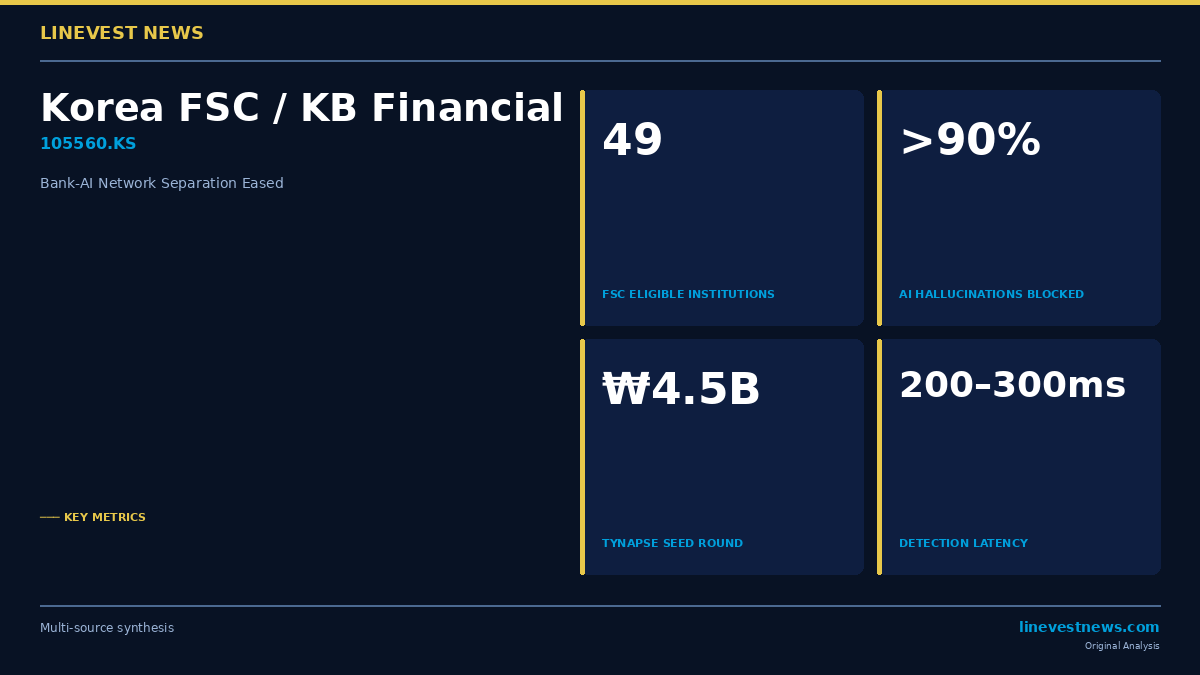
In emergency measures announced in late May, the FSC said it would grant financial firms a one-year exemption from mandatory network separation for deploying AI-based security tools, according to Seoul Economic Daily; a broader "full lifting" for general AI deployment was foreshadowed in the July 10 chairman remarks. Eligibility is initially capped at the 49 institutions holding at least ₩10 trillion ($7.3 billion) in assets and 1,000-plus employees, with up to 10 firms cleared in a first round in June–July, 10–20 more in August–September, and a third round in the fourth quarter (Seoul Economic Daily). On July 10, the FSC chairman went further, vowing a "swift full lifting" of the rule for firms with sufficient security and AI capability (Seoul Economic Daily).
This is not a minor technicality. Korea mandated physical separation of banks' internal networks from the internet after the March 20, 2013 cyberattack that damaged roughly 32,000 machines and hit Shinhan Bank, Jeju Bank and NongHyup; the FSC and FSS subsequently mandated physical network separation for financial institutions under the Electronic Financial Transactions Act in 2014 (ACCA, 'The Network Separation Rule in South Korea', 2024). That architecture — built to keep hackers out — also blocked the large language models banks now want to run. Easing it is the precondition for domestic bank AI at any real scale.
The first read on demand: KB and Tynapse
The clearest early signal comes from KB Financial Group (105560.KS), one of Korea's largest banking groups. On June 24, KB Kookmin Bank and startup Tynapse (티냅스) won the FSC Chairman's Award at the "Startup OI #Finance" event co-hosted by D.CAMP (a bank-funded startup foundation) and the Korea Fintech Support Center (a government-backed fintech body), for a system the bank says blocked more than 90% of AI "hallucinations" before they reached customers (Aju Business Daily). The joint project built a real-time answer-quality evaluation and control layer, using retrieval-augmented generation to verify a generative-AI advisory agent's responses (Aju Business Daily). Tynapse chief executive Kang Min-seung told Chosun Biz the entry ranked highest among 44 teams.
Kang's framing, in the same Chosun Biz interview, is that his product is a "filter" bolted onto whatever chatbot a bank already runs: before an answer goes out, it is checked against a finance-specific "ground truth," and every AI decision leaves a legally admissible audit trail. A detection-only pass runs in 200–300 milliseconds, he said, while answers needing reasoning take seconds. He credited KB's AI center — which he said is staffed by more than 100 specialists — with making the collaboration unusually productive, versus the typical bank proof-of-concept that stalls before deployment.
Venture money is chasing the same theme
Tynapse raised a ₩4.5 billion ($3.3 million) seed round within roughly six months of founding, led by Mirae Asset Venture Investment, with Kakao Ventures — the venture arm of Kakao (035720.KS) — alongside Mirae Asset Capital and Murex Partners (Seoul Economic Daily). The company was also selected for TIPS, Korea's government-backed startup accelerator program, worth up to ₩800 million ($580,000) in R&D grants (Asia Business Daily), and placed as the only Asian team in the top tier of the NVIDIA (NVDA) GTC 2026 AWS Startup Pitch (Chosun Biz). Kang, a former financial-sector chief technology officer, has built a team that includes AI specialists from Google Research (Tynapse company blog on the NVIDIA GTC 2026 pitch).
The open question
The size of this market hinges on how quickly the FSC moves from time-limited exemptions to full deregulation. The second round of approvals (10–20 firms) is due in August–September, and the chairman's promised timetable for a full lifting is the next concrete signal of whether bank-AI deployment broadens beyond the largest institutions. Whether third-party "trust" tooling becomes a standard budget line rather than a pilot will show up in how many proof-of-concept projects convert to paid contracts — the very threshold Kang flagged as the industry's usual failure point.
This article is journalism, not investment advice. LineVest News is not a registered investment adviser. Figures are drawn from the cited primary and secondary sources as of publication; currency conversions use an approximate rate of 1 USD = 1,370 KRW except where a source provides its own figure.