Kia Partners With Kakao Mobility to Build Purpose-Built Robotaxis as Seoul Sets October Level-4 Debut
TL;DR - Kia Corp. (000270.KS) and Kakao Mobility signed an MOU on July 16 to co-develop autonomous purpose-built vehicles (PBVs) for commercial robotaxi service - Kia will supply PV5 vans fitted with autonomous DevKits for Kakao Mobility's 2026 pilot programme; longer-term goal is a jointly engineered PBV tailored to driverless fleet operations - The deal deepens Korea's robotaxi supply chain ahead of Seoul's planned October 2026 launch of the country's first fully unmanned Level-4 taxis in the Sangam autonomous driving district - Kakao Mobility's existing Kia EV6-based fleet has been charging fares in Gangnam since April 6, giving both partners a live data trove no paper agreement can replicate
Part A — The Announcement
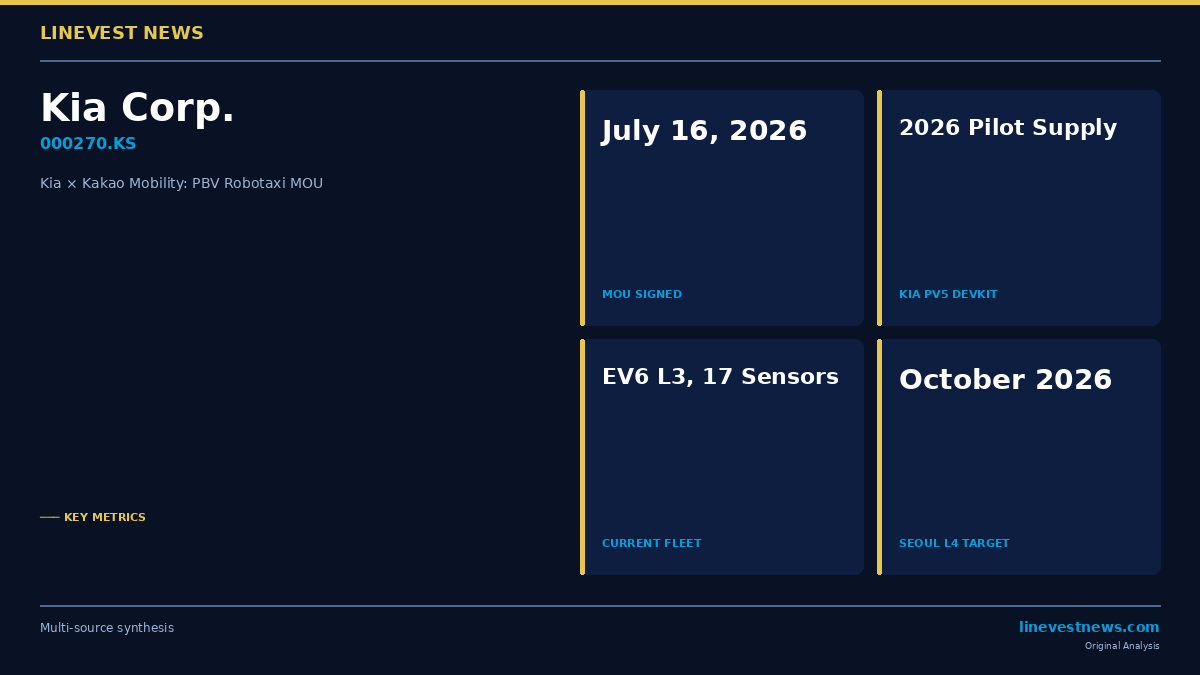
Kia Corp. and Kakao Mobility Corp. signed a memorandum of understanding on July 16, 2026, at Kia's headquarters in Yangjae, southern Seoul, committing to "co-develop a purpose-built vehicle (PBV) optimised for autonomous mobility services."
The agreement was signed by Kim Sang-dae, Kia's executive vice-president for PBV business, and Yoo Ji-han, EVP for SDV platform, alongside Kim Jin-kyu, Kakao Mobility's EVP for Physical AI, and An Gyu-jin, EVP for business operations.
What each side brings:
| Partner | Contribution |
|---|---|
| Kia Corp. | Vehicle supply (PV5 + DevKit), E-GMP.S platform, hardware engineering |
| Kakao Mobility | Autonomous driving software (AV-Kit), real-world operational data, Kakao T fleet network |
Two-phase roadmap:
Short-term (2026): Kia will supply PV5 electric vans fitted with autonomous DevKits — standardised hardware control units — to Kakao Mobility's ongoing pilot in Seoul. The vans will run alongside the existing Kia EV6-based fleet that already handles paying passengers in the Gangnam autonomous zone.
Long-term: The partners intend to co-develop a dedicated PBV model using accumulated operational data. Collaborative R&D will cover remote vehicle assistance (RVA), wireless charging, in-vehicle and exterior displays, and a command-and-communication architecture designed for driverless environments where no safety operator is aboard.
About the current Kakao Mobility fleet: - Vehicle: Kia EV6 (modified) - Autonomy level: SAE Level 3 (conditional, safety operator on board) - Sensor array: 17 units — LiDAR, radar, and cameras - Operational software: hybrid of Tesla-style end-to-end neural networks and Waymo-style rule-based safety logic - Service zone: Gangnam-gu / Seocho-gu, Seoul; weekday nights, 22:00–05:00 KST - Paid service launch: April 6, 2026 (trial began March 16)
Part B — Korea Market Analysis
Why This Deal Matters Beyond the Headlines
The Kia–Kakao Mobility MOU is more than a bilateral technology agreement — it is a competitive counter-move in a race that will define Korea's ₩10-trillion-plus urban mobility market well into the next decade.
Seoul's October deadline creates urgency. The Seoul Metropolitan Government is planning to deploy Korea's first fully unmanned SAE Level-4 robotaxis in the Sangam autonomous driving district (6.6 km²) in October 2026, which would make Seoul only the third city in the world — after San Francisco and Beijing — to put genuinely driverless taxis on public roads. The first cohort will be three vehicles; the city targets more than ten by 2027. Kakao Mobility is the strongest domestic candidate to operate that fleet. Landing a co-development partner for purpose-built vehicles rather than retrofitted consumer cars is exactly the kind of credibility signal that wins government tenders.
Kia's PBV pivot is in full stride. The PV5 is built on Hyundai Motor Group's E-GMP.S platform — an architecture that supports 16 body configurations, including a robotaxi-specific "PV5-R" variant being developed in parallel with Motional (HMG's joint venture with Aptiv). In 2026, Kia targets 54,000 PV5 global sales; European deliveries have already surpassed 10,000 units in the first half of the year alone, making the platform financially de-risked before the Korean autonomous variant even enters service. For Kia shareholders, the MOU signals that the PBV segment will have both domestic software partners and operational data pipelines that pure hardware suppliers cannot match.
Kakao Mobility's data moat deepens. Kakao T, the country's dominant taxi-hailing app, processes tens of millions of trips per month. Feeding anonymised trip data — origin-destination patterns, pick-up/drop-off clustering, peak-hour demand maps — into autonomous-driving training sets is a competitive advantage that no overseas rival (Waymo, Cruise, WeRide) can replicate without local presence. The partnership transfers that advantage directly into Kia's vehicle engineering loop.
Competitive landscape:
| Competitor | Approach | Status (July 2026) |
|---|---|---|
| Hyundai Motor (005380.KS) | Wayve (UK AI) autonomous software + RoboRide fleet | Pilot stage; RoboRide expanding |
| Kakao Mobility / Kia | EV6 now → PV5 DevKit Q3 2026 → co-designed PBV (TBD) | Commercial paid service active |
| Renault Korea + Kakao Mobility | Separate MOU signed July 8, 2026 — future mobility services | Agreement stage |
| Nuro / WeRide | International; no local fleet presence | No Korea operation |
Risks investors should weigh: 1. Regulatory pace: Korea's Road Traffic Act currently caps commercial Level-4 operations to designated pilot zones; national legislation to expand these zones is still in draft committee. 2. Kakao Mobility's IPO uncertainty: Kakao Mobility (unlisted; majority shareholder Kakao Corp., 035720.KS) has been in IPO discussions since 2022. An equity event would crystallise the value of the robotaxi franchise — but also inject new shareholder pressure on commercialisation timelines. 3. PV5-R vs PBV conflict: Kia's parallel development of a robotaxi PV5-R with Motional could compete with the jointly developed PBV, depending on commercialisation sequence. If Motional brings its platform to Korea first, Kakao Mobility's custom-vehicle pipeline could be delayed. 4. Insurance and liability: Korea's Digital Autonomous Vehicle Act (2023) places accident liability on the operator, not the OEM, for Level-3 vehicles. Level-4 liability rules remain unsettled — a gap that commercial insurers are watching closely before underwriting fleets at scale.
Bottom line for investors: Kia shares have underperformed the broader KOSPI year-to-date as investors focused on EV demand softness in Europe. The PBV segment — now backed by a domestic software partnership with real operational data — offers a growth narrative that is structurally insulated from the cyclicality of consumer EV demand. Kakao Corp. (035720.KS) investors should monitor the Kakao Mobility IPO pipeline; a successful Level-4 pilot in Sangam would materially improve the valuation case.
This article is for informational purposes only and does not constitute investment advice. LineVest News is an independent publication and does not receive compensation from any company mentioned herein.
Sources: - Kia–Kakao Mobility MOU announcement — KED Global - 기아, 카카오모빌리티와 자율주행 서비스 전용 PBV 개발 협력 — Edaily - Kakao Mobility robotaxi in Gangnam — BigGo Finance - Kia PV5 expands to 16 variants at Busan Mobility Show — TechTimes - Korea Robotaxi 2026: Inside the Self-Driving Taxi War — Seoulz - Kakao Mobility Launches Paid Robo-Taxi Service — BigGo Finance