SK Hynix's Nasdaq Triumph Backfires in Seoul: 15% Crash Triggers Circuit Breaker as KOSPI Falls 9%
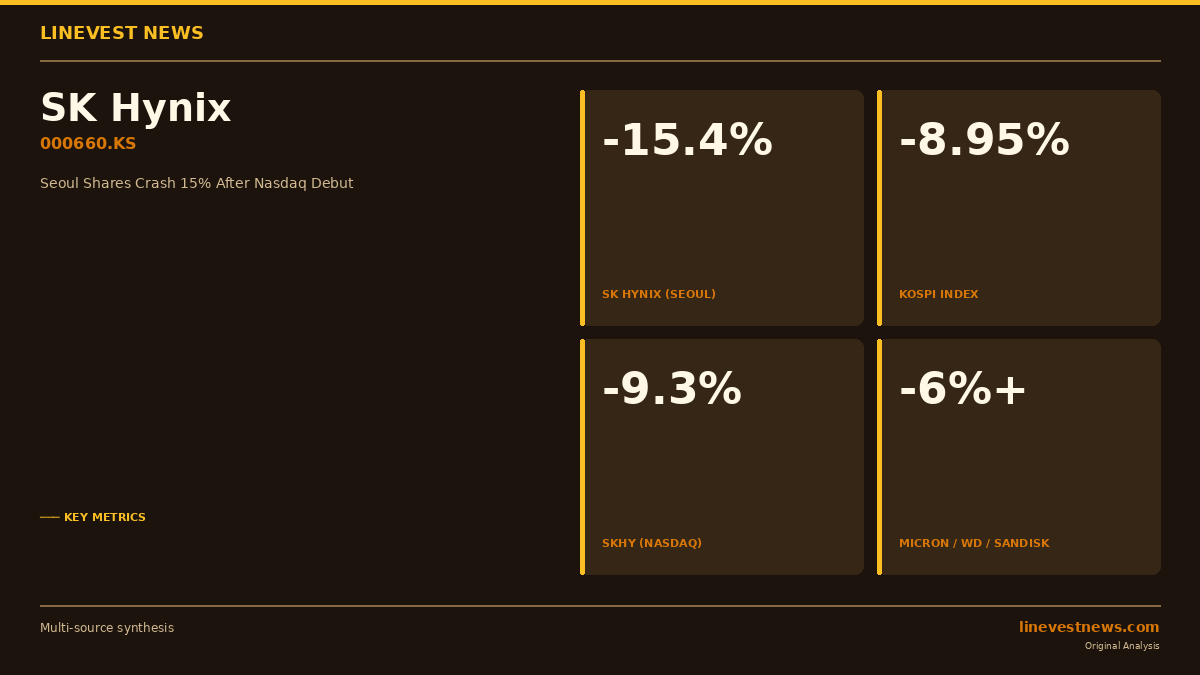
TL;DR - SK Hynix (000660.KS) plunged a record 15.4% in Seoul on July 13, closing at ₩1,845,000 — lowest since May 20 - KOSPI index fell 8.95%, breaching the 7,000 level; both a sidecar and full circuit breaker were triggered - On Nasdaq, SK Hynix ADRs (SKHY) dropped 9.3% on their second trading day, falling back near the $149 pricing level - The selloff spread globally: Micron, Sandisk, Western Digital all fell more than 6%; Japan's Nikkei fell 1.92% - The paradox: a flawlessly-priced $26.5B dual listing that popped 14% on debut became the catalyst for the steepest single-day KOSPI rout in recent memory
Part A — What Happened
SK Hynix's highly anticipated Nasdaq dual listing closed on July 10 as one of the most successful Korean offerings ever. The ADRs (ticker: SKHY) priced at $149 per share — itself 7× oversubscribed — and surged 14% on their first trading day, lifting all three major US equity indices. Wall Street declared the Korea-discount test a pass.
Three trading days later, the picture looked dramatically different.
On the morning of July 13 (KST), SK Hynix shares opened lower in Seoul and accelerated into freefall. By midday the Korea Exchange had triggered a 매도 사이드카 (sell-side sidecar), a temporary brake applied when the KOSPI 200 futures drop more than 5% for one minute. Selling pressure continued into the afternoon, forcing a full circuit breaker — a 20-minute halt on all KOSPI trading — for the first time in 2026. By the close, SK Hynix had shed 15.4%, ending at ₩1,845,000; the benchmark KOSPI fell 8.95%, breaching the 7,000 level.
On Nasdaq the same day, SKHY ADRs tumbled 9.3%, bringing them to within a few dollars of their $149 IPO price. Micron Technology, Sandisk, and Western Digital each fell more than 6%. The carnage spilled into Asia: the Nikkei 225 closed down 1.92%, dragged by Kioxia, Tokyo Electron, and Advantest.
The U.S. Securities and Exchange Commission separately asked at least one asset manager to delay the launch of a 2× leveraged SK Hynix ADR ETF — originally scheduled for July 13 — to July 14, citing concerns about amplified volatility in a newly listed, high-beta stock.
Part B — Market Impact and Investor Implications
The Dual-Listing Premium Trap
The mechanics of the selloff are not complicated, even if the speed was startling. When SK Hynix ADRs debuted in New York at a premium to the Seoul price — and that premium persisted — domestic Korean investors faced a logical arbitrage: sell the local shares and capture the difference. As selling pressure mounted, the discount on Seoul shares deepened, attracting more sellers in a self-reinforcing loop.
Chosunbiz noted that the 190만원 line, widely viewed as a near-term support level, had not been breached since May 20. Its violation on heavy volume signalled that the local paper loss was severe enough to trigger margin-linked forced selling — an observation echoed by reports of a surge in 반대매매 (forced liquidation) in the days surrounding the ADR listing.
For dual-listing theory, this is textbook. What is unusual is the scale: a 15.4% single-day drop in one of the most liquid Korean equities dragging the entire KOSPI down nearly 9% is a tail event. The index's weighting toward Samsung Electronics and SK Hynix — together comprising more than half of KOSPI's market capitalisation — amplified the contagion beyond what a single-stock event would normally cause.
Is the AI Upcycle Story Intact?
The Bank of Korea's published remarks on July 13 (see our earlier coverage) argued that the AI memory upcycle has a "considerable period" to run. That view was issued before the market opened; the question after the crash is whether the mechanism of value transfer — from Seoul to New York — changes the calculus for Korean equity investors.
Bloomberg Intelligence's Global Head of Tech Research, Mandeep Singh, commented that the ADR tumble "underscore[s] growing investor concerns that the boom is overextended." That framing — overextension rather than structural reversal — is consistent with a sell-the-news correction rather than a fundamental breakdown. SK Hynix's order book for HBM3E and HBM4 into 2026 and 2027 has not changed.
However, three risks are worth monitoring:
| Risk | Description | Implication for 000660.KS |
|---|---|---|
| ADR Premium Overhang | As long as SKHY trades at a meaningful premium to the ₩-converted local price, arbitrage selling pressure on 000660.KS persists | Continued volatility until premiums normalise |
| Leveraged ETF Flows | The SEC's hesitation on a 2× SKHY ETF suggests US regulators are watching for volatility amplification | Possible delayed demand uplift from ETF inclusion |
| Sector Contagion | The Micron/WD/Sandisk moves confirm this is a memory-sector re-rating, not purely a Korea story | Pressure on HBM pricing assumptions into H2 2026 |
The KOSPI Sidecar/Circuit Breaker Record
The July 13 dual trigger — sidecar followed by full circuit breaker on the same day — is notably the first such double event in 2026. Prior circuit breakers in the current cycle (six were triggered in 2026 prior to today, per our July 7 coverage of the Samsung Q2 earnings selloff) have largely been single-mechanism events. A double trigger signals the severity of order imbalance and is typically followed by elevated intraday volatility for several sessions.
Foreign investor net selling on the day is estimated at approximately ₩3 trillion, echoing the pattern observed on July 7 when Samsung's Q2 earnings result — despite beating estimates — triggered a similar sell-the-news reaction.
What Comes Next
TSMC's release of record June monthly revenue on the same day (covered separately by LineVest) partially stabilised sentiment in Tokyo and provided a tailwind into the US afternoon. If TSMC's full Q2 earnings, expected later this week, confirm the AI server build-out remains on track, a portion of the KOSPI discount may recover.
For SK Hynix specifically, the near-term technical picture is challenging: ₩1,845,000 is now a key level to reclaim. The $149 SKHY pricing floor on Nasdaq provides a psychological support reference. Investors who bought into the ADR at $149 and saw a 14% gain on day one, now sitting near breakeven, will be a key price-discovery force as the week progresses.
This article is for informational purposes only and does not constitute investment advice. All figures are sourced from market data and news reports as of July 13, 2026 (KST). LineVest is not a registered investment adviser.
Sources: Bloomberg — SK Hynix ADRs Tumble · Chosunbiz — 15% 폭락 분석 · Nikkei Asia · Newsis — 일본증시 영향 · Seeking Alpha