Samsung's Largest Union Says 84% of Members Oppose Honam ₩40 Trillion Fab, Calls for Tripartite Talks
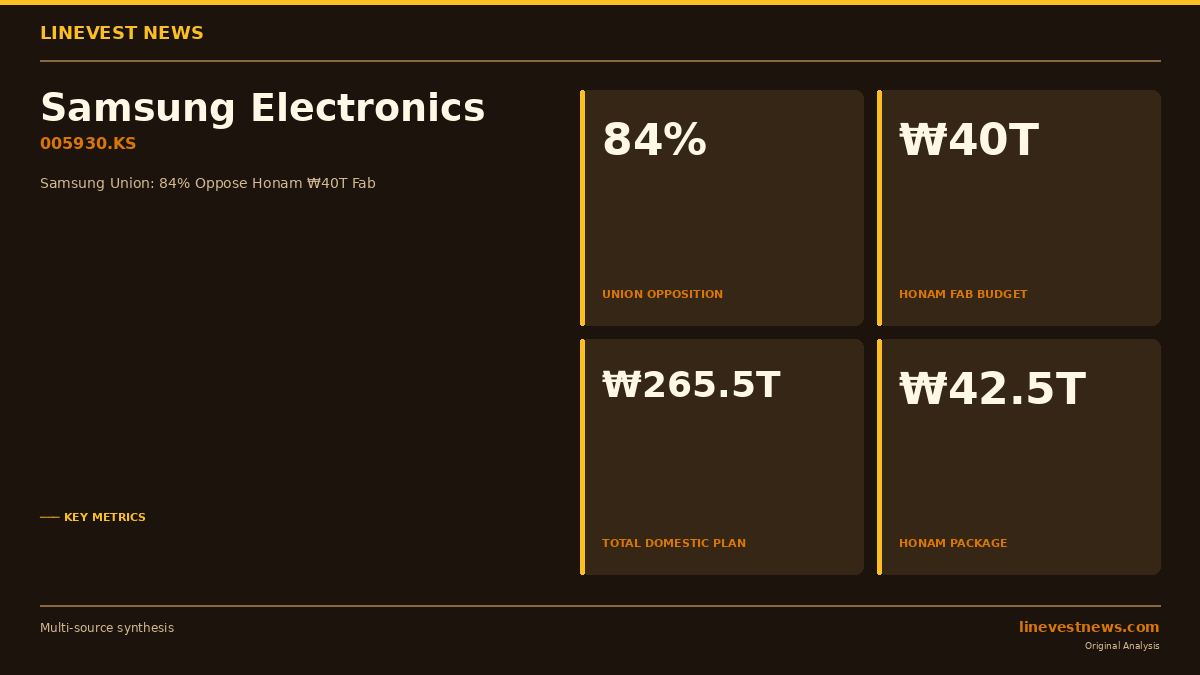
TL;DR - Samsung Electronics' largest union surveyed members on the government-backed Honam fab: 84% oppose the project - The union cites forced transfers, deteriorating work conditions, and a contradiction with the government's own 4.5-day work week push - Samsung management is also reported to be internally lukewarm, telling workers "they feel burdened" in two separate meetings - The union plans to table Honam as a formal 2027 collective bargaining agenda item, using revised labor laws that allow business decisions affecting worker conditions to become negotiable - Total at stake: Samsung's ₩265.5T domestic investment plan earmarks ₩42.5T for Honam (₩40T for the Gwangju semiconductor fab alone)
Part A — What the Public Disclosure Says
Samsung's dominant labor body — the Samsung Group Super-Enterprise Labor Union, Samsung Electronics Branch (삼성그룹 초기업노동조합 삼성전자지부, hereafter "the Union") — released survey results on July 13 showing that 84 percent of its members oppose the Honam semiconductor fab proposed by the government as part of Samsung Electronics' ₩265.5 trillion ($192 billion) five-year domestic investment plan.
The Union submitted a formal proposal to the government on July 1 and, as of the date of this report, has received no official response. Union leadership is now publicly demanding that a government-labor-management tripartite consultation body be established before the project advances further.
The ₩42.5 Trillion Honam Plan
Under Samsung's announced domestic investment framework:
| Component | Amount | Location |
|---|---|---|
| Semiconductor fab | ₩40T | Gwangju (광주) |
| Supporting infrastructure | ₩2.5T | Honam region |
| Honam subtotal | ₩42.5T | Southwest Korea |
| Total domestic plan | ₩265.5T | Nationwide |
The Gwangju fab would be Samsung's first major semiconductor facility outside its traditional Gyeonggi-do/Gyeongsang-do heartland. Government officials have positioned the project as a landmark regional development initiative.
Union's Three Core Objections
Forced transfer risk: Workers fear involuntary reassignment from existing fabs in Hwaseong and Pyeongtaek to Gwangju, disrupting family situations and accumulated seniority rights.
52-hour exemption hypocrisy: The government, while separately promoting a 4.5-day work week in other policy documents, is simultaneously seeking to exempt Honam fab construction and operations from the 52-hour weekly work limit. The Union calls this a direct contradiction.
Power supply ambiguity: Samsung Electronics CEO Jae-hyun Jeon's own public request — for "active promotion of nuclear expansion, power purchase agreements, and LNG cogeneration" — signals to workers that baseline infrastructure is not yet secured.
What Samsung Management Said Internally
The Union reports that in two separate company-level meetings, Samsung management indicated that they also "feel burdened" and expressed negative views toward the Honam plan. This aligns with reporting that Samsung executives have privately pushed back on a timeline they view as politically driven rather than operationally optimal.
Part B — Korea Market Impact Analysis
Why This Matters for Investors: A Policy-Labor Collision
The Samsung Honam story sits at the intersection of three forces that rarely resolve quickly: government industrial policy, corporate capital allocation, and organized labor. Each element independently has market impact; combined, they create meaningful execution risk on a ₩40 trillion commitment.
The government's political calculus is straightforward. The Honam region (Jeollanam-do and Gwangju) has historically been economically left behind relative to the Seoul-Gyeonggi corridor. A Samsung fab there would be a political milestone for any administration. But precisely because the project is politically driven, course-correction becomes harder without face-saving mechanisms — which is why the government has, so far, not publicly acknowledged the union's July 1 submission.
Samsung's management reluctance is the more telling signal for investors. Corporate hesitancy, now cited by the union from internal meetings, fits with broader analyst concerns that Samsung's ₩265.5T plan was announced under significant government pressure amid the broader "K-Chip Act" legislative push. If Samsung views Honam as a politically mandated extension of its investment plan rather than an organic capacity decision, the project faces heightened risk of delay, scope reduction, or quiet cancellation after political conditions shift.
The union's leverage is growing. Under revisions to Korea's labor law that took effect in 2025, companies must now negotiate with unions on "business decisions that materially affect working conditions." Honam — involving forced transfers and potential 52-hour exemptions — fits squarely within this definition. With the union already signaling Honam as a 2027 collective bargaining agenda item, Samsung faces a legally enforceable negotiation obligation, not just a moral one.
The 52-Hour Exemption Contradiction
The government's desire to exempt Honam from the 52-hour rule deserves particular attention from governance-focused investors. Korea's 52-hour weekly cap was itself a hard-won labor reform from 2018. Carving out a semiconductor-specific exemption — while publicly promoting a shorter work week elsewhere — risks:
- A legal challenge from unions citing selective regulatory treatment
- Reputational cost for Samsung's global ESG standing (HBM customers in the US and Europe increasingly audit labor practices in their supply chains)
- A legislative fight that delays groundbreaking well beyond Samsung's preferred timeline
Sectoral Read-Through
The Honam opposition should not be read as a binary fab/no-fab outcome. The more likely scenario — based on similar Korean labor-government-chaebol standoffs — is delay and modification: the fab eventually proceeds on a compressed initial scale, the 52-hour exemption is quietly dropped or narrowed, and the tripartite body the union demands is established as a face-saving mechanism for all sides.
For Samsung Electronics (005930.KS) investors, the near-term implication is that the ₩40T Honam commitment should be discounted in capex timeline models by at least one to two years from the originally implied schedule. This is not necessarily bad for the stock — delayed capex improves near-term free cash flow — but it does reduce the credibility of government-announced investment totals as a read on Samsung's actual spending intent.
The read-through for Gwangju-area construction and civil engineering contractors, who had begun pricing in fab-related work, is more immediately negative.
Sources: MK Economy · Hankyung · Yonhap
This article is for informational purposes only and does not constitute investment advice. LineVest News is an independent publication and is not affiliated with any brokerage or Samsung Electronics.