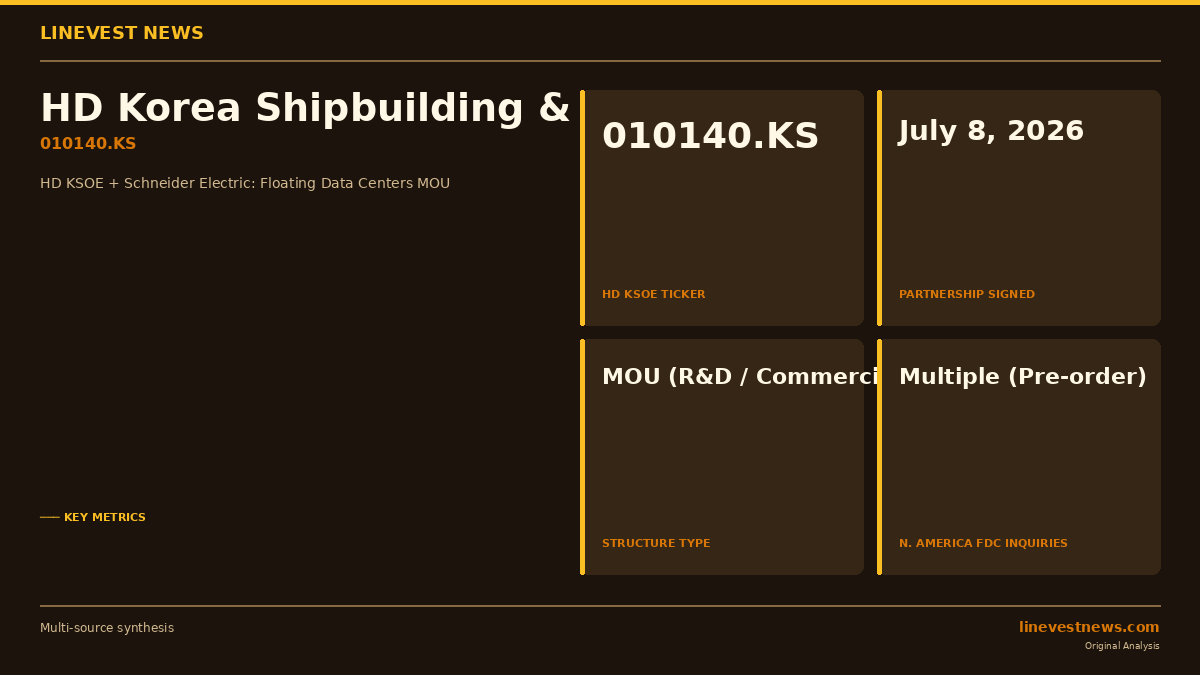
HD Korea Shipbuilding & Offshore Engineering (HD KSOE, 010140.KS) and Schneider Electric signed a memorandum of understanding on July 8, 2026 to jointly develop floating data center (FDC) infrastructure, marking a significant pivot for Korea's shipbuilding sector toward AI-era demand.
The agreement was formalized at HD Hyundai's Global R&D Center in Seongnam, Gyeonggi Province, attended by HD KSOE President Kim Hyung-gwan and Schneider Electric Korea CEO Kwon Ji-woong.
Part A: What Was Agreed
Under the MOU, the two companies will jointly assess the infrastructure and engineering requirements needed to commercialize floating data centers — offshore computing platforms designed to be deployed on water rather than on land.
The partnership combines Schneider Electric's expertise in power management and liquid cooling systems with HD KSOE's offshore platform engineering capabilities developed through decades of designing and building FPSOs (floating production, storage and offloading vessels), FLNGs (floating liquefied natural gas facilities), and semi-submersible platforms.
Specific collaboration areas include:
- Engineering feasibility studies for offshore data center deployment
- Optimized cooling system design leveraging seawater as a heat sink — a natural advantage of marine platforms
- Power distribution architecture for remote offshore installations
- Technical exchange on engineering challenges unique to marine environments and AI workloads
No contract values, production timelines, or revenue targets were disclosed. The partnership remains in its scoping phase.
Part B: The Investment Case for KOSPI Shipbuilders
Why floating data centers, and why now?
Global data center capacity is struggling to keep pace with accelerating AI infrastructure demand. The constraint is not primarily capital — it is land, grid connection capacity, and cooling water availability in densely populated metropolitan areas. Floating data centers address all three bottlenecks simultaneously: they sit offshore, use seawater for cooling at near-zero marginal cost, and can be positioned near undersea cable infrastructure without competing for urban real estate.
North American technology clients have already begun sending inquiries to Korean shipbuilders for FDC orders, according to industry sources cited by KED Global, underscoring that demand is moving from conceptual to procurement.
HD KSOE's structural advantage
HD KSOE serves as the intermediate holding company for HD Hyundai Heavy Industries Group's shipbuilding and offshore divisions — a portfolio that includes HD Hyundai Heavy Industries (329180.KS), the world's largest single-site shipyard by volume.
The offshore engineering capabilities at the heart of this MOU — structural integrity for harsh sea states, marine power distribution, corrosion-resistant systems, and redundant propulsion and mooring — are the same competencies refined over 50 years of FPSO and FLNG construction. An FDC is, in engineering terms, a modified offshore accommodation and processing platform with computing loads substituted for hydrocarbon processing.
This reduces HD KSOE's learning curve compared with pure technology companies or real estate developers attempting to build offshore. The Schneider partnership adds the critical piece Korean shipbuilders have historically outsourced: integrated electrical, cooling, and building management systems.
Sector implications: order book diversification at a key moment
KOSPI-listed Korean shipbuilders entered 2026 with historically full order books driven by LNG carrier demand. However, the LNG ordering cycle has begun to plateau as buyers digest capacity ordered in 2023–2024. The question for equity investors is whether new order categories can sustain the volume momentum.
Defense naval vessels (the subject of last week's US Navy RFI to Korean yards) and floating data centers represent two distinct demand vectors that are structurally uncorrelated with LNG commodity cycles — a meaningful de-risking narrative for sector investors.
HD KSOE's stock (010140.KS) has been one of the stronger performers in the KOSPI shipbuilding sub-index in 2026, benefiting from both the LNG cycle and defense exposure through affiliated yards. A credible FDC commercialization pathway would add a third revenue leg to a sector that has traditionally been highly cyclical.
Risks and what to watch
The MOU is non-binding and carries none of the financial commitments of a commercial contract. Key uncertainties include:
- Regulatory approvals: Floating data centers operating in exclusive economic zones involve complex maritime, environmental, and data sovereignty regulations in target markets
- Connectivity costs: Submarine cable links to onshore internet exchanges add capital cost and latency
- Power supply: Offshore power generation or shore-to-sea cable transmission is expensive; nuclear SMR applications for FDCs remain pre-commercial
- No timeline: Both parties have declined to specify a commercialization date
Investors should treat this as an option on a high-growth theme rather than a near-term earnings catalyst. The next signpost is whether the MOU converts to a funded Joint Development Agreement (JDA) or whether a non-disclosure procurement process begins with named North American clients.
Peer context
Microsoft, Google, and Amazon have collectively announced over USD 300 billion in data center capital expenditure for 2025–2027. Even a 1–2% offshore component would represent a USD 3–6 billion addressable market for specialized engineering firms. Korean shipbuilders, who collectively hold over 50% of global LNG carrier and FPSO market share, are the natural engineering partners for floating-platform configurations.
Hyundai Heavy Industries, Samsung Heavy Industries (010140.KS peers via Samsung C&T), and Hanwha Ocean (042660.KS) are all evaluating offshore data center concepts. The HD KSOE-Schneider MOU is the first signed partnership to be publicly disclosed among the major Korean yards, giving HD KSOE a potential first-mover narrative in analyst coverage.
Sources: Korea Herald · KED Global