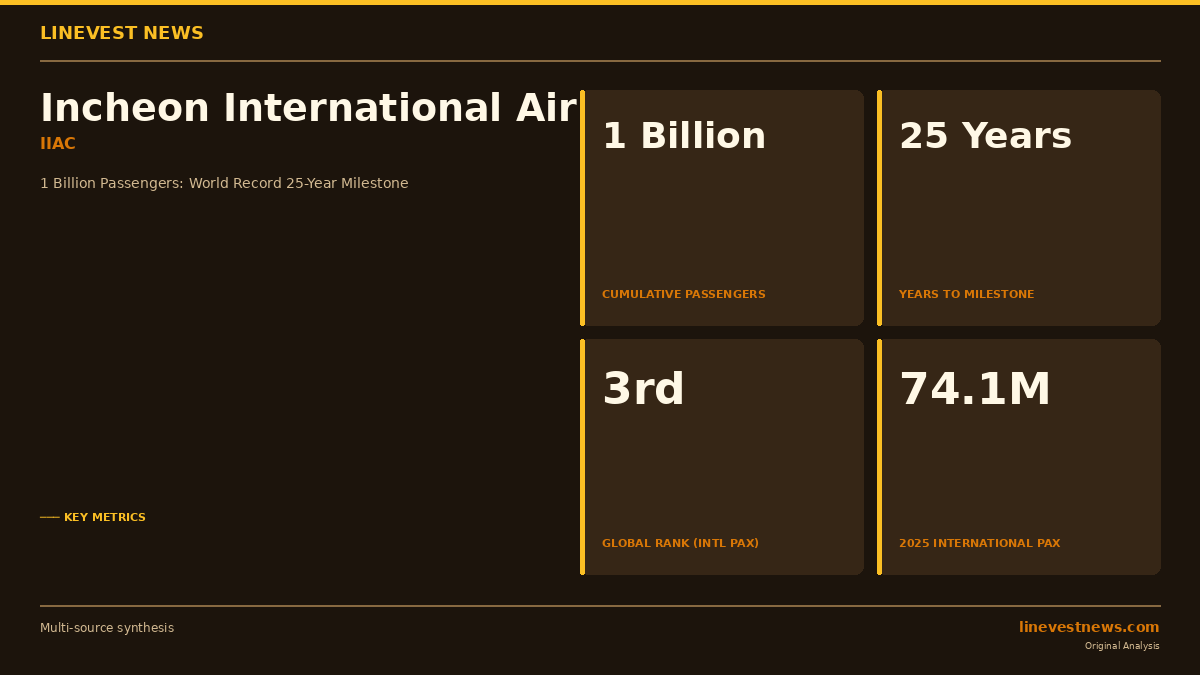
Incheon International Airport surpassed 1 billion cumulative passengers in July 2026, the Incheon International Airport Corporation (IIAC) announced, marking a threshold reached faster than any peer hub in the world.
The airport opened its first terminal in March 2001 on reclaimed tidal flats off the west coast of Incheon, a site chosen to relieve Seoul's aging Gimpo Airport and position South Korea as the gateway to Northeast Asia. It logged its 100 millionth passenger in 2005 and its 500 millionth in 2016 before reaching the billion mark this month — a trajectory made possible by a near-uninterrupted run of capacity additions across four expansion phases.
The speed record stands out in the peer set. Munich Airport took approximately 34 years to reach the same milestone. Singapore Changi needed about 35 years. Tokyo's Narita required 39 years, and Dubai International took more than 58 years. Incheon's 25-year pace is the shortest in that group.
In 2025, the airport handled 74.1 million international passengers, placing it third globally in international traffic. Its route network spans 183 cities across 53 countries served by 101 airlines. A fourth expansion phase, completed in 2024, raised annual capacity to 106 million passengers — the third-largest international capacity in the world, behind Hong Kong and Dubai.
Acting president Kim Bum-ho stated the corporation would continue "investing in facilities and service innovation to improve convenience" for travellers.
Korea Market Implications
Aviation: Korean Air in the Hub Position
The billion-passenger milestone arrives as the Korean aviation market completes a structural realignment. Korean Air Lines (003490.KS), which operates the largest number of international routes at Incheon, is the most direct beneficiary of every incremental upturn in hub traffic. With IIAC's fourth terminal and concourse additions in place, Korean Air gained the gate capacity it needs to expand long-haul widebody operations — a constraint that had limited schedule growth in 2023–2024.
Asiana Airlines (020560.KS), now integrated into the Korean Air group following multi-jurisdictional regulatory proceedings across the United States, European Union, and Asia-Pacific, adds a second major carrier with heavy exposure to Incheon's traffic curve. The combined entity has the fleet depth and bilateral traffic rights to benefit disproportionately from a rising inbound passenger count.
Tourism: The 30 Million Visitor Target Creates a Structural Demand Floor
The South Korean government has set an explicit target of 30 million foreign visitors per year — a level that requires traffic to grow 58.5% from the 18.94 million recorded in 2025. That gap represents roughly 11 million additional arrivals, the equivalent of adding another mid-sized Asian source market at full saturation.
If approached over a three-to-five-year horizon, the throughput demand on Incheon would be structurally higher than current assumptions. Airlines and handlers have already priced some of this upside through the Phase 4 capacity build-out. What the billion-passenger announcement does is confirm that actual demand has tracked the pace needed to close that gap.
Cargo and Semiconductor Logistics
Incheon handles approximately 99% of South Korea's semiconductor exports by value, a concentration that reflects the airport's proximity to the main wafer-fabrication corridors in Gyeonggi Province and its investment in specialized cold-chain and time-critical freight facilities.
In a year when Samsung Electronics (005930.KS) posted a record Q2 2026 operating profit of KRW 89.4 trillion and SK Hynix (000660.KS) is preparing a record Nasdaq ADR listing, cargo volumes at Incheon have accelerated alongside production and export runs. Cargo revenue represents roughly 30–40% of IIAC's total revenue — meaning the airport's own trajectory is co-incident with the earnings cycle of Korea's top two semiconductor exporters.
What Investors Should Watch
- IIAC monthly traffic releases: The gap to the government's 30 million visitor target is the leading indicator for aviation sector earnings.
- Korean Air long-haul load factors during July–September peak season, when international premium demand is highest.
- Yield management: If the sector front-runs the tourism upside via aggressive capacity additions, yield compression could offset volume gains.
- Cargo rate trends at Incheon: Tied directly to semiconductor production cycles at Samsung and SK Hynix.
For the domestic economy, the 1 billion passenger record reinforces Incheon's position as Northeast Asia's preferred long-haul transit hub — a designation that carries network-effect advantages: more routes attract more passengers, which attract more airlines, which expand concession and cargo revenue further.
Sources: Korea Herald