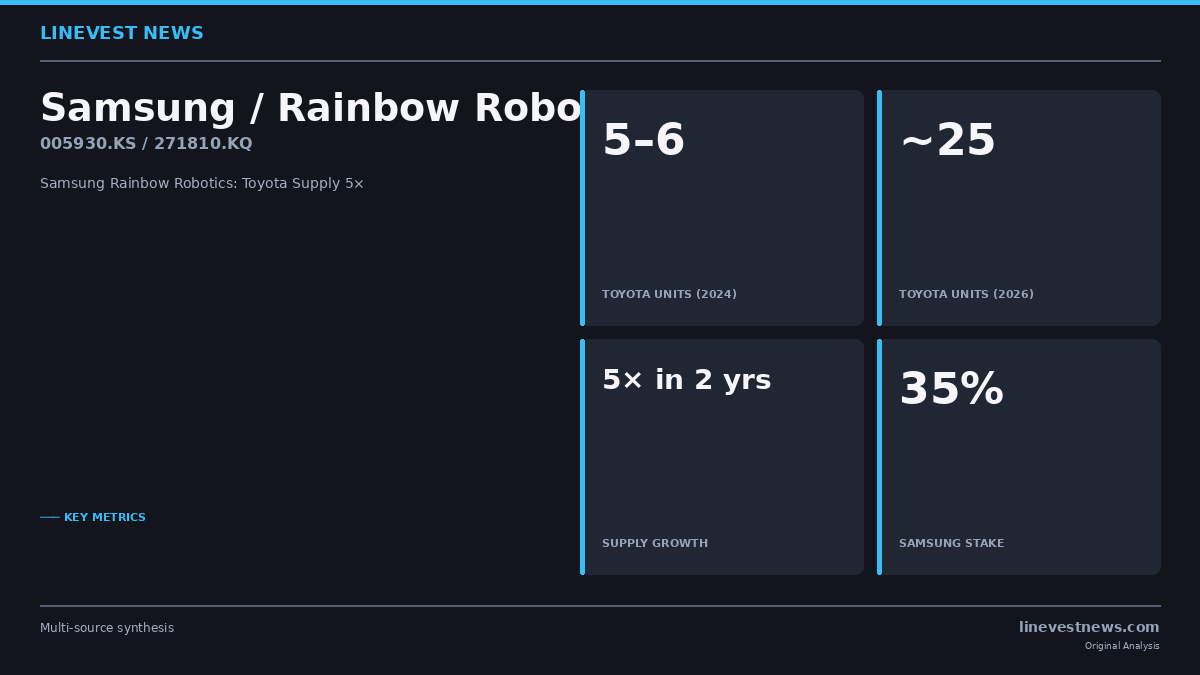
Samsung Electronics' robotics subsidiary Rainbow Robotics has quietly grown its footprint inside Toyota Motor's factories, delivering around 25 units of its RB-Y1 mobile humanoid to the Japanese automaker — a roughly fivefold increase from the initial batch of five to six robots shipped in 2024, according to industry sources cited by ET News.
The expansion underscores the accelerating commercial traction of Korea's humanoid ecosystem at a moment when the global market is projected to scale from USD 4.3 billion in 2025 to roughly USD 70 billion by 2032.
A Prestigious Beachhead in Japan's Tightly-Knit Supply Chain
Toyota, the world's largest automaker by sales for six consecutive years, operates within Japan's closely-integrated domestic robotics supply chain. That the Nagoya-based carmaker chose a Korean-made platform for iterative, hands-on manufacturing trials speaks to the RB-Y1's positioning as one of the few commercially deployable wheeled humanoids on the market today.
Rainbow Robotics' RB-Y1 mounts a dual-arm upper body — capable of dexterous bimanual manipulation — on a fast-moving wheeled base, bypassing the stability limitations of fully legged humanoids while preserving the reach and dexterity needed for assembly-line tasks. Research institutions including MIT, UC Berkeley, and Georgia Tech also use the platform.
Samsung's Expanding Bet: KRW 354 Billion and a CEO-Level Robotics Office
Samsung Electronics converted Rainbow Robotics into a controlled subsidiary in late 2024, exercising a call option worth KRW 267 billion (approximately USD 181.6 million) to lift its stake from 14.7% to 35%. Combined with the original KRW 86.8 billion (USD 59 million) entry in 2023, Samsung has committed more than KRW 350 billion to the venture.
To signal long-term intent, Samsung simultaneously established a Future Robotics Office reporting directly to its CEO. Dr. Jun-Ho Oh, Rainbow's co-founder and KAIST honorary professor, was appointed to lead the unit — merging Rainbow's robotics hardware depth with Samsung's semiconductor, AI, and global sales infrastructure.
Samsung has stated its goal of transforming all global production facilities into AI-driven factories by 2030, with humanoid robots as a central pillar.
Coupang Pilot and the Expanding Commercial Roster
Beyond the Toyota relationship, Rainbow Robotics recently placed an RB-Y1 unit inside a Coupang (CPNG) logistics fulfillment center — its first reported deployment in a live commercial setting outside manufacturing. Coupang, Korea's leading e-commerce operator, offers a test bed for autonomous pick-and-place operations at scale. The dual-track approach — premium OEM customers like Toyota plus high-volume logistics operators — mirrors the commercialization path taken by incumbents such as Boston Dynamics and Agility Robotics.
Korea's Broader Robotics Ambitions
Korea's government has set a target of deploying 700,000 industrial robots and an additional 300,000 service robots by 2030. Korean chaebols collectively plan to absorb tens of thousands of humanoid units into their own facilities over the same horizon, seeding early commercial volumes and accelerating learning curves for the global market.
Competitors in Korea's humanoid supply chain include Doosan Robotics, Hyundai Motor Group's Boston Dynamics unit, and component makers pivoting from automotive and semiconductor supply chains. LG Electronics and Hyundai Mobis have also signalled ambitions in the actuator and sensor layers.
Market Impact and Investor Considerations
For Samsung (005930.KS), the Toyota wins carry outsized reputational weight even at current volumes. Design wins with a globally respected OEM — particularly one with the manufacturing discipline and in-house robotics expertise of Toyota — create a reference case for Samsung's outbound sales effort in Europe, the Americas, and Southeast Asia. Rainbow Robotics revenue remains early-stage, but the trajectory from five units to 25 in two years aligns with the inflection curves seen in early industrial automation adoption.
For Rainbow Robotics (271810.KQ), Samsung's 35% stake and the CEO-level Future Robotics Office signal that Rainbow is now a strategic asset, not merely a portfolio investment. Incremental stake expansion cannot be ruled out as commercial milestones accumulate.
The global humanoid robot market is estimated at USD 4.32 billion for 2025, with projections reaching approximately USD 70 billion by 2032 — a roughly 16-fold expansion implying a compound annual growth rate near 50%. Korea's integrated semiconductor-to-robotics industrial base positions its producers as structurally advantaged suppliers of the AI compute, sensors, and actuators that humanoid robots require.
Risk factors: Unit economics for wheeled humanoids remain unproven at scale. Toyota's 25-unit trial represents a proof-of-concept phase, and commercial scale-up will hinge on reliability data from real manufacturing environments. Competition from Chinese producers — which have demonstrated aggressive cost reduction in factory automation — also bears watching over a multi-year horizon.
Sources: ET News · The Robot Report · Korea Humanoid Robotics 2026 — Seoulz · TechTimes — Rainbow Robotics at Coupang