South Korea's flagship shipbuilders are poised to miss out on one of the largest naval procurement contracts in Canadian history. According to Korean news media reports on July 6, 2026, the country's joint bid by Hanwha Ocean (042660.KS) and HD Hyundai Heavy Industries (329180.KS) was not selected for Canada's submarine replacement program, with Germany's Thyssenkrupp Marine Systems — partnered with Norway — reportedly named the preferred bidder. Canada's Prime Minister Mark Carney is expected to formalize the announcement in Halifax on July 7.
Part A: The Contract and Korea's Bid
A CA$50 Billion Opportunity — Lost
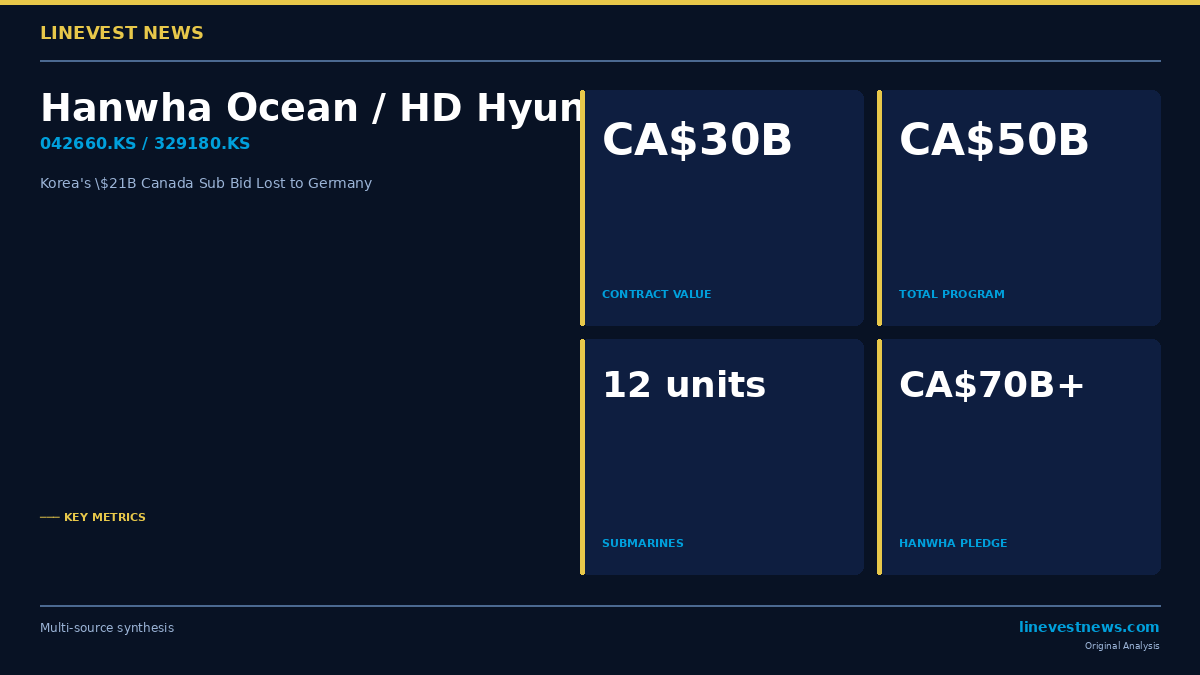
Canada's submarine fleet replacement program calls for up to 12 new submarines, with the acquisition cost estimated at approximately CA$30 billion (USD 21 billion). Including through-life maintenance and sustainment, the total program value rises to as much as CA$50 billion — one of the largest defense contracts ever awarded by the Canadian government.
South Korea mounted an aggressive bid. Hanwha Ocean, which has built KSS-III-class attack submarines for the Republic of Korea Navy, and HD Hyundai Heavy Industries, among the world's largest shipbuilders by output, jointly pitched their combined naval expertise. To sweeten the offer, Hanwha Ocean pledged more than CA$70 billion in trade and investment between 2026 and 2044, pledging to support more than 25,000 Canadian jobs annually. HD Hyundai Heavy Industries proposed an additional offset package including the import of Canadian crude oil through its affiliate HD Hyundai Oilbank, potentially worth trillions of won.
Despite these commitments, Germany's Thyssenkrupp Marine Systems — operating in consortium with Norway — is reported to have prevailed. Thyssenkrupp's proposal claimed a projected economic impact of CA$86 billion and 650,000 jobs, undercutting Korea's bid on both financial returns and political optics.
The competition was launched in August 2025 after Canada concluded its previous submarine program assessment.
Part B: Market Implications for Hanwha Ocean and HD Hyundai Heavy Industries
Hanwha Ocean: Defense Pipeline Dent, But Orderbook Remains Robust
Hanwha Ocean (042660.KS) has built its defense credibility over years of constructing submarines for the Korean Navy. The loss of the Canada contract removes a potential USD 21 billion revenue pipeline from its long-range planning. For context, Hanwha Ocean's annual revenue runs in the range of KRW 8–10 trillion per year — meaning the Canadian contract, if won, would have represented multi-year revenue equivalent to approximately two to three full years of top-line revenue.
That said, Hanwha Ocean's near-term orderbook is driven by LNG carriers, very large crude carriers (VLCCs), and offshore assets. Commercial orders remain strong on the back of global energy logistics demand. The Canada loss is a blow to Hanwha's defense export ambitions rather than an immediate revenue event — the contract would have only begun generating revenue in the early 2030s at the earliest.
Investors should monitor whether Hanwha Ocean re-channels the CA$70 billion investment pledge into other defense markets — Australia's submarine program (AUKUS alternatives) and the Philippines, Poland, and India remain active naval procurement markets where Korean shipbuilders are bidding.
HD Hyundai Heavy Industries: Defense as a Secondary Lever
HD Hyundai Heavy Industries (329180.KS) derives most of its revenue from commercial shipbuilding — LNG carriers, containerships, and offshore structures. Defense, while growing, is a secondary segment for the group. The Canada loss therefore carries less concentrated risk for HD Hyundai Heavy compared with Hanwha Ocean, which has positioned defense shipbuilding as a strategic growth vertical under Hanwha Group.
Still, the offset package HD Hyundai proposed — routing Canadian crude oil imports through HD Hyundai Oilbank — suggests the group was prepared to make a genuinely transformative commitment to the bid. The withdrawal of that prospect removes a downstream revenue tie-in as well.
Broader Defense Sector Read-Through
Korea's defense export industry has achieved notable wins in recent years — K2 tanks and K9 howitzers to Poland, FA-50 fighters to Malaysia, and patrol vessels to Southeast Asian navies. The Canada submarine loss, if confirmed, would mark the highest-profile rebuff of Korea's naval export strategy to date.
The structural reason Germany may have been preferred relates to submarine technology transferability and NATO interoperability. Canada is a NATO member, and Thyssenkrupp submarines (the Type 212 family) are already in service with Germany, Portugal, Italy, and Norway — minimizing integration risk. Korean KSS-III submarines, while technologically advanced, operate outside the NATO supply chain.
For foreign investors in Korean defense names, the key question is whether this outcome signals systemic limits to Korea's non-NATO naval export strategy, or whether it is a one-off loss in a politically sensitive NATO-member procurement process. The latter interpretation appears more probable — Korea's wins in land systems and aviation suggest strong export competitiveness in sectors where NATO interoperability is less critical.
Valuation Context
As of mid-2026, Hanwha Ocean trades at an elevated premium relative to historical multiples, driven by record LNG tanker ordering cycles and defense narrative. The Canada loss removes one pillar of that defense premium but does not alter the commercial shipbuilding thesis. A 5–10% near-term price reaction would not be surprising on the day of the official announcement, but the medium-term case — centred on LNG and offshore — remains intact.
HD Hyundai Heavy Industries shares similarly reflect a combination of LNG cycle enthusiasm and defense optionality. The Canada loss trims the defense optionality component, but given its secondary weight in the revenue mix, the share price impact is expected to be more muted.
Sources: Korea Herald – "S. Korea may lose Canada's multibillion-dollar submarine bid" · Korea Herald – Business Roundup