Bank of Korea Flags KOSPI Concentration Risk as Samsung and SK Hynix ETFs Surge — While 'Chipflation' Hits Consumer Wallets
Seoul's central bank escalated its warnings about financial-stability risks on July 5, telling parliament that single-stock leverage ETFs tracking Samsung Electronics and SK Hynix are deepening an already extreme concentration in South Korean equities, even as surging chip prices begin hurting household budgets across the country.
Part A — What the Bank of Korea Said
The Bank of Korea submitted written responses to the National Assembly's finance committee on Sunday, flagging two distinct but related risks stemming from the memory-chip boom.
Concentration risk from leverage ETFs
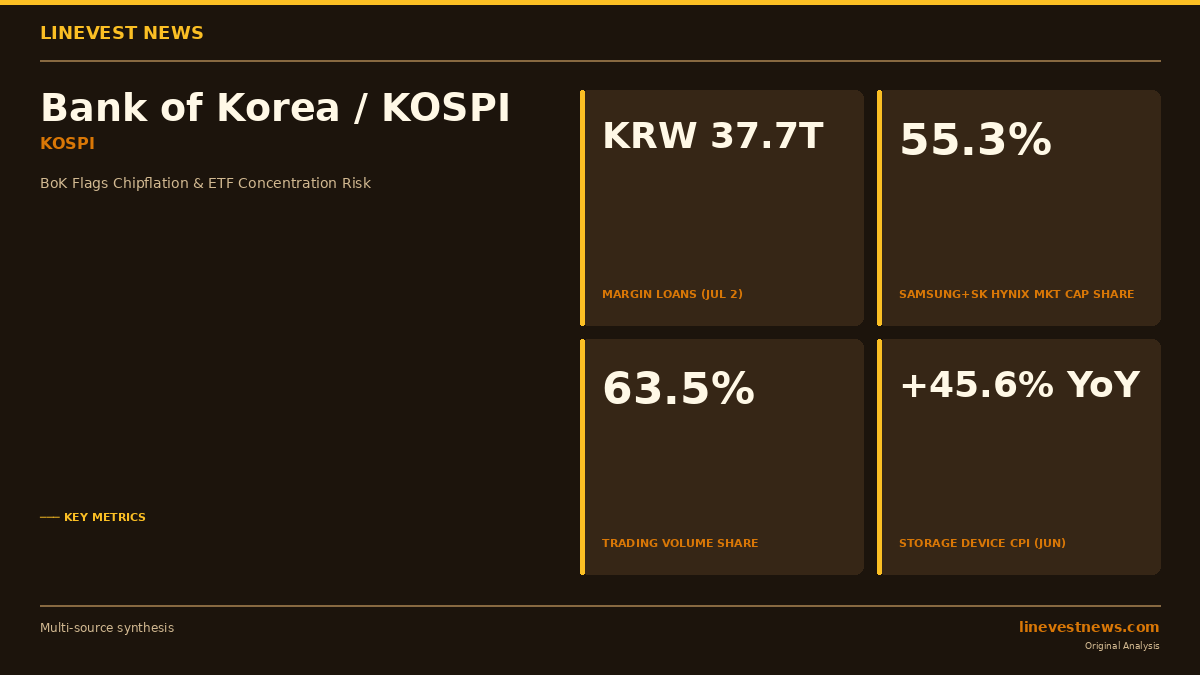
Samsung Electronics and SK Hynix together accounted for just 36.1% of total KOSPI market capitalization at the end of 2025. By June 24, 2026, that share had risen to 55.3% — a jump of 19.2 percentage points in roughly six months. Their combined share of daily trading volume on the Korea Exchange expanded even more sharply, from 27.9% to 63.5% over the same period.
The Bank of Korea said the proliferation of single-stock leverage ETFs tied to both companies is amplifying the concentration further. "The expansion of single-stock leverage ETF investment is likely to deepen this concentration," the central bank said, noting that daily rebalancing and futures-based arbitrage activity embedded in leverage products can magnify price swings in both directions.
The warning marks a conspicuous shift in tone. Just ten days earlier, on June 24, the Bank of Korea's semi-annual Financial Stability Report had characterised the new ETF products as tools that could attract foreign inflows and stem domestic capital outflows. The July 5 submission, by contrast, called for heightened monitoring and inspection of their impact on markets and the broader financial system.
Financial Supervisory Service Governor Lee Chan-jin added to the chorus of caution. Speaking at a press conference on June 22, Lee said he "personally reflects on whether [the regulator] should have blocked [single-stock leverage ETFs] by lying down in front of them" — a striking admission from the head of the country's securities watchdog.
Margin debt rising in parallel
The Bank of Korea separately noted that individual margin-loan balances (신용거래융자) reached KRW 37.72 trillion (approximately USD 27 billion) as of July 2, having grown by KRW 400 billion in the preceding 48 hours alone. Aggregate unsecured credit balances at the five major commercial banks — KB Kookmin, Shinhan, Hana, Woori, and NH Nonghyup — stood at KRW 109.16 trillion as of the same date, up KRW 494.4 billion from end-June.
"While the recent rally is grounded in solid semiconductor fundamentals, leverage investing by individuals has also contributed to a meaningful degree," the central bank said. It cautioned that a sharp price correction could trigger cascading margin calls, forced selling and ETF redemptions that would amplify losses beyond the initial investors.
Part B — Market and Household Impact
The chipflation feedback loop
The same supply constraints and AI-driven demand surge that have propelled Samsung and SK Hynix to combined operating-profit forecasts of more than KRW 600 trillion for 2026 are now transmitting into consumer prices in ways that analysts are beginning to call "chipflation."
Data from Korea's national statistics agency show that storage-device prices jumped 45.6% year-on-year in June 2026, the highest inflation rate among the 458 items tracked in the country's consumer price index. Personal computer prices rose 22.2% over the same period, accelerating from just 5.1% in January through 10.8% in February, 12.4% in March, 19.4% in April, and 19.0% in May.
To put those figures in context: diesel fuel — whose price surged amid ongoing Middle East conflict — rose 33.7% year-on-year in June. Gasoline rose 23.1%. Korean consumers are now paying more for a hard drive or a laptop than they are absorbing from oil-price inflation at the fuel pump.
Structural risk: a two-company market
The market-cap data cited by the Bank of Korea underscore how unusual the current KOSPI structure has become. When two companies in a single industry account for more than half the benchmark index's market capitalisation and nearly two-thirds of its daily trading turnover, sector-specific shocks — a HBM yield miss, a major customer inventory correction, or a fresh round of US export controls — carry systemic implications for retail portfolios far beyond their footprint in the real economy.
The Bank of Korea's concern is not just about individual investor losses in a downturn. The leverage ETF mechanism — daily rebalancing and delta-hedging by market makers — means that selling pressure in the underlying shares can amplify mechanically as prices fall, potentially converting a fundamentals-driven correction into a broader liquidity event.
What foreign investors are watching
Foreign net selling of KOSPI equities in the first half of 2026 totalled KRW 156 trillion, making it the second-worst H1 for foreign outflows since 1998, according to the article published earlier today on this site. Today's BoK submission adds a new dimension to that trend: domestic retail investors have stepped into the void left by foreigners, partly via leverage and single-stock ETFs, at precisely the moment regulators are raising alarm about concentrated positions in two heavyweight names.
Whether the Bank of Korea follows its written warnings with concrete macroprudential action — such as tighter loan-to-value limits on margin accounts or position-size caps on leverage ETF exposure — remains to be seen. The June 24 Financial Stability Report contained softer language than Sunday's submission, suggesting the central bank is still calibrating its response. Investors with concentrated exposure to Samsung and SK Hynix, either directly or through leverage products, should treat the escalating warnings as a signal that regulatory intervention is on the table.
Sources: Chosunbiz — BoK leverage ETF warning · Chosunbiz — BoK margin debt warning · Newsis — Chipflation analysis