Part A — The News
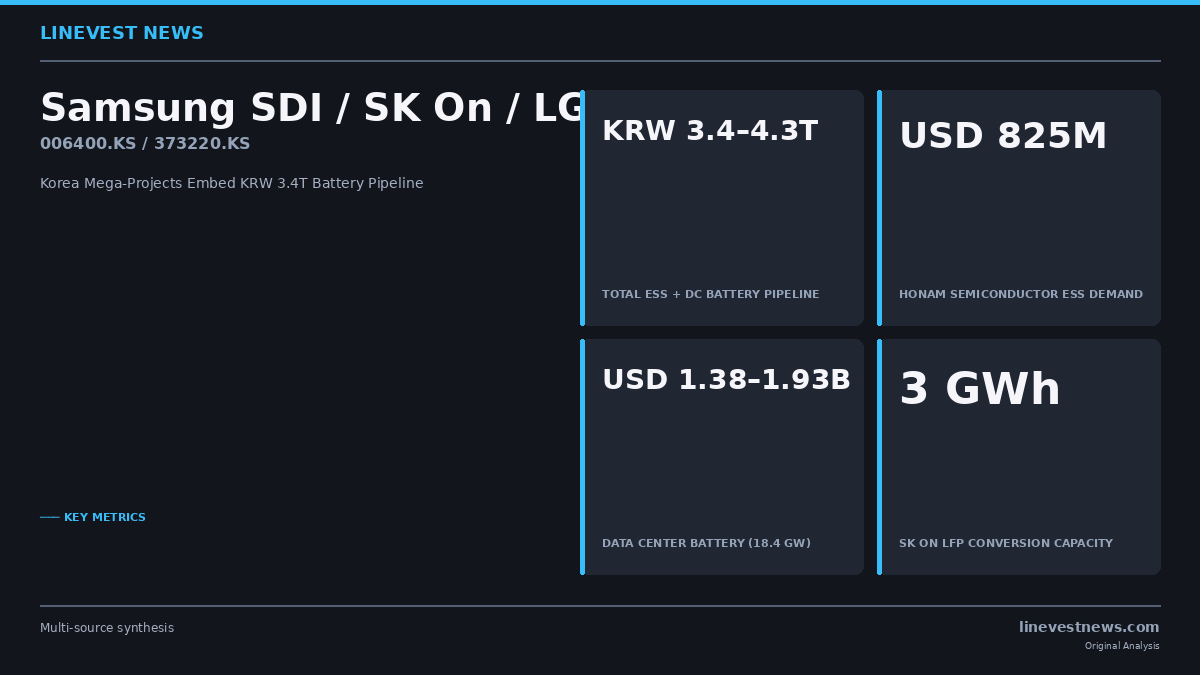
Samsung SDI, SK On, and LG Energy Solution are each quietly recalibrating their energy-storage roadmaps following the South Korean government's announcement, together with Samsung Group and SK Group, of a sweeping KRW 1,000 trillion "Three Mega-Projects" development plan unveiled on June 29. Industry insiders now estimate the blueprint embeds roughly KRW 3.4 trillion to KRW 4.3 trillion in battery demand that has so far received far less attention than the semiconductor headlines.
The first demand source is the Honam semiconductor cluster in Gwangju and South Jeolla Province, which will require approximately 6.3 GW of continuous power once Samsung Electronics and SK Hynix complete their planned eight memory-fab lines. Because the region runs on solar (6.97 GW installed) and wind (0.56 GW), grid operators will need large-scale energy-storage systems to smooth intermittency. Using a standard 2 GWh per GW backup ratio and an LFP cell cost of roughly USD 55 per kWh, analysts calculate the Honam grid alone could absorb up to USD 825 million (approximately KRW 1.28 trillion) in battery investment.
The second, larger driver is the nationwide data-center buildout. SK Group, GS Group, and Naver have committed to 18.4 GW of AI data centers by 2035, with a first phase of 8.4 GW by 2029. Each gigawatt of capacity requires roughly 300 MWh of lithium battery backup—the equivalent of 3,750 electric-vehicle battery packs—to bridge the gap between a grid outage and diesel-generator startup. At installed costs of USD 250–350 per kWh, the 18.4 GW programme translates to USD 1.38 billion to USD 1.93 billion (KRW 2.14 trillion to KRW 2.99 trillion) in battery expenditure.
The combined pipeline of KRW 3.4 trillion to KRW 4.3 trillion is spread unevenly across the three Korean cell makers. Because Samsung SDI (006400.KS) and SK On fall under the Samsung and SK conglomerates that are anchoring the mega projects, battery industry sources suggest those two companies are positioned to capture a disproportionate share. SK On has already begun converting part of its Seosan Plant 2—roughly 3 GWh of capacity—from EV to LFP-based ESS production. Samsung SDI is similarly repurposing lines at its Ulsan plant and at its Indiana joint venture with Stellantis. LG Energy Solution (373220.KS), which has no formal ties to the project sponsors, is said to have its existing ESS capacity fully committed, leaving limited bandwidth to bid on new contracts until additional lines are brought online.
Part B — Market Context
Korea's battery industry has spent much of 2025–2026 absorbing the dual shock of slower global EV adoption and intensifying Chinese competition on LFP costs. The mega-project announcement does not solve either of those structural problems, but it does open a domestic market window that is insulated from Chinese price competition: both semiconductor-fab ESS and data-centre UPS systems require long-term service contracts, safety certifications, and grid-integration expertise where Korean makers hold a home-court advantage.
The numbers also cut the other way. Even if SK On captures its entire projected share of the Honam ESS market, the KRW 1.28 trillion ESS spend will unfold over the multi-year construction timeline of the semiconductor cluster rather than arriving as a near-term earnings catalyst. Investors should calibrate expectations accordingly.
For LG Energy Solution, the more meaningful near-term question is whether its capacity constraint becomes permanent or transitional. The company has previously guided that its Michigan and Arizona gigafactories could be redeployed toward ESS if EV orders slow—exactly the scenario playing out in parts of the North American market. A formal pivot toward domestic ESS contracts could partially offset the earnings drag from delayed EV ramp-up.
One caveat: the KRW 1,000 trillion headline investment figure encompassing the full mega-project package is a multi-decade commitment. Market participants expecting rapid battery procurement should watch for government tenders rather than corporate announcements, as the Ministry of Climate and Energy will need to publish a formal grid-stability plan for the Honam corridor before utilities can issue battery-procurement contracts.
Sources: Chosunbiz – "재생에너지·데이터센터엔 필수… '3대 메가 프로젝트'에 웃는 배터리 업계"