Korean Air Pegs ₩900 Billion–₩1 Trillion Price Tag on Asiana Integration, Targets Breakeven by End-2028
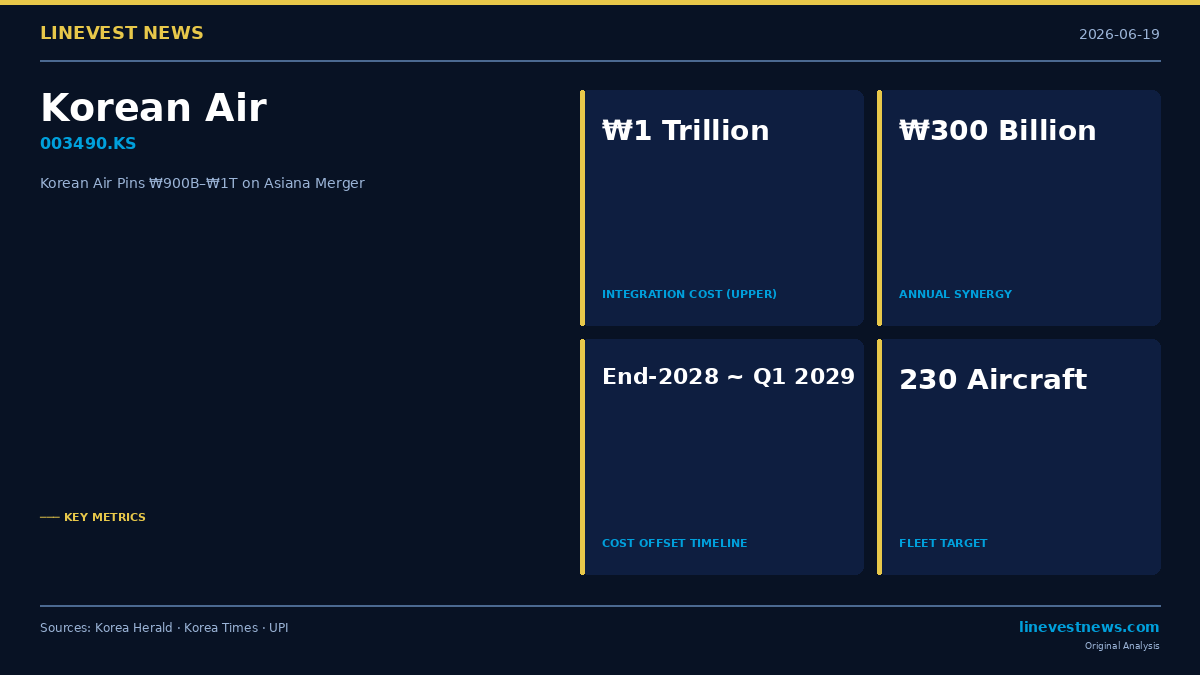
Korean Air disclosed Friday that absorbing Asiana Airlines will cost between ₩900 billion and ₩1 trillion (up to USD 654 million), but projected annual synergies of roughly ₩300 billion should wipe out the bill by late 2028 or early 2029—marking the clearest financial timeline the flag carrier has offered since sealing its landmark takeover.
The figures were presented during an investor-relations session in Seoul, where management laid out a post-merger integration (PMI) roadmap for stakeholders.
"We expect the synergy effects could exceed the results of the PMI analysis," said Park Hee-don, a senior vice president at Korean Air. "If things go well, we believe the integration costs could be fully offset sometime between the end of 2028 and early 2029."
Unified Carrier Launch Set for December 17
Korean Air is targeting December 17 as the completion date for launching the integrated carrier. Before that milestone, management aims to finalize the merger of both airlines' frequent-flyer programs ahead of an August shareholders' meeting—a move that will determine how roughly 25 million combined loyalty members earn and redeem miles under a single brand.
₩23 Trillion Revenue and a Top-10 Global Ranking
Once fully merged, the combined airline is expected to operate a fleet of 230 aircraft and generate ₩23 trillion in annual revenue, which would vault Korea's flag carrier into the top 10 globally by size. Korean Air completed its acquisition of Asiana in December 2024 after a three-year regulatory marathon that extracted concessions on transatlantic and transpacific routes.
The ₩300 billion annual synergy figure implies the integration investment recovers in roughly three years at that run rate—a payback period management appears comfortable defending to investors, even as short-haul seat overlap and legacy IT systems remain the costliest unknowns.
Wider Implications for Korea's Aviation Sector
The merger created a dominant domestic player with more than 60% of South Korea's international seat capacity. With a breakeven horizon now clearly set for 2028–2029, Korean Air is effectively signaling that near-term earnings pressure from integration expenses is manageable—and that the long-term calculus of a combined network dwarfs those costs.
Sources: Korea Herald (June 19, 2026) · Korea Times (June 19, 2026) · UPI (June 19, 2026) · Asia Business Daily (June 19, 2026) · Seoul Economic Daily (June 19, 2026)
Sources: Korea Herald · Korea Times · UPI · Asia Business Daily · Seoul Economic Daily