KakaoPay, Toss Pay Pull Payment Services From Megabox as Court Freeze Locks Out Refunds
KakaoPay (377300.KS), the mobile-payments arm of messaging giant Kakao, and Toss Pay, the payments service run by fintech firm Viva Republica, both stopped offering payment-gateway (PG) services for Megabox online ticketing from the afternoon of June 18, business outlet Chosunbiz reported. Megabox — Korea's third-largest multiplex cinema operator, formally Megabox JoongAng — entered court rehabilitation this week, and the two fintechs disappeared from its checkout page as a result.
The immediate trigger is a court order. On June 15, the Seoul Bankruptcy Court — Korea's specialized insolvency court — issued a preservation measure and a comprehensive prohibition order against Megabox JoongAng, freezing the company's debts and assets, per Chosunbiz. Toss Pay said it "temporarily restricted new Toss Pay payments at Megabox" because the rehabilitation filing raised uncertainty over settlement and refund processing, and that it would review resuming service "once the settlement structure and customer-protection measures are confirmed," according to Chosunbiz.
Why the payment firms are running
The mechanics explain the urgency. When a customer pays for a ticket through a PG provider and later cancels, the cinema owes that refund money back to the payment firm. With Megabox's assets frozen under the comprehensive prohibition order, the pay companies cannot recover those amounts — and if Megabox ultimately fails its rehabilitation and shuts down, they may never be repaid, a finance-industry official told Chosunbiz. Withdrawing quickly caps the exposure. KakaoPay is publicly listed; Toss Pay's operator, Viva Republica, is privately held.
Sizing the distress
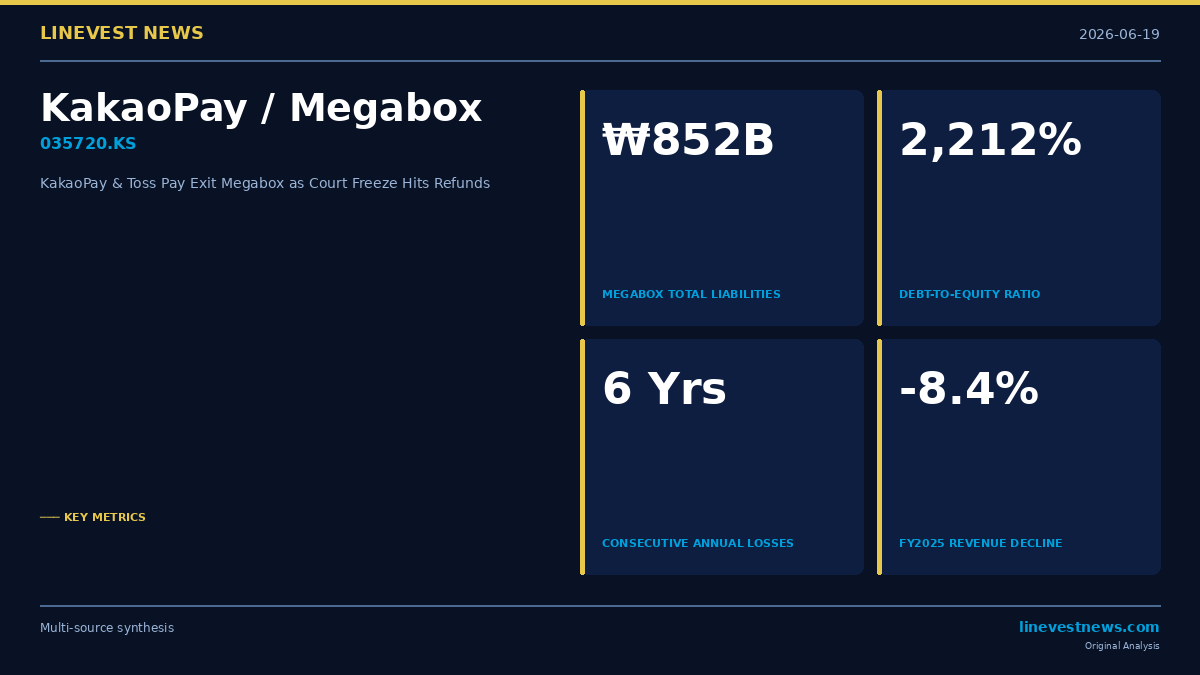
Megabox's balance sheet was already stretched before the filing. As of the end of last year it carried total liabilities of ₩852.2 billion (USD622 million) against total equity of just ₩38.5 billion (USD28 million) — a debt-to-equity ratio of about 2,212%, per Chosunbiz. That ratio had jumped from roughly 857% a year earlier, according to Business Post. Chosunbiz reported the chain has booked losses for six consecutive years through 2025. Revenue last year fell 8.4% to ₩323.8 billion (USD236 million), Business Post reported, and in the first quarter of 2026 Megabox JoongAng posted ₩61.8 billion (USD45 million) in revenue with a ₩1.4 billion (USD1.0 million) operating loss — the only major Korean cinema operator to stay in the red as box-office conditions recovered.
The cinema sits inside a wider corporate failure. JoongAng Group, one of Korea's largest media conglomerates, was tipped into crisis when its flagship cable broadcaster JTBC declared a default on June 12 after failing to repay ₩20.6 billion (USD13.6 million) in securitized borrowings, The Korea Times reported. JoongAng Holdings, Contentree JoongAng, JoongAng P&I and Megabox JoongAng filed for court rehabilitation, with JTBC following the next day. The Korea Times traced the liquidity squeeze to roughly USD500 million (about ₩700 billion) the group spent on Olympic and World Cup broadcast rights that did not pay off. Korea Investors Service (KIS), one of Korea's main credit-rating agencies, cut Megabox JoongAng's short-term credit rating to 'C' and placed it under review for further downgrade, per Chosunbiz.
A familiar playbook
Korea has seen this sequence before. When e-commerce platforms TMON and WeMakePrice collapsed in July 2024, overdue vendor settlements ultimately swelled to ₩1.3 trillion (about USD978 million), The Korea Herald reported. Payment firms including Naver Pay, KakaoPay, Toss Pay and Payco stopped handling payments and cancellations on the platforms as their insolvency became clear, The Korea Herald separately reported. Refunds proved largely unrecoverable afterward — The Korea Times later reported that only a fraction of consumer damages were repaid. The current Megabox withdrawal follows the same logic: payment intermediaries de-risk first, leaving the question of who absorbs the loss to the court process.
The open question
The next concrete marker is the Seoul Bankruptcy Court's decision on whether to formally open rehabilitation proceedings for Megabox JoongAng. That ruling will also clarify whether refund liabilities to KakaoPay and Toss Pay sit inside the frozen estate, and whether other Megabox counterparties — film distributors awaiting box-office settlements among them — move to protect themselves as well.
This article is for informational purposes only and does not constitute investment advice. Figures are sourced from the cited reporting; currency conversions use approximate rates and may differ from those in the original sources.
Sources
- https://biz.chosun.com/stock/finance/2026/06/19/WPIWLGZ7E5E5LE5FSCGCOZHDLI/
- https://www.koreatimes.co.kr/southkorea/society/20260616/jtbc-files-for-corporate-rehabilitation-as-costly-world-cup-olympics-deals-push-joongang-group-into-crisis
- https://www.businesspost.co.kr/BP?command=article_view&num=439984
- https://m.koreaherald.com/view.php?ud=20240825050151
- https://www.koreaherald.com/article/3440219
- https://www.koreatimes.co.kr/business/banking-finance/20250212/only-11-mil-out-of-93-mil-refunded-to-tmon-wemakeprice-victims