Posco Opens Korea's Largest Electric Arc Furnace, Launches Rare Gas Unit That Can Supply 52% of Domestic Semiconductor Demand
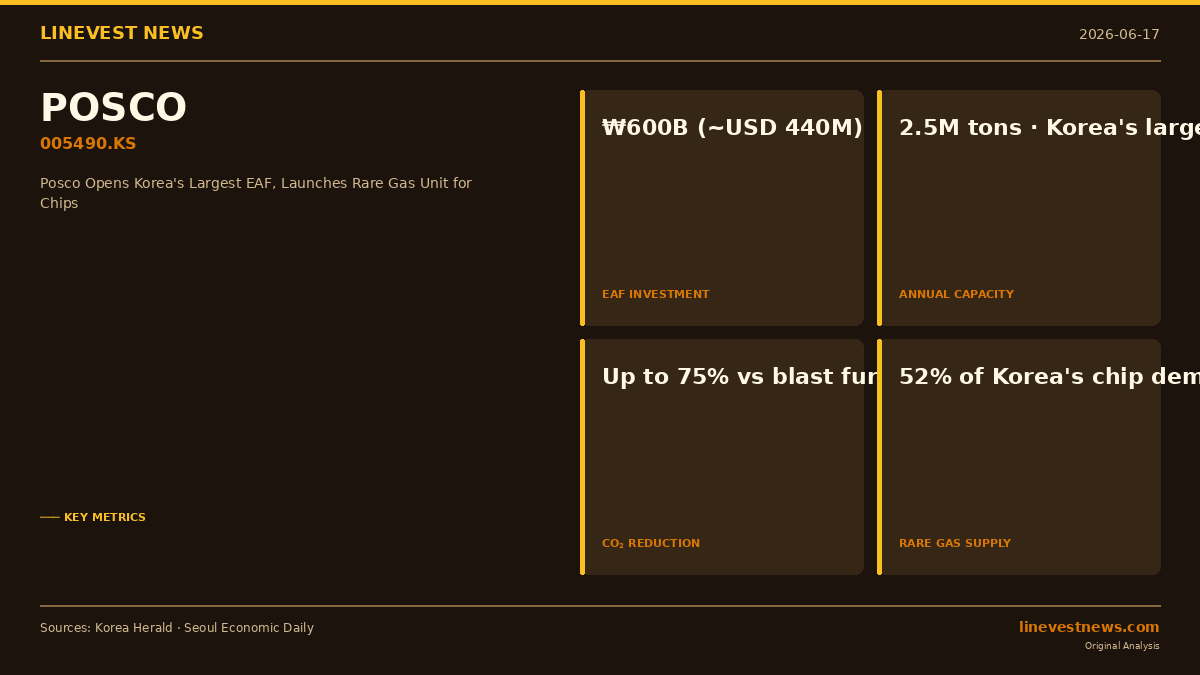
Gwangyang, South Jeolla Province — June 17, 2026 — Posco Group inaugurated South Korea's largest electric arc furnace (EAF) on Wednesday at its Gwangyang steel complex, completing a ₩600 billion (approximately USD 440 million) investment that the company says can cut carbon emissions by up to 75 percent compared with its conventional blast-furnace process. Prime Minister Kim Min-seok and Posco Group Chairman Chang In-hwa attended the completion ceremony, signaling the project's strategic weight for both Korea's decarbonization agenda and its industrial supply chains.
The new furnace has annual crude steel production capacity of 2.5 million metric tons, making it the single largest electric arc furnace in the country. Unlike traditional blast furnaces that smelt iron ore with coking coal, the EAF melts recycled steel scrap using electricity, slashing direct CO₂ output by as much as three-quarters per ton of steel produced. Posco will source roughly two million tons of external scrap in 2026 alone as the facility ramps up, with in-house storage at the Gwangyang site being expanded from 110,000 to 160,000 tons by August. The Gwangyang EAF uses Italian steelmaker equipment specialist Tenova's Consteel continuous-scrap-feeding system, which preheats incoming scrap with waste furnace gases, further improving energy efficiency.
Alongside the EAF, Posco Air Solution — the group's industrial gas arm — opened a high-purity rare gas production plant at the same site. The facility can output 130,000 normal cubic meters per year of xenon, krypton and neon, gases essential to extreme-ultraviolet (EUV) and deep-UV (DUV) lithography as well as semiconductor etching processes. At that output level, the plant is estimated to cover approximately 52 percent of South Korea's domestic demand for semiconductor-grade rare gases. The gases are separated and refined from by-product oxygen streams at Posco's existing steelworks — a circular-process approach that converts industrial waste gas into a high-value feedstock.
Chairman Chang In-hwa said the EAF "demonstrates our commitment to addressing the global challenge of decarbonization and reshaping the future competitiveness of the steel industry," and added that the ability to "produce and stably supply key materials for the semiconductor and aerospace industries with our own technology is highly meaningful."
Part B — Why This Matters for Korea's Industrial Supply Chain
Green steel under pressure, EAF offers a bridge. Korea's steel industry faces a tightening regulatory environment as the European Union's Carbon Border Adjustment Mechanism (CBAM) — which prices embedded carbon in steel imports — phases in over the 2026–2034 window. Posco exports significant volumes of value-added steel to EU auto and shipbuilding customers, and high carbon intensity could translate into effective tariffs on those sales. The Gwangyang EAF, operating on grid electricity rather than coking coal, gives Posco its first large-scale low-carbon production route and a credible commercial argument with climate-conscious buyers in Europe and North America.
Posco's longer-term decarbonization road map goes further. The company is developing HyRex, a proprietary hydrogen-reduction steelmaking technology that eliminates the need for carbon entirely. HyRex is currently in demonstration-scale trials with a target of 300,000 tons of annual output; Posco aims to begin mass production using HyRex by 2030 and to transition its full steel output to hydrogen-based routes by 2050. The Gwangyang EAF serves as a stepping stone on that path, establishing operational experience with low-carbon steelmaking while HyRex matures.
Rare gas supply chain: a strategic gap closed. Russia's invasion of Ukraine in 2022 triggered a global supply shock in neon — a by-product of Russian steel oxygen plants — which accounted for roughly 70 percent of world neon supply at the time. Neon is a critical feedstock for DUV lithography lasers used in semiconductor fabs worldwide, and the disruption pushed neon prices up more than ten-fold before alternative sources came online. Korea, home to Samsung Electronics, SK Hynix and a dense cluster of chip-packaging and display companies, remained heavily import-dependent for semiconductor rare gases.
By extracting xenon, krypton and neon from its own oxygen plants at Gwangyang and refining them to semiconductor-grade purity, Posco Air Solution addresses that vulnerability directly. At 52 percent of domestic demand, the plant does not eliminate Korea's import dependence but meaningfully reduces it and gives Korean chipmakers a domestic buffer against future supply disruptions. Rare gases also serve aerospace (propulsion systems, satellite sensors) and medical (imaging and laser surgery) end markets, broadening the revenue base.
Investment implications. POSCO Holdings (KRX: 005490) shares have outperformed the KOSPI industrials index by roughly eight percentage points year-to-date through June 16, buoyed in part by expectations around the Gwangyang EAF ramp and growing interest in the group's rare-materials platform. Analysts have flagged the rare gas business as a nascent but potentially high-margin segment — specialty gas margins can run three to five times those of commodity steel — and the June 17 launch removes execution risk from the investment thesis. The combination of green-steel transition credentials and semiconductor-supply-chain positioning arguably reduces the Korea-discount premium that has historically weighed on Posco's valuation multiple.
Sources: Korea Herald, Seoul Economic Daily, IndexBox Steel Industry Report, Posco Group press release