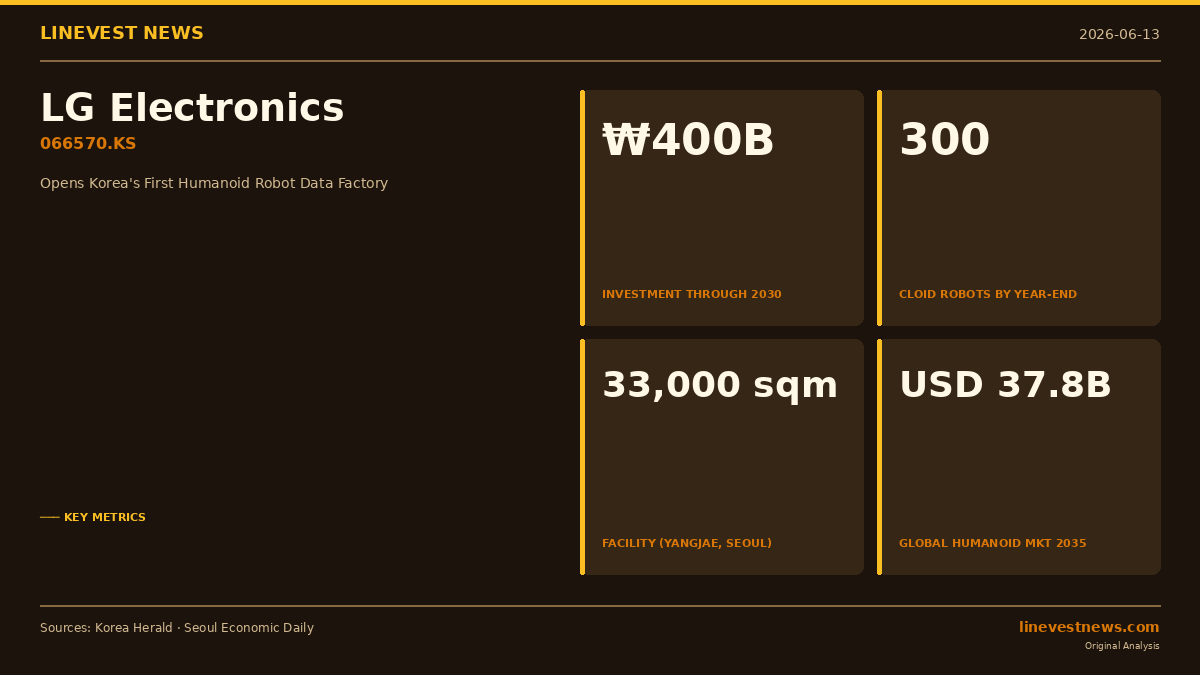
LG Electronics (KRX: 066570) has converted its 33,000-square-meter R&D campus in Seoul's Yangjae district into what the company calls Korea's first dedicated humanoid robot data factory, committing more than KRW 400 billion (USD 263 million) through 2030 to generate the real-world motion data that has become the central bottleneck in the global race to commercialize humanoid robots.
The facility — spanning four floors of a converted research building — will begin operations in July 2026 with 100 units of CLOiD, LG's dual-arm prototype humanoid. The company plans to scale that fleet to 300 units by year-end, each robot repeatedly performing household tasks across mock living spaces fitted with LG appliances and a running production line. A transport cart imported from LG's Tennessee manufacturing plant has been added to expand the range of environments the robots can train in.
CEO Lyu Jae-cheol — who visits the site weekly to oversee progress — confirmed LG is targeting a 2028 commercial launch in the home-robot market. The timeline is ambitious: when CLOiD debuted at CES 2026, reviewers noted slow movements and the absence of independent decision-making. The data factory is explicitly designed to close that gap through what LG calls a Robot Foundation Model (RFM), the AI brain enabling faster and more autonomous motion.
Why Data, Not Hardware, Is the Stall Point
The strategic logic mirrors what happened in large language models, but with a critical difference. Generative AI like GPT can learn from text and images that already exist on the internet. A robot cannot scrape the experience of gripping a cup, opening a refrigerator door, or transferring objects between shelves — it has to perform each motion physically and record what happens, thousands of times.
"Large-scale training is needed," an LG official said. "Data that can only be acquired through direct physical interaction with the real world must be collected systematically."
LG is not alone in recognizing this bottleneck, but the Yangjae factory is the largest single deployment of humanoid units for proprietary data collection in Korea, and one of the more substantial in Asia. Nvidia, through its Isaac platform and a partnership with LG Group, is also pushing into physical AI training infrastructure globally.
Market Context and Investor Takeaways
The global humanoid robot market is forecast to reach USD 37.8 billion by 2035, according to industry estimates, though near-term revenue remains speculative. LG's actuator mass production — the mechanical joints that enable humanoid movement — is scheduled to begin in the first half of 2026, giving the company a potential component-supply business independent of CLOiD's commercial success.
For investors, the KRW 400 billion commitment represents a meaningful but bounded R&D bet for a company with annual revenue exceeding KRW 80 trillion. LG Electronics shares (066570.KS) have underperformed the KOSPI over the past year amid margin pressure in home appliance and TV businesses; CEO Lyu has explicitly positioned robotics and B2B services as the next growth pillar to replace commoditizing consumer electronics revenue.
Key risks include execution against a 2028 commercial deadline — humanoid commercialization timelines have consistently disappointed industry-wide — and the possibility that the Robot Foundation Model data edge erodes if competitors achieve similar throughput at scale. LG's advantage, if sustained, is its existing appliance ecosystem giving CLOiD purpose-built environments with real user data, a moat that pure-play robotics startups cannot easily replicate.
Key Numbers
- KRW 400B+ (USD 263M): committed investment through 2030
- 33,000 sqm: facility footprint at Yangjae, Seoul
- 100 to 300 CLOiD units: fleet scaling from July to December 2026
- 2028: target year for commercial home-market launch
- USD 37.8B: global humanoid market forecast by 2035
Sources: Korea Herald, Seoul Economic Daily (en.sedaily.com), June 2026