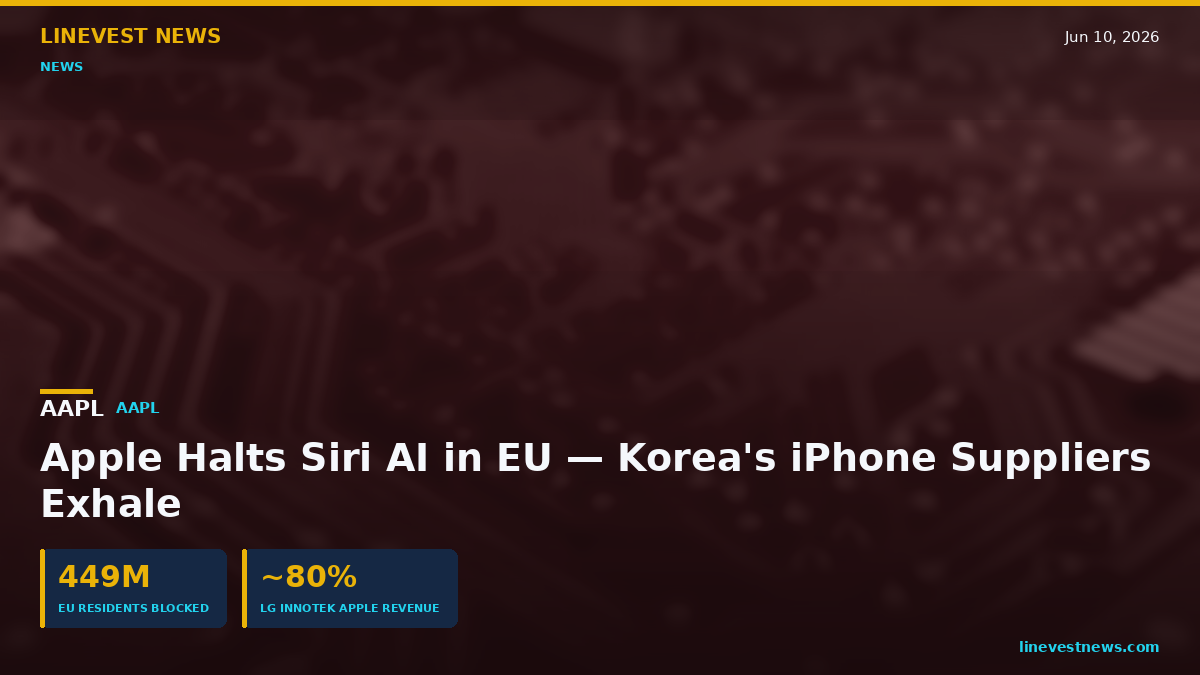
Apple Inc. said on June 8 that it cannot launch Siri AI, the rebuilt voice assistant it unveiled at WWDC 2026, on iPhones or iPads in the European Union when iOS 27 and iPadOS 27 ship later this year — and gave no timeline for when, or whether, that will change (Apple Newsroom; Bloomberg). The feature is blocked across all 27 EU member states, leaving the bloc's roughly 449 million residents — and an EU iPhone installed base estimated in the low hundreds of millions — without it at launch, while U.S. and U.K. owners get it on day one (Apple Newsroom; Engadget).
For a portfolio that holds Korea through its Apple supply chain, the headline raises one question before any other: is this a hardware-volume event, or a software fight that leaves iPhone shipments — and therefore Korean component revenue — untouched? On the evidence, it is the latter.
What actually changed — and what didn't
The dispute is regulatory, not commercial. Apple blames the EU's Digital Markets Act, the bloc's gatekeeper competition law, which it says would force the company to grant AI systems "nearly unlimited access to a user's device," including the ability to read and send messages, make purchases and access files (Apple Newsroom). Apple's most concrete counter-offer — a "Trusted System Agent" middle layer it proposed rolling out over 18 months — was rejected by the European Commission, the EU's executive arm, alongside every other proposal (Apple Newsroom). "We're deeply disappointed that our EU users won't have Siri AI on iPhone or iPad," software chief Craig Federighi said (Apple Newsroom).
Crucially, nothing here stops Apple from selling iPhones in Europe. Siri AI is a free software feature delivered over the air; the hardware ships regardless. Korean component makers are paid per unit built, not per software feature switched on — so the mechanical, first-order link from a withheld feature to their order books is effectively nil.
Sizing the Korean exposure
That matters because Korea's exposure to the iPhone bill of materials is concentrated and large. LG Innotek, Korea's dominant iPhone camera-module maker, draws roughly 80% of its revenue from Apple, with some prior reporting putting the figure closer to 70% (The Korea Herald; KED Global). Its fourth-quarter 2025 sales hit a record ₩7.61 trillion (about $5.6 billion at ~1,370 won/dollar), up 14.8% year-on-year, with operating profit of ₩324.7 billion ($226 million) up 31%; the camera-led Optical Solutions division alone supplied 87% of that quarter's revenue (The Korea Herald). On the display side, Samsung Display — the world's top smartphone OLED maker — provides roughly half of iPhone OLED panels, with LG Display, Korea's No. 2 panel maker, at about 30% and China's BOE at 20% (The Korea Herald). Samsung Electro-Mechanics, Korea's leading maker of MLCCs (multilayer ceramic capacitors), rounds out the list with passive components and substrates (The Korea Herald).
The transmission channel worth watching is therefore indirect: not a shipment cliff, but the risk that a flagship AI feature missing from the entire EU market dampens upgrade enthusiasm and, with a lag, softens the iPhone unit volumes those Korean lines depend on. That is a demand-elasticity question, and it is unproven.
A delay Apple has walked back before
There is a recent precedent that argues against treating this as permanent. Apple withheld its original Apple Intelligence suite from EU iPhones when it launched in the U.S. in October 2024, citing the same DMA concerns — then brought those features to the bloc with iOS 18.4 in April 2025 after months of negotiation (TechCrunch; The Next Web). This is the second such standoff, and the first one resolved with the feature arriving roughly six months late rather than never. Whether the 2026 dispute follows the same arc depends on talks that, for now, both sides describe as deadlocked.
The data point that settles it
The cleanest read on whether this dents Korean suppliers will come from EU iPhone sell-through and from the Korean component makers' own results. LG Innotek's next quarterly print and any commentary on iPhone 18-cycle camera-module orders will show whether order volumes diverge from the long-running "weak first half, strong second half" seasonal pattern its panel and module peers share (The Korea Herald). Until then, the Siri standoff reads as a Brussels-versus-Cupertino regulatory event with no measured hit to Korean component demand — a software dispute, not a supply-chain one.
This article is for informational purposes only and does not constitute investment advice. Figures are sourced from the publications cited inline; currency conversions use an approximate rate of 1 USD = 1,370 KRW unless a source provided its own conversion. Readers should verify figures against primary disclosures before making any decision.