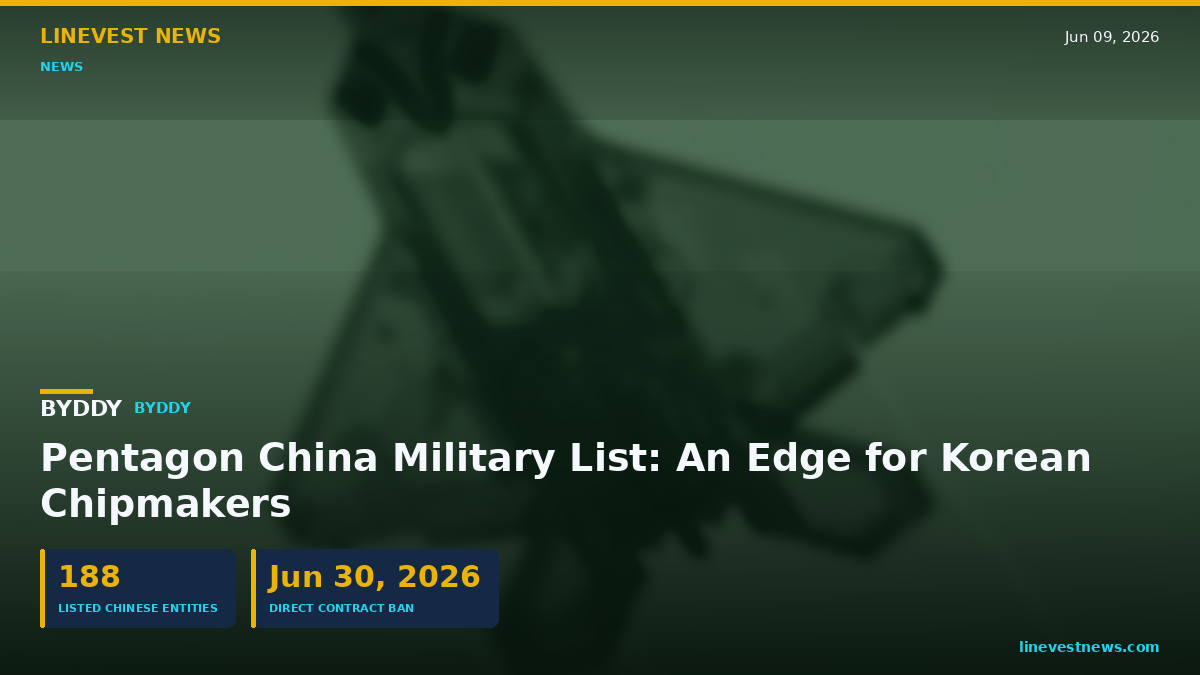
The U.S. Department of Defense on June 8 (Washington time) added Alibaba, Baidu and electric-vehicle maker BYD to its Section 1260H list of "Chinese military companies" operating in the United States, expanding the roster to 188 entities (Reuters via Seoul Economic Daily; The Next Web; etnews, chosunbiz, Newsis). For a Korean market reader, the question is narrower than the headline: what actually changes for Korean firms? Two things — one a competitive opening for the memory makers, one a compliance clock for anyone selling into the U.S. defense supply chain.
What the list does, and when
Section 1260H of the FY2021 National Defense Authorization Act (the annual U.S. defense budget law) requires the Pentagon to name Chinese companies with direct or indirect ties to the People's Liberation Army. Being listed does not, by itself, impose sanctions, export controls or asset freezes, as the Financial Times noted in coverage cited by Newsis. The bite comes from contracting bans: effective June 30, 2026, the DoD may not enter into, renew or extend contracts directly with listed companies, and a broader ban on goods or services that incorporate products from these firms follows on June 30, 2027 (chosunbiz; Reuters via Seoul Economic Daily). The Pentagon described the entities as contributors to China's "military-civil fusion" strategy, citing links to bodies such as SASAC (China's state-asset regulator) and MIIT (its Ministry of Industry and Information Technology) (Newsis).
The newly designated or re-confirmed names span China's advanced-industry frontier: Alibaba and Baidu (cloud and AI platforms), BYD (the world's leading EV maker), battery makers CATL, CALB and EVE Energy, lidar firm RoboSense, drone and robotics makers DJI and Unitree, and biotech WuXi AppTec (Newsis; Reuters via Seoul Economic Daily). Note: CATL was added to the list in January 2025 and DJI in 2022; the June 2026 update principally added Alibaba, Baidu and BYD while retaining prior designees. WuXi AppTec told Reuters its inclusion was "clearly a mistake" and pledged to take immediate action to "correct this erroneous designation"; Alibaba and Baidu have argued their products are purely commercial and signaled possible legal challenges (chosunbiz, Newsis).
The memory angle: why Samsung and SK hynix read this as favorable
The most direct Korean consequence is about who was kept on the list. Chinese NAND maker Yangtze Memory Technologies (YMTC) and DRAM maker ChangXin Memory Technologies (CXMT) — both rising challengers to Korea's memory duopoly — were retained (Newsis; Seoul Economic Daily). A February version of the list had excluded those chip names; Reuters noted at the time that leaving them off "would deal a blow" to U.S.-based Micron and Korea's Samsung Electronics (005930.KS, the world's largest memory chipmaker) and SK hynix (000660.KS, the No. 2 DRAM supplier), per Seoul Economic Daily. Their retention on the finalized June list therefore tightens the U.S. procurement screws on the two Korean firms' nearest Chinese rivals rather than on the Korean firms themselves — an observation, not a forecast of share gains.
The compliance clock for Korea's defense supply chain
The second-order effect reaches Korean manufacturers that sell into U.S. defense, telecom and aerospace programs. Because the June 30, 2027 ban covers third-party products that contain listed companies' components, any supplier to the DoD — Korean included — will have to verify its bill of materials is free of those parts (chosunbiz). A military vehicle carrying BYD or CATL battery cells, RoboSense lidar, or Alibaba cloud services could see a bid blocked outright, chosunbiz reported, citing U.S. law firm analyses warning of heightened China-related due-diligence obligations. South Korea is an established arms exporter and U.S. defense partner, which is precisely why a parts-level screening rule lands on Korean balance sheets rather than staying a U.S.-versus-China story.
Precedent and the open question
This is the second attempt in four months. The Pentagon first published a similar list including Alibaba, BYD and Baidu around February 13, then withdrew it within minutes without explanation — widely read as restraint ahead of the Trump–Xi summit held in Beijing on May 14–15 (Newsis, chosunbiz). Craig Singleton of the Foundation for Defense of Democracies, a Washington think tank, told reporters the re-released list "serves as a reality check" after the summit, arguing the meeting "didn't stop the competition — it clarified where it will continue" (Newsis, chosunbiz).
The confirming data point to watch is the Federal Register entry itself and whether the Pentagon expands the roster further, as it said it reserves the right to do (Newsis); the harder test arrives at the June 30, 2026 direct-contracting deadline and the June 30, 2027 third-party ban, when Korean DoD suppliers' sourcing audits become enforceable rather than theoretical.
This article is for informational purposes only and does not constitute investment advice. Figures are sourced from the cited publications as of June 9, 2026.