Samsung Group's pay dispute is no longer confined to its chip-making flagship. Less than three weeks after Samsung Electronics (005930.KS) reached a landmark bonus deal with its union, the discontent has jumped to profitable affiliates whose workers say they are being left behind, raising the question fund managers are now asking: how far does this spread, and does it threaten output or margins at any one Samsung company?
What happened
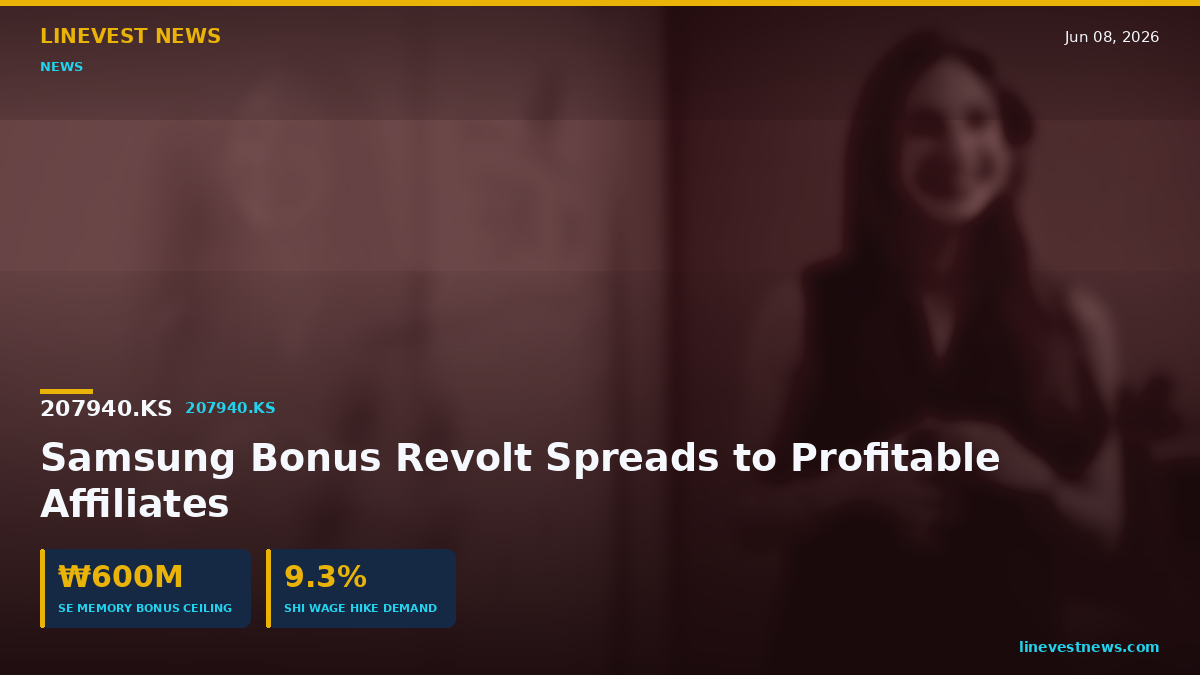
On June 8, the labor council of Samsung Heavy Industries (010140.KS), one of Korea's three large shipbuilders, began a five-day protest outside Samsung Electronics' Seocho headquarters in Seoul, running through June 12, according to Chosun Biz. The council is demanding a 9.3% base-pay increase, abolition of the wage-peak system, an unconditional extension of the retirement age, a 50% rise in the seniority allowance, and the hiring of at least 150 new production workers; its formal wage demand was delivered to management on June 4 (Chosun Biz).
Separately, the union at Samsung Biologics (207940.KS) — the world's largest contract development and manufacturing organization (CDMO) — is moving to quit the Samsung Group "super-enterprise union" (chogieop nojo, the umbrella body that bargains across Samsung affiliates). Per Yonhap and Asia Business Daily, the union will put the withdrawal to a members' general meeting on June 16-18 and an electronic vote around June 24-28; approval requires more than half of members to participate and at least two-thirds of voters to agree.
The trigger: a bonus gap
The catalyst is the "special management performance bonus" Samsung Electronics agreed with its union on May 20. The scheme is funded at 10.5% of agreed business performance, carries no payout cap, and is paid entirely in treasury shares, according to The Korea Herald. Memory-division employees could receive up to about ₩600 million (USD 438,000) this year (The Korea Herald), and even staff in the loss-making non-memory units (System LSI and foundry) could clear more than ₩200 million (USD 146,000) once the special bonus and the existing over-performance incentive, or OPI, are combined (Chosun Biz).
That is the grievance at the affiliates: workers at companies posting operating profits fear they will earn less than colleagues in Samsung Electronics' loss-making chip units. Samsung Heavy reported first-quarter 2026 operating profit of ₩273.1 billion (USD 199 million), up 122% year-on-year, on stronger LNG-carrier and offshore work, per Seoul Economic Daily, and is guided toward roughly ₩1 trillion (USD 730 million) for the full year (Chosun Biz). Despite posting its best result in a decade last year and paying an OPI worth 208% of agreed wages early this year — its first such payout in 12 years — the company's bonuses lagged rivals: HD Hyundai Samho paid about 1,000% of base wage, HD Hyundai Heavy roughly 800%, and Hanwha Ocean around 400% of monthly base pay (Chosun Biz).
The mechanism workers want changed
The sticking point is how the bonus pool is calculated. Samsung Electronics' chip division agreed to switch its OPI funding from economic value added (EVA) — after-tax operating profit minus capital costs, a figure whose formula is treated as confidential — to a transparent 10% of operating profit. Samsung's affiliates remain on the EVA basis, which workers argue produces opaque, lower payouts even when operating profit rises (Chosun Biz). Samsung Biologics' union is now seeking bonuses of roughly 20% of operating profit, while Samsung Electro-Mechanics' union wants 15% of operating profit and Samsung Display plans to negotiate alternative compensation in the second half (The Korea Herald; Chosun Biz).
Operational angle for Samsung Biologics
For the cluster's primary name, the labor action is already past the talking stage. After a partial strike on April 28-30 (about 60 members) and a full walkout on May 1-5 (about 2,800 participants), the Samsung Biologics union has run a work-to-rule campaign since May 6, refusing overtime and holiday shifts, according to Asia Business Daily. Union leader Park Jae-sung framed the proposed exit from the group union as a turn toward independence after the coalition delivered "neither common agenda items nor any agenda items specific to our company." The financial impact of the work-to-rule on Samsung Biologics' contract manufacturing throughput has not been quantified by the company.
Context and what to watch
The pressure did not start at Samsung. SK hynix (000660.KS), Korea's second-largest memory chipmaker, scrapped its bonus cap and tied 10% of operating profit to bonuses in 2025, a move The Korea Herald describes as kicking off the competitive escalation that Samsung's May deal has now amplified across corporate Korea — Hyundai Motor and Kia unions are seeking bonuses equal to 30% of net profit, and HD Hyundai Heavy unions want at least 30% of operating profit (The Korea Herald).
The nearest confirming data point is the Samsung Biologics electronic vote around June 24-28: a two-thirds approval would mark the first defection from Samsung's group-wide bargaining structure and signal whether the affiliate revolt fragments or consolidates. Samsung Heavy's wage negotiation, now under public pressure, is the second gauge of how much the Samsung Electronics template will reset pay across the group.
This article is for informational purposes only and does not constitute investment advice. Figures are sourced from company filings and the news outlets cited inline; currency conversions use an approximate rate of 1 USD = 1,370 KRW.
Sources
- https://biz.chosun.com/industry/company/2026/06/08/F2VNBFKQEBA63HIW3LVUTO25PQ/
- https://www.yna.co.kr/view/AKR20260608177300017
- https://en.sedaily.com/business/2026/04/30/samsung-heavy-industries-q1-operating-profit-soars-122
- https://www.asiae.co.kr/en/article/2026060821123564598
- https://www.koreaherald.com/article/10742934