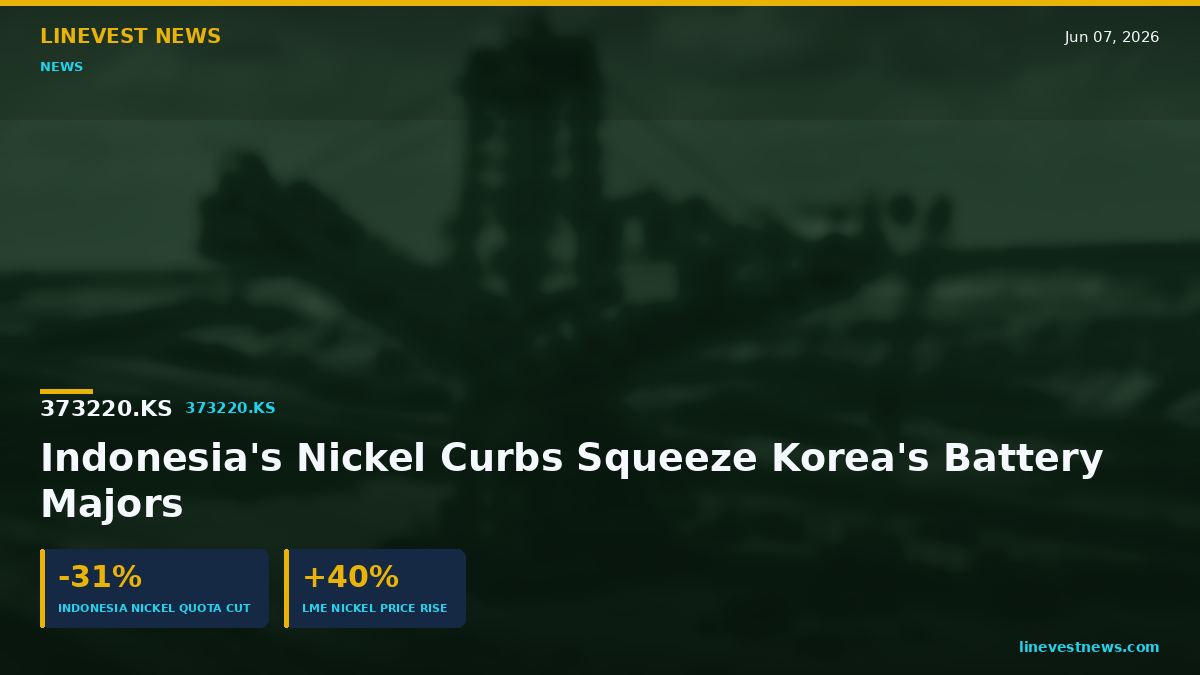
Indonesia, the world's largest nickel producer, has cut its 2026 nickel ore production quota by roughly one-third — to approximately 255–270 million tonnes from about 379 million tonnes in 2025 — throttling supply of the metal that sits at the core of Korea's flagship EV batteries just as the sector is already losing ground in Seoul. For a portfolio holding LG Energy Solution (373220.KS), Korea's largest EV battery maker, the immediate question is blunt: how much does this raise input costs, and does the supposed offsetting "win" for cathode makers actually hold?
What changed
Indonesia's Ministry of Energy and Mineral Resources (ESDM, the country's mining and energy regulator) has cut the 2026 production quota for nickel miners to roughly 255–270 million tonnes of ore, down from about 379 million tonnes approved for 2025 — a reduction of roughly one-third, according to figures reported by Japan's Nikkei and carried by Chosun Biz. Jakarta is also forcing nickel exporters to park their foreign-currency earnings in domestic banks for at least a year. Argus Media independently reported the same quota cut to "260mn-270mn t" from a "2025 approved quota of 379mn t," and Indonesia's ESDM has confirmed a target near 250–260 million tonnes (Mysteel).
The price response has been sharp. Nickel futures on the London Metal Exchange (LME, the benchmark global metals venue) traded near $18,600 per tonne on June 4, more than 40% above their level in early December before Jakarta first signaled the cuts, per LME data cited by Nikkei via Chosun Biz. The move is corroborated by independent analysis showing LME nickel rallying about 37% from late December into April (Crux Investor). The International Nickel Study Group (INSG, the intergovernmental supply-demand body) now expects global nickel supply to fall about 4% year-on-year in 2026, swinging its 2026 balance from a 283,000-tonne surplus to a roughly 32,000-tonne deficit (Crux Investor) — the first such deficit in five years (Chosun Biz).
Why this lands hardest on the Korean three
Nickel is the principal raw material in the ternary chemistries that LG Energy Solution, Samsung SDI (006400.KS) and SK On have built their businesses around — nickel-cobalt-manganese (NCM) and nickel-cobalt-aluminum (NCA) cells, with the high-nickel variants the three are pushing toward running 80–90% nickel content (Chosun Biz). That concentration is exactly what makes a nickel price shock a margin problem rather than a footnote. It also sharpens an existing strategic threat: switching a pack from NCM to cheaper lithium-iron-phosphate (LFP) chemistry can cut battery-pack cost roughly 20–30% per kWh (IEA Global EV Outlook 2025), with GM publicly guiding to about $6,000 of savings per vehicle once it transitions to LFP cells (GM Authority, Oct 2024), giving automakers a standing incentive to walk away from ternary cells if nickel-driven prices stay elevated.
The "winners" narrative deserves scrutiny. Cathode-active-material producers such as EcoPro BM (247540.KQ) and POSCO Future M are expected to book a short-term gain because they can turn cheaply-stockpiled nickel into product sold at higher prices — a lagging effect on inventory. But, as the Chosun Biz reporting itself flags, that benefit fades once those firms must restock at the new, higher prices; a sustained rally hurts cathode makers and cell makers alike.
The sector was already de-rating
This cost shock arrives as batteries slide down Seoul's pecking order. As of June 5, LG Energy Solution had fallen to sixth by market capitalization on the KOSPI, down from a higher rank earlier in the year, while seven of the index's top 10 names changed rank over the half-year, with AI-linked Samsung affiliates and chip names rising as secondary-battery and shipbuilding stocks faded, according to Korea Exchange data via Chosun Biz.
Precedent and what to watch
Nickel has form for violent, supply-driven dislocations. In March 2022 an LME short squeeze sent the metal up more than 270% over three trading days, from $27,080 to $101,365 per tonne, before the exchange halted trading and canceled trades (per the January 2023 LME Independent Review conducted by Oliver Wyman). Prices later normalized — a reminder that policy- and positioning-driven spikes can reverse, complicating any straight-line cost forecast.
The first hard read on whether higher nickel is flowing through to earnings will come with the Korean cell makers' second-quarter 2026 results, due in late July, alongside cathode makers' margins, which will show whether the lagging-effect tailwind is real or already eroding. Watching the LME nickel curve and the finalization of Indonesia's 2026 RKAB quota approvals will indicate whether this is a durable repricing or another nickel head-fake.
This article is for informational purposes only and does not constitute investment advice. Figures are sourced as cited and may be revised.