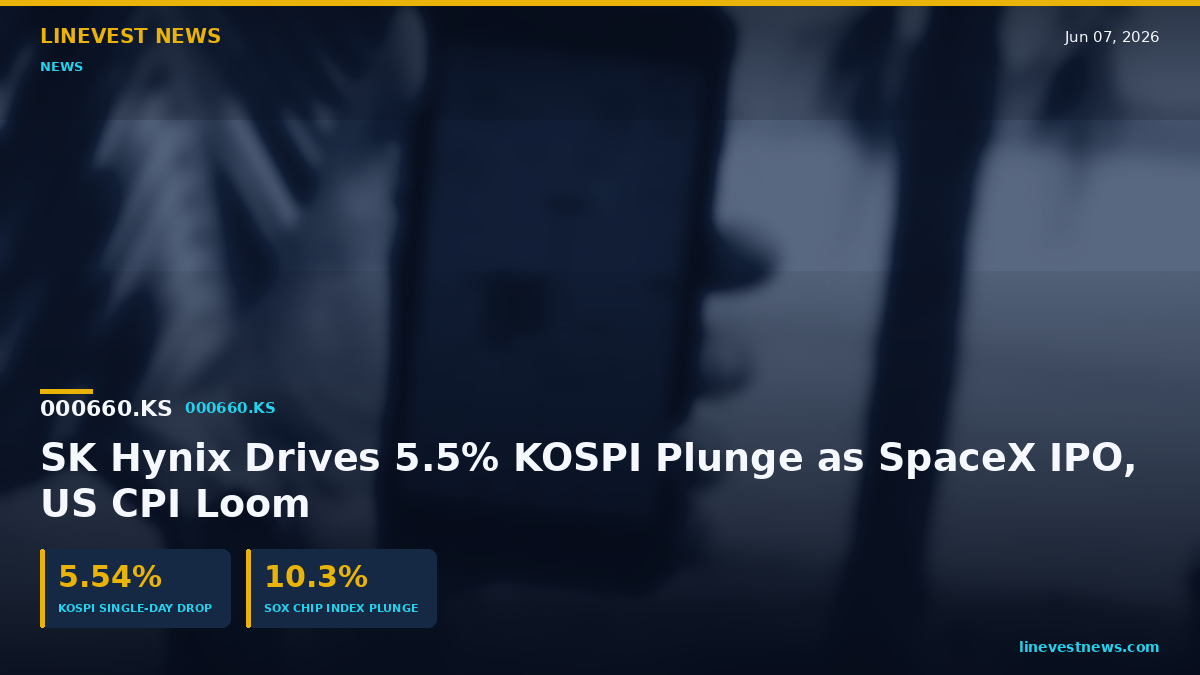
Korea's benchmark KOSPI index tumbled 5.54% on Friday, June 5, closing at 8,160.59 — a 478.82-point drop that briefly pushed the index toward the 8,000 level intraday, hitting a low of 8,038.10, according to Businesskorea. The selloff was led by the country's two memory champions: SK Hynix (000660.KS), the world's dominant high-bandwidth memory (HBM) supplier, fell 9.92%, while Samsung Electronics (005930.KS), the world's largest memory-chip maker, lost 6.40%, per Businesskorea. The KOSDAQ, Korea's tech-heavy secondary bourse, fell 4.50% to close at 1,002.44 after briefly dipping below the 1,000 mark intraday (low of 992.80), the Seoul Economic Daily reported.
For global investors, the question is whether the AI-memory thesis that had driven the KOSPI past 8,800 to record highs has cracked — or whether this is a sentiment shock with intact fundamentals.
What got hit
The rout originated in the United States. On June 5 the Philadelphia Semiconductor Index (SOX) plunged 10.3% (Chosun Biz), wiping out roughly $1.3 trillion in chip-sector market value, with Micron Technology down about 13% and AMD off roughly 11% (per US market coverage via GuruFocus). The S&P 500 fell 2.64% and the Nasdaq Composite 4.18%, according to Chosun Biz.
The trigger: expectations, not demand
The proximate cause was Broadcom's June 3 guidance. The company projected fiscal third-quarter AI-chip revenue of $16 billion — more than 200% higher year-on-year but about 7% below the $17.2 billion analyst consensus — and declined to raise its full-year forecast (CNBC). Yuanta Securities Korea, a Korean brokerage, framed the reaction as profit-taking against stretched expectations rather than a demand problem. "The selling after Broadcom reflects disappointment that the guidance raise fell short of elevated expectations, more than any cooling in AI demand," analyst Lee Jae-won said (Chosun Biz).
The bull case
Analysts point to sustained big-tech capital spending as the counterweight. Alphabet (Google's parent company) announced on June 1 plans to raise $80 billion through equity offerings to fund AI compute infrastructure (CNBC). Lee Sang-jun of NH Investment & Securities, one of Korea's largest brokerages, cited the raise as a signal of "strong commitment to AI investment" that should keep Korea's AI-infrastructure value chain — HBM, memory, AI servers and power equipment — in a position to benefit (Chosun Biz).
The concentration risk
The danger is how narrow the rally has become. On June 5 the KOSPI's daily-average volatility reached 4.0%, a level the Seoul Economic Daily notes has been exceeded only during the 1997–98 Asian financial crisis (5.7%), the 2000 dot-com unwind (4.6%), the 2008 global financial crisis (7.4%) and the 2020 COVID crash (4.9%) — each followed by sharp drawdowns. The same outlet attributes the swing to extreme concentration in the "Samsung–Hynix" pair. The prior week's surge — fueled by Nvidia CEO Jensen Huang's visit to Korea, during which he confirmed HBM4 qualification for SK Hynix, Samsung and Micron as suppliers for Nvidia's Vera Rubin platform (Korea Herald) — had already left the index leaning on a handful of names.
The near-term overhang
Two events dominate the June 8–12 week. SpaceX is set to debut on the Nasdaq on June 12 in what would be the largest IPO on record, selling 555.6 million shares at $135 each to raise about $75 billion (₩112 trillion, per Chosun Biz) at a target valuation near $1.77 trillion (CNBC, Fortune). NH Investment & Securities warns the deal could divert global liquidity from existing names. Separately, US May CPI (June 10) and PPI (June 11) precede the Federal Reserve's June 17 rate decision; April CPI rose 3.8% year-on-year (CNBC, BLS). NH projects the KOSPI to trade in a 7,800–8,900 range this week.
What to watch
The June 10 CPI print and the June 17 FOMC meeting will test whether inflation forces the Fed's hand, while the latest capex guidance and earnings commentary from Alphabet and other hyperscalers will reveal whether AI-infrastructure spending — the foundation of Korea's memory thesis — is still accelerating. A SpaceX debut well below its target could also reset risk appetite: Morningstar's discounted-cash-flow estimate for the company is about $780 billion, roughly half its targeted valuation (CNBC).
This article is for informational purposes only and does not constitute investment advice. Figures are as reported by the cited sources as of June 7, 2026; market data is subject to change.