Samsung (005930.KS) Holdings Top ₩60T on AI-Memory Surge as KOSPI Hits Records
The wealth milestone making Korean headlines on Monday is best read as a thermometer, not a story in itself: the value of the listed-stock holdings of Lee Jae-yong, chairman of Samsung Electronics (005930.KS) — Korea's largest company and the world's biggest memory-chip maker by revenue — crossed ₩60 trillion for the first time. The figure is a proxy for how violently Samsung shares have re-rated on artificial-intelligence memory demand. The number a portfolio manager actually needs to size is the move underneath it.
How big the move is
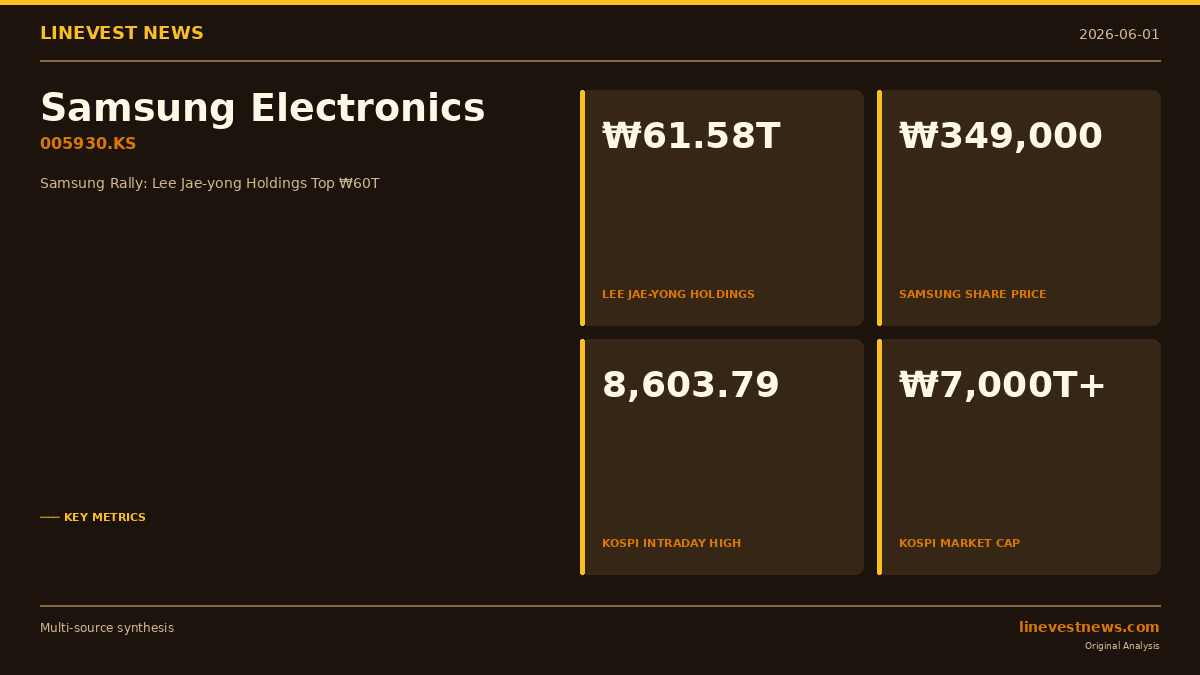
Lee's combined stake in seven Samsung-affiliated listed stocks — Samsung Electronics, Samsung C&T, Samsung Life Insurance, Samsung SDS, Samsung E&A, Samsung Fire & Marine Insurance and Samsung Electronics preferred shares — was worth ₩61.58 trillion ($45.0 billion) as of June 1, according to Korea CXO Research (한국CXO연구소), a Seoul-based corporate-analysis firm cited by Newspim. That is up from ₩14.29 trillion ($10.4 billion) on June 4, 2025 — the period the firm benchmarks to the start of the Lee Jae-myung administration — an increase of roughly ₩47.3 trillion ($34.5 billion), or 331.1%, in one year (Newspim).
The driver is the underlying equity. Samsung Electronics shares rose from ₩57,800 ($42) to ₩349,000 ($255) over the same 12 months, a gain of 503.8%, per the same Korea CXO Research tally (Newspim).
What is pulling the stock
The re-rating tracks the AI memory cycle. Korea CXO Research attributes the surge to Samsung passing Nvidia's qualification for next-generation HBM4 — high-bandwidth memory, the stacked DRAM that feeds AI accelerators — and entering that supply chain ahead of competitors (Newspim). U.S. business magazine Forbes, cited by Newsis, called Samsung Electronics the world's largest AI-memory chip company by revenue, noting its HBM is used in AI processors from Nvidia, AMD and Alphabet.
The rally is broad enough to move the whole market. On June 1 the KOSPI, Korea's benchmark index, hit an intraday high of 8,603.79, clearing the 8,500 and 8,600 levels for the first time, with Samsung up 3.47% in early trade, according to Seoul Economic Daily. The KOSPI's market capitalization alone crossed ₩7,000 trillion ($5.1 trillion) for the first time the same day, per Yonhap, after Korea's combined KOSPI-plus-KOSDAQ market cap first breached that level on May 11.
The family-wealth angle
The ₩60 trillion line item sits within a wider sweep. Forbes' real-time billionaire ranking on May 11 placed four members of the Samsung founding family in the top four spots on Korea's rich list for the first time, as reported by Newsis: Lee Jae-yong at $34 billion (about ₩46.6 trillion), Hotel Shilla president Lee Boo-jin at $12.4 billion, Samsung C&T's Lee Seo-hyun at $12.0 billion and former Leeum museum director Hong Ra-hee at $11.2 billion. Forbes attributed the jump to a roughly 40% rise in Samsung shares over the prior month (Newsis). The gap between Forbes' $34 billion net-worth estimate and Korea CXO Research's later ₩61.58 trillion stock-only figure reflects both the three-week interval and differing methodologies — one a total-wealth estimate, the other a snapshot of listed holdings.
The precedent worth remembering
Memory is cyclical, and the last turn was brutal. In the first quarter of 2023, Samsung's semiconductor division posted an operating loss of ₩4.58 trillion (about $3.4 billion at the time) — its first quarterly chip loss since 2009 — as a pandemic-era inventory glut cratered DRAM and NAND prices, and the company cut production in response, per CNBC's reporting at the time. The current up-cycle is demand-led rather than supply-led, but the 2023 episode is the reference point for any thesis that today's pricing power is permanent.
The open questions
Two near-term data points will test whether the move is structural. The first is execution on HBM4: whether Samsung converts Nvidia qualification into sustained, high-volume shipments, which will show up in coming quarterly results rather than in qualification headlines. The second is this week's Korea visit by Nvidia CEO Jensen Huang, who is scheduled to arrive in Seoul Thursday night and meet conglomerate heads Friday after the COMPUTEX show in Taipei, according to Korea Times industry sources; those sources said Lee Jae-yong is not expected to attend due to an overseas schedule, with SK Group's Chey Tae-won, LG Group's Koo Kwang-mo and Naver founder Lee Hae-jin among the expected participants, and talks ranging beyond AI chips into robotics and physical AI. Separately on June 1, Lee attended the Samsung Ho-Am Prize ceremony at Seoul's Shilla Hotel for the fifth straight year, per Etnews.
This article is for informational purposes only and does not constitute investment advice. Figures are drawn from cited sources as of June 1, 2026; currency conversions use an approximate rate of 1 USD = 1,370 KRW unless otherwise noted. Markets carry risk, and readers should conduct their own research.