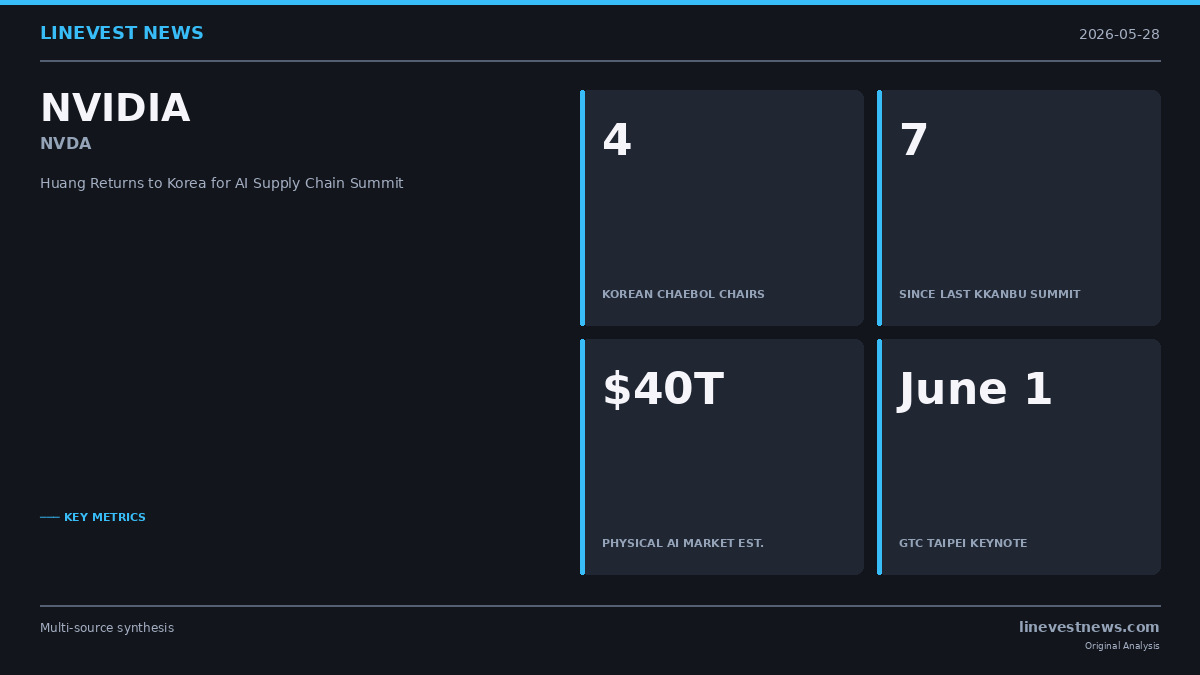
SEOUL — Nvidia Chief Executive Jensen Huang is expected to fly to South Korea immediately after delivering his keynote at GTC Taipei 2026 on June 1, with plans to hold face-to-face sessions with the heads of four of the country's largest conglomerates in what industry observers are calling the second "kkanbu summit" — an informal, deal-making circuit that last convened on Korean soil during the APEC CEO Summit in Gyeongju seven months ago.
The visit, first reported by Korea's Hankyung and confirmed by multiple domestic newswires, is set to include meetings with Samsung Electronics Chairman Lee Jae-yong, SK Group Chairman Chey Tae-won, Hyundai Motor Group Executive Chairman Chung Euisun and LG Group Chairman Koo Kwang-mo — the last of whom would be meeting Huang for the first time in an official capacity. Yonhap News Agency also reported that Naver could be added to the schedule.
Memory First, Then Robots
The Korea leg comes at an inflection point for Nvidia's supply chain. The company's next-generation Grace Blackwell server rack has been ramping at TSMC since late 2025, while the subsequent Vera Rubin architecture — which entered start of production this spring — will lean even more heavily on next-generation HBM4 memory from Samsung and SK Hynix. Huang, who held a working dinner in Taipei on May 26 alongside TSMC Chairman Mark Liu and SK Group Chairman Chey, is expected to press both Korean chipmakers on ramp commitments for the second half of 2026, which he has described as "the biggest half-year ever" for both Nvidia and its supply partners.
SK hynix, which supplies the bulk of the HBM3E stacked memory inside current Blackwell systems, has already locked in a position as Nvidia's primary HBM4 vendor; the Korea visit is seen as an opportunity to discuss volume allocations and co-development roadmaps. Meetings with Samsung Electronics Chairman Lee Jae-yong — their first bilateral encounter in seven months — may also touch on whether Samsung Foundry can serve as a secondary-source fabricator for AI fabless companies seeking to diversify away from TSMC, a conversation that dovetails with Samsung's foundry revival strategy after winning a $16.5 billion chip-manufacturing contract from Tesla in mid-2025.
LG's Physical AI Bet
The more novel component of the agenda is a planned first official meeting between Huang and LG Group Chairman Koo Kwang-mo, which Hankyung identified as a potential anchor deal for physical AI — Nvidia's term for inference systems embedded in robots, smart-home appliances and industrial machines rather than in data centers. Huang has put a $40 trillion long-run market estimate on physical AI, a figure he has repeatedly cited to justify Nvidia's expansion beyond GPU clusters.
Under the framework being discussed, LG and its affiliates would integrate Nvidia's Isaac robot-inference platform across multiple business lines: LG Electronics for smart-home and humanoid robots, LG AI Research (which develops the EXAONE large language model) for on-device inference, LG Innotek for sensing substrates and camera modules, and LG Uplus for cloud delivery of AI workloads. The breadth of a potential partnership reflects LG's ambition to build a software-and-services revenue layer on top of its hardware and component businesses.
Hyundai and Autonomous Driving
A session with Hyundai Motor Group Chairman Chung Euisun is expected to revisit the autonomous-driving collaboration the two companies explored at CES 2026 in January. Hyundai has been deepening its use of Nvidia's DRIVE platform for next-generation vehicles and holds a separate stake in Boston Dynamics — acquired from SoftBank in 2021 — whose robotics hardware could extend into Nvidia's Isaac inference stack.
Market Context
Huang's visit comes a day after South Korea's KOSPI index closed above 8,100 for the first time, driven in large part by the debut of single-stock leveraged exchange-traded funds tracking Samsung Electronics and SK hynix, with SK hynix's market capitalization having breached $1 trillion during the session. The timing underscores how closely Korea's equity markets have become correlated to Nvidia's AI capital-expenditure cycle.
A second kkanbu summit carries no fixed agenda or joint communiqué, and much of what is agreed is likely to surface weeks later in earnings calls and regulatory filings. But the concentration of four conglomerate chairmen in a single visit — spanning memory, foundry, robotics, home appliances and autonomous driving — signals that Nvidia views Korea not merely as a component vendor but as an integrated partner in the architecture of the next AI infrastructure cycle.
Sources
- Asia Business Daily — After Taiwan, Jensen Huang Expected to Meet Korean Business Leaders Including Koo Kwang-mo Next Week, May 28, 2026
- Seoul Economic Daily — Jensen Huang to Visit Korea for Possible Second Kkanbu Summit, May 28, 2026
- Hankyung — LG's Koo Kwang-mo and Jensen Huang Set to Meet in Korea for Physical AI Alliance, May 28, 2026
- Yonhap News Agency — Second Kkanbu Summit Forming; Jensen Huang to Meet LG and Naver in Korea, May 28, 2026
- MK Economy — Jensen Huang to Visit Korea Next Week; Second Kkanbu?, May 28, 2026
- ChosunBiz — Jensen Huang Visiting Korea Next Week; AI Semiconductor Supply Chain Discussions, May 28, 2026
- ETNews — Jensen Huang to Visit Korea Next Week; Semiconductor and AI Cooperation in Focus, May 28, 2026
- Crypto Briefing — Nvidia CEO Jensen Huang to Visit South Korea Next Week, May 28, 2026