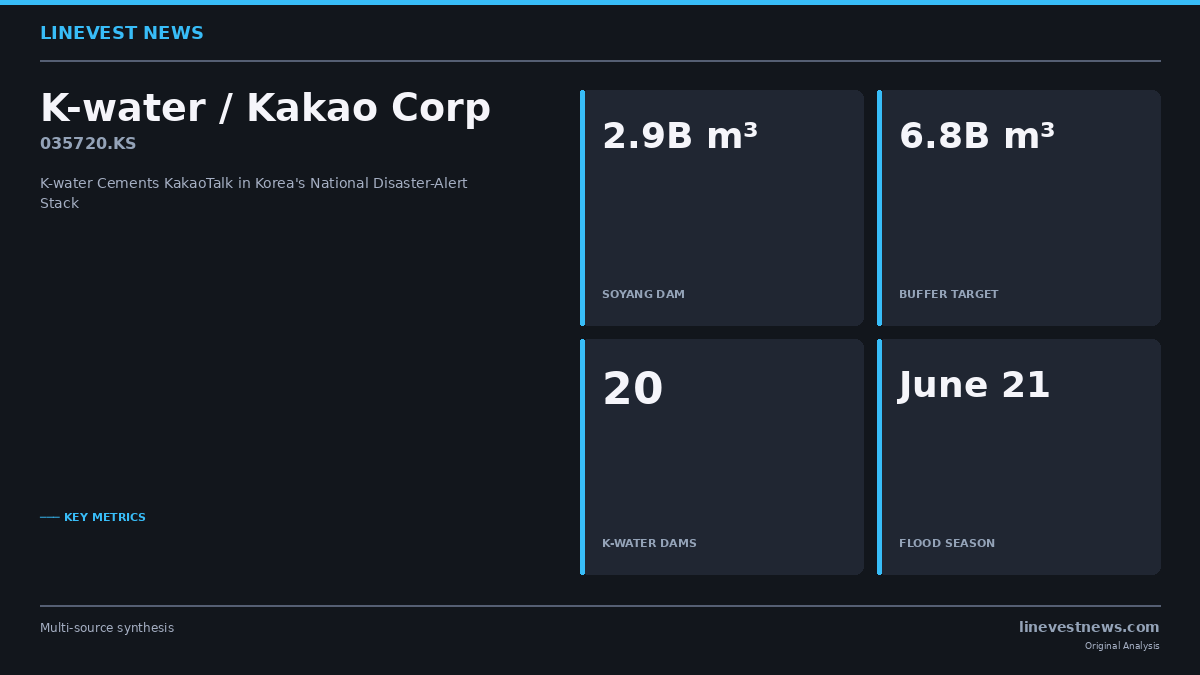
K-water (Korea Water Resources Corporation, the state-owned operator of the country's multi-purpose dam system) staged a special flood-season countermeasure meeting and live drill at Soyang Dam in Chuncheon on May 28, led by president Yoon Seok-dae, the agency said in a statement carried by Newsis (a Seoul-based Korean wire service) (source). The drill designated KakaoTalk — the messaging platform operated by Kakao Corp (035720.KS) — as one of three official channels for notifying downstream residents if a discharge becomes necessary. The exercise rehearsed extreme-rainfall response procedures roughly three and a half weeks before the official start of Korea's flood season on June 21 — the start of the flood-monitoring window the Korea Meteorological Administration (KMA, the central government's weather agency) maintains each year.
For offshore investors the operational details — water levels, sluice-gate sequencing, joint dispatch with Korea Hydro & Nuclear Power (KHNP, the state-owned operator of Korea's nuclear fleet and five hydroelectric dams on the Bukhan River, per K-water's statement) — are not a direct catalyst. The listed-equity hook is buried in one sentence of the announcement: when a discharge is unavoidable, K-water will push alerts to downstream residents through three channels — SMS, the emergency disaster text run by the Ministry of the Interior and Safety (Korea's central civil-protection ministry), and KakaoTalk, the dominant messaging app operated by Kakao Corp (035720.KS) (Newsis).
Why the Kakao line matters
KakaoTalk's inclusion in a state-operator's official disaster-alert workflow — alongside government-run SMS and the emergency-text system — formalises the platform's de facto status as critical national communications infrastructure. That status cuts both ways for Kakao's regulatory story: it strengthens the argument that KakaoTalk is too entrenched to be substituted, and it strengthens the counter-argument that a platform of that systemic weight warrants tighter oversight. The K-water statement describes only the operational use of KakaoTalk for downstream notification and does not reference any commercial contract or fee, so the line is reputational rather than revenue-impacting on the evidence disclosed (Newsis).
Sizing the operation
Soyang Dam, completed in 1973 and managed by K-water, holds a total storage capacity of 2.9 billion cubic metres — the largest multi-purpose dam in Korea — with an active capacity of 1.9 billion cubic metres and a 200 MW hydro plant (Wikipedia, confirming the 2.9 billion m³ figure cited by Newsis).
Ahead of the season, K-water plans to draw down water levels at 20 multi-purpose dams nationwide by June 20 to secure a combined 6.8 billion cubic metres of flood-buffer capacity, equal to roughly 2.3 times Soyang's full reservoir (Newsis). That figure is consistent with the 6.84 billion cubic metres the agency told the Korea Herald it secured ahead of last summer's record rains, when 18 of 20 dams retained all incoming water without discharging (Korea Herald).
The AI-procurement signal
K-water also said it will run up to 48 multi-discharge scenarios simultaneously, fed by a combined Korea Meteorological Administration forecast and its own rainfall model, and visualise downstream impact through a three-dimensional digital twin (Newsis). The disclosure lands two weeks after the central government's broader 2026 flood plan, which committed to AI-enhanced radar resolution improving from 8 km to 1 km and an additional 1.04 billion cubic metres of nationwide flood-control capacity versus 2025 (Seoul Economic Daily, May 12). For listed AI-infrastructure and digital-twin vendors selling into the public sector, the May 28 drill is incremental evidence that the procurement pipeline behind those headline numbers is being operationalised at site level rather than sitting in a policy paper.
Historical reference and what to watch
The most recent stress test of the system was last year's rainy season, when 18 of K-water's 20 multi-purpose dams retained all incoming water without sluice-gate discharge despite rainfall exceeding design capacity in some regions — Namgang Dam in South Gyeongsang took an inflow peak of 16,951 cubic metres per second yet released only 22% of incoming water, the agency told the Korea Herald (Korea Herald). The next concrete data point is the KMA's seasonal outlook update through June and the agency's first published discharge log once the flood window opens on June 21. Whether KakaoTalk's alert channel is invoked in an actual discharge event — and how Kakao chooses to frame that role — will be the first observable signal on whether the integration is treated as a regulatory asset or a regulatory liability.
Disclaimer: This article is for informational purposes only and does not constitute investment advice. Korea Water Resources Corporation and Korea Hydro & Nuclear Power are not publicly listed. Figures cited are sourced as marked; readers should consult primary disclosures before acting on any market views.